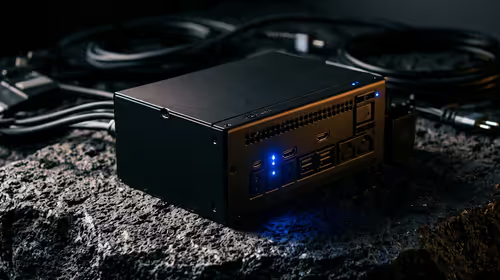
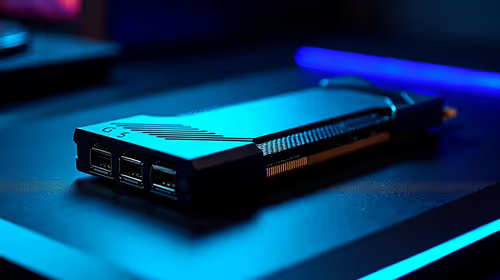
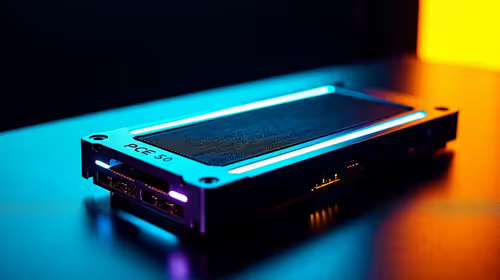
The phrase personal AI supercomputer sounds like marketing until you look at what NVIDIA's DGX Spark actually puts on a desk: up to one petaFLOP of AI compute in a box about the size of a paperback. That is a thousand trillion operations a second, a figure that used to belong to a server rack, now running off a wall socket next to your monitor. The label is doing real work, not selling hype.
Quick Answer
A personal AI supercomputer is a desktop machine built to run AI workloads that once needed a data centre. NVIDIA's DGX Spark is the reference example: a GB10 Grace Blackwell superchip delivering up to 1 petaFLOP of AI performance at FP4, paired with 128GB of unified memory, in a 6 by 6 inch enclosure that can run models up to roughly 200 billion parameters.
Where the petaFLOP figure comes from
The headline number is one petaFLOP, measured at FP4 precision with sparsity. That is a specific, narrow benchmark: FP4 is a four-bit number format used for AI inference, and sparsity skips the zeros in a model's weights to count fewer operations. So the petaFLOP is a real measurement of how fast the chip pushes AI inference, not a general-purpose figure you would use for, say, scientific maths.
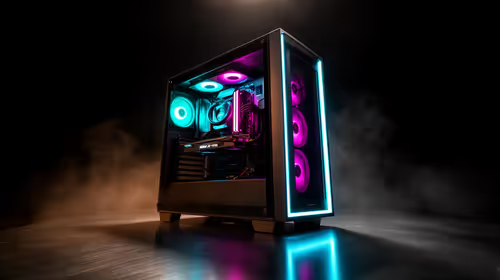
That distinction is the whole point of the category. A personal AI supercomputer is tuned for one job, running and fine-tuning large AI models, and it is genuinely fast at that job. It is not a faster gaming PC and it will not give you higher frame rates.
What makes it different from a gaming rig
The real trick is the memory. The DGX Spark carries 128GB of unified memory shared between the Arm-based Grace CPU and the Blackwell GPU on the same package. A normal gaming PC keeps its system RAM and its GPU VRAM separate, and large AI models choke when they have to shuttle data across that gap. Unified memory removes the gap, so a model up to around 200 billion parameters can sit in one pool the chip reads directly.
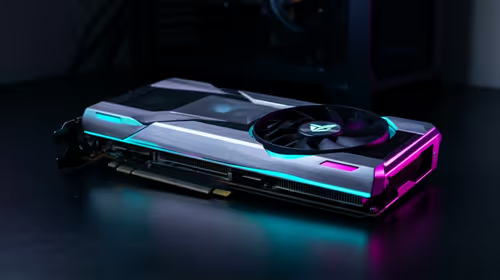
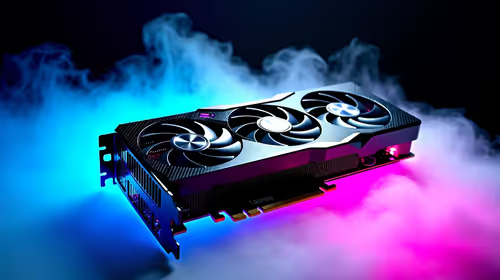
For comparison, a flagship gaming GPU tops out at 32GB of VRAM. Plenty for games and image generation, nowhere near enough to hold a 200B model. That memory ceiling, not raw graphics horsepower, is what separates a personal AI supercomputer from the best gaming PC you can buy. If you are weighing local AI hardware, Evetech's AI PC range covers the full spectrum from consumer GPU builds to dedicated inference machines, and the GPU best sellers show what local AI builders pair with their rigs.
Frequently Asked Questions
Is a personal AI supercomputer just marketing?
Mostly no. The petaFLOP figure is a real FP4 inference measurement and the unified memory genuinely lets it run models a gaming PC cannot. The term is narrow rather than dishonest, since it describes AI throughput, not all-round performance.
Can it play games?
That is not what it is built for. The DGX Spark is optimised for AI inference and development, not gaming frame rates, so a dedicated gaming GPU will serve a gamer far better for the money.
How big a model can it run?
The DGX Spark is rated to run AI models up to roughly 200 billion parameters. With 128GB of unified memory the entire model sits in one coherent pool, well beyond the capacity of any standard desktop GPU.
Do I need one for local AI?
Only if you work with very large models. Plenty of useful local AI, including image generation and mid-size language models, runs fine on a strong gaming GPU with 24 or 32GB of VRAM.
Whether you want a true AI workstation or a GPU strong enough for local models, the AI PCs at Evetech cover the full range from gaming-grade cards to dedicated AI machines.