Ask ChatGPT a question and your words travel across the internet to OpenAI's servers, get processed there, and come back. A local private AI does the opposite: the language model lives on your own computer, so the question never leaves the room. That single difference, where the thinking happens, drives everything else about how the two compare on privacy, cost and control.
Quick Answer
A local private AI runs the entire language model on your own hardware, so every prompt and reply is generated on your machine and nothing is sent to a remote server. ChatGPT sends your input to OpenAI's cloud to process it. The trade-off is straightforward: local AI keeps your data fully private but depends on your PC's power, while ChatGPT taps massive cloud hardware but sees your prompts.
How A Local AI Differs From ChatGPT
The core distinction is location of processing. With ChatGPT, you are renting time on OpenAI's enormous server farms. Your prompt is uploaded, a very large model runs on their hardware, and the answer is returned. It is powerful precisely because that hardware is far beyond anything in a home or office.
A local AI flips this. You download an open model, it sits on your own drive, and when you prompt it the computation happens on your CPU or graphics card. No network request leaves your device for the AI to answer, which is why people reach for it.
The Privacy Difference That Matters Most
For anyone handling sensitive material, the appeal is obvious. A lawyer reviewing a contract, a doctor summarising notes, a business working with confidential figures, none of that data ever touches an outside company when the model runs locally. There is no question of how prompts might be stored, retained or used for future training, because they were never transmitted in the first place.
A local model also keeps working with no internet connection at all, which suits patchy connectivity or sensitive environments where keeping a machine offline is the safer choice.
What You Give Up Running Locally
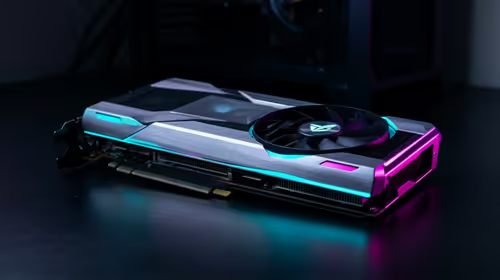
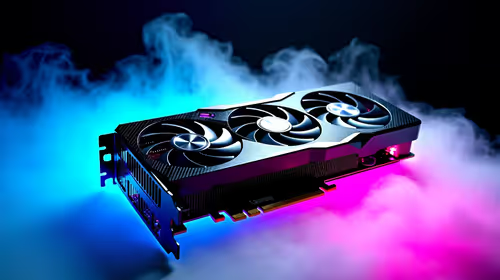
Local AI is not free of trade-offs. The models you can run at home are smaller than the largest cloud systems, so the very biggest, most capable AI still lives in the cloud. Performance depends directly on your hardware: a capable graphics card with plenty of memory, or a modern processor with a dedicated AI engine, makes local models run smoothly, while a weaker machine runs them slowly. You also handle setup and updates yourself rather than just opening a website.
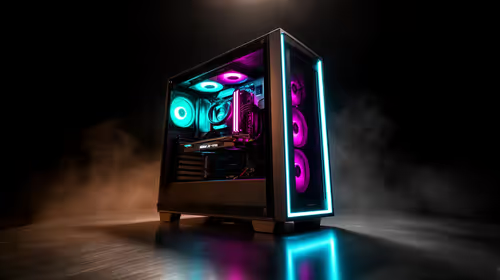
For South African users, there is a practical upside too. A local model does not consume data every time you use it, and it is not affected by an outage on a provider's side. The hardware that makes this comfortable is increasingly common, and the range of AI-ready PCs at Evetech shows the kind of machines built with on-device AI in mind.
If you would rather pick from complete systems that already have the processing headroom for local models, the desktops selling best right now are a good shortlist to start from.
Frequently Asked Questions
What is the main difference between a local AI and ChatGPT?
A local AI runs the model entirely on your own hardware, so prompts never leave your machine. ChatGPT sends your input to OpenAI's servers to process. The split is on-device privacy versus cloud-scale power.
Is a local AI more private than ChatGPT?
Yes. Because nothing is transmitted to a remote server, your prompts and data are never stored or processed by an outside company, which is why privacy-sensitive users prefer running models locally.
Does a local AI work without internet?
Yes. Once the model is downloaded, a local AI runs fully offline, since all the computation happens on your own computer with no network request needed.
What hardware do I need to run a local AI?
A capable graphics card with ample memory or a modern processor with a dedicated AI engine runs local models smoothly. Weaker machines still work but respond more slowly.
Can a local AI match the largest cloud models?
Not at the very top end. Home hardware runs smaller models than the largest cloud systems, so the most capable AI still lives in the cloud, though local models are very capable for everyday tasks.
Curious about running AI privately on your own machine? Explore the AI-ready PCs at Evetech and find hardware built to handle local models without sending a single prompt to the cloud.