Game graphics have leaped forward dramatically in recent years, and one term keeps appearing at the centre of every major graphical showcase: path tracing. If you've been wondering what separates this technology from conventional rendering - and why it demands so much from your GPU - this breakdown covers everything you need to know.
Quick Answer
Path tracing is a rendering technique that simulates how light physically behaves in a scene by tracing rays of light from the camera back to their sources, calculating realistic reflections, shadows, and indirect lighting. It produces dramatically more accurate and beautiful visuals than traditional rasterisation or even standard ray tracing, but requires significantly more GPU compute power to run at playable frame rates.
🔦 How Path Tracing Differs from Rasterisation and Ray Tracing
Traditional rasterisation - the method games have used for decades - approximates lighting using clever tricks like shadow maps, screen-space reflections, and baked ambient occlusion. It's fast, but fundamentally faking physical light behaviour. Ray tracing, introduced to games around 2018, traces specific rays (usually for reflections and shadows) to improve realism. Path tracing takes this much further: it traces multiple rays per pixel across their full bounced path through a scene, sampling indirect illumination, caustics, and subsurface scattering in a physically unified way. The result is lighting that genuinely behaves the way light does in the real world - no tricks, no fakes. Games like Alan Wake 2 and Cyberpunk 2077 demonstrated what full path tracing can look like in a real-time context, and the gap in visual fidelity compared to rasterisation is substantial. A capable GPU with dedicated ray tracing hardware is essential to run it at acceptable performance levels.
⚡ Why It Needs So Much GPU Power (and How DLSS/FSR Helps)
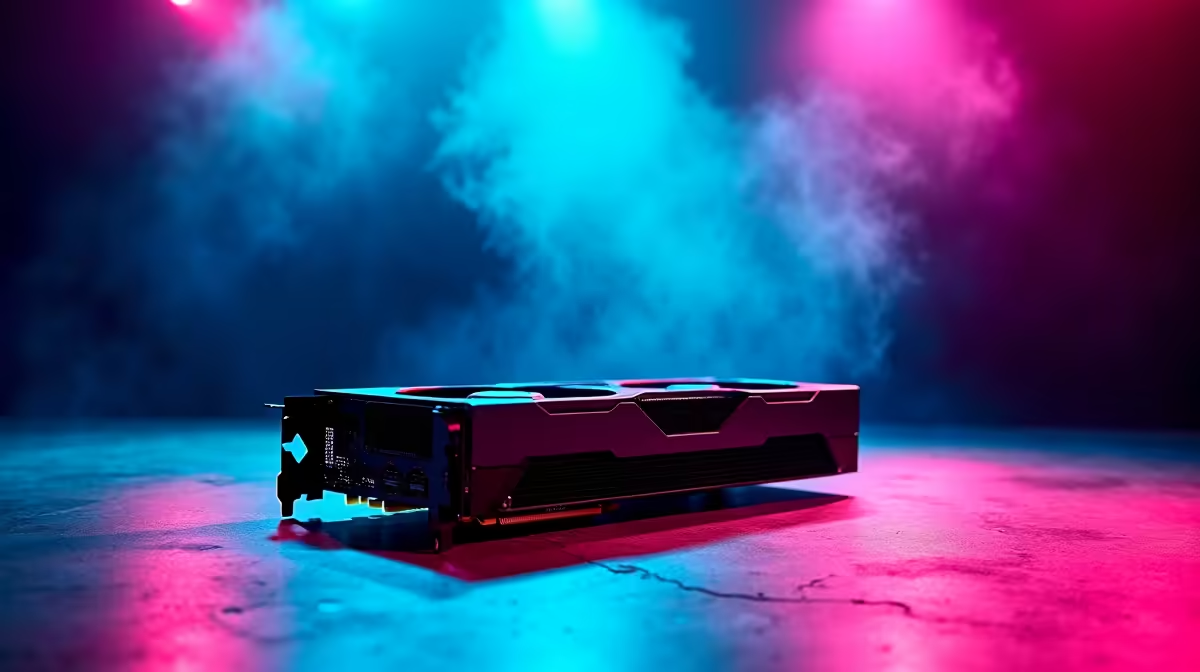
Path tracing is computationally brutal. Each pixel requires dozens to hundreds of ray samples per frame to produce a noise-free image, multiplied across millions of pixels at 1080p or higher. Without AI-powered upscaling and denoising, path tracing would be completely impractical on consumer hardware. NVIDIA's DLSS 4 (with Multi Frame Generation) and AMD's FSR 4 have become essential companions to path tracing - they render at a lower internal resolution and reconstruct the image at target resolution, dramatically reducing the raw GPU workload. Even with these assists, you'll want an RTX 4080 or better for a comfortable path-traced experience at 1440p. The RTX 5000 series has further optimised path tracing performance, making it the most compelling reason to upgrade if this rendering mode is your priority.
🎮 Which Games Support Full Path Tracing Right Now?
Full path tracing (sometimes called "overdrive mode") is still rare but growing. Cyberpunk 2077's Overdrive Mode was the landmark first implementation. Alan Wake 2 followed with impressive results. Indiana Jones and the Great Circle shipped with a path-traced lighting pipeline from launch, signalling that developers are now building around the technology rather than bolting it on. The list is growing as engines like Unreal Engine 5 and proprietary tech incorporate path tracing pipelines more natively. Expect the next two to three years to see significant adoption, particularly in narrative and open-world titles where environmental storytelling benefits most from accurate, consistent lighting.
❓ FAQ
Q: Do I need an RTX GPU for path tracing?
A: NVIDIA RTX GPUs have dedicated RT cores that handle path tracing most efficiently. AMD's RDNA 3 and RDNA 4 GPUs also support ray tracing workloads and can run path-traced games, though performance per frame differs. For playable path tracing, a high-tier GPU from either manufacturer is necessary.
Q: Can I run path tracing at 1080p with an RTX 3080?
A: With DLSS Quality or Balanced mode, an RTX 3080 can run path-traced titles like Cyberpunk 2077 at approximately 40–60fps at 1080p output. It's playable but not smooth by modern standards. Upgrading to an RTX 4080 or 5080 delivers a far more comfortable experience.
Q: Is path tracing the same as ray tracing?
A: No. Ray tracing is a broader technique that traces specific rays for targeted effects like reflections and shadows. Path tracing is a more comprehensive implementation that traces the full light transport equation, producing physically accurate global illumination. Path tracing is effectively "full" ray tracing.
Evetech stocks All Graphics Cards and Graphics Card Deals — browse current SA pricing and availability online.