Quick Answer
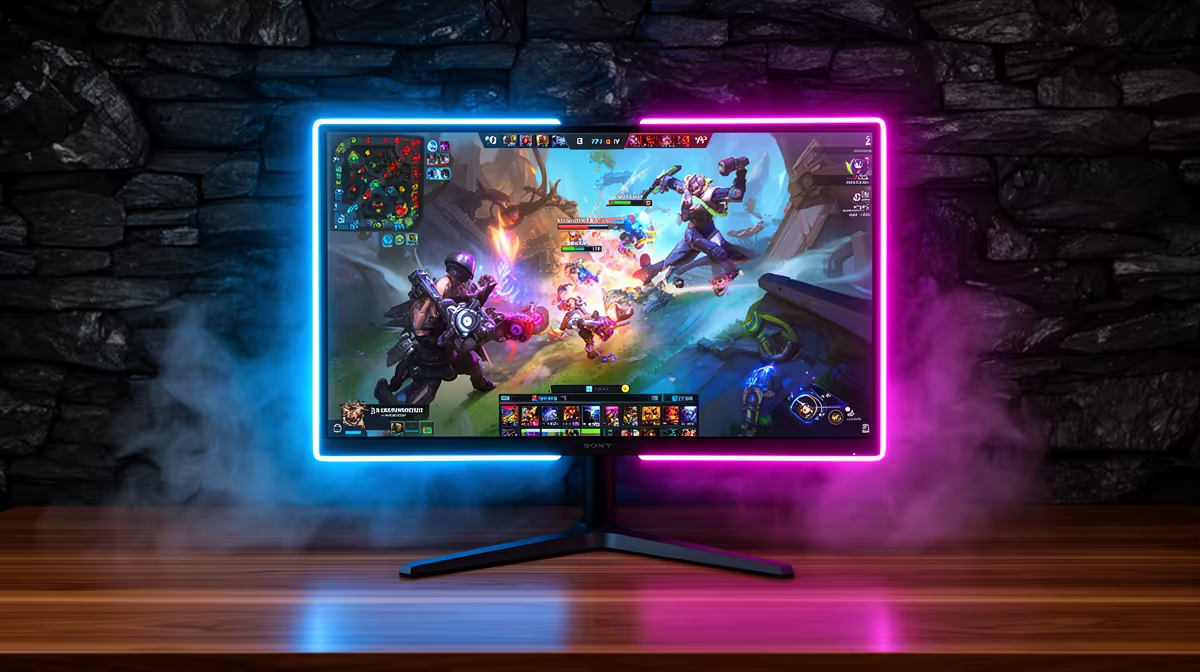
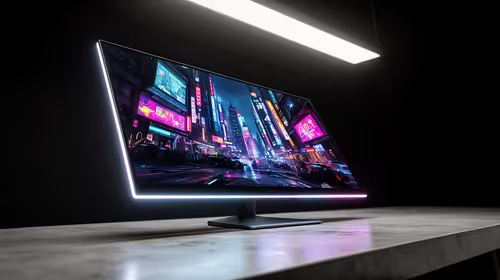
240Hz monitors went mainstream in Durban esports because esports PCs can now drive very high fps, and the price gap from 144Hz is much smaller than it used to be. At 240Hz, each refresh is about 4.17 ms, compared with 6.94 ms at 144Hz and 16.67 ms at 60Hz.
Why 240Hz matters in esports
In Counter-Strike 2, Valorant, Fortnite, Rocket League, and Apex Legends, smoother motion helps tracking, peeking, and recoil control. A 240Hz screen will not create skill by itself, but it reduces visual delay when the PC can feed it enough frames. That is why it makes sense for serious mouse-and-keyboard players.
For Durban esports players at home, school residences, gaming rooms, and fibre-connected flats, 240Hz is now a realistic upgrade rather than a luxury reserved for tournament setups.
Hardware and price expectations
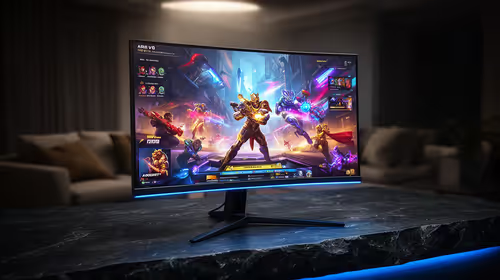
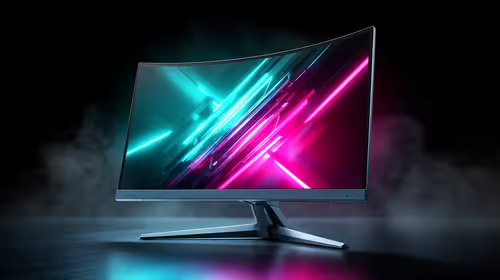
Broad SA pricing puts many 240Hz 1080p monitors around R4,000-R8,000, while 1440p 240Hz models often move into a higher R8,000-R16,000 band. Compare models by panel type, response time, adaptive sync, stand quality, and DisplayPort support, not refresh rate alone.
A Ryzen 5 7600, Ryzen 7 7800X3D, Core i5-class gaming CPU, RTX 4060 Ti, RTX 4070, RX 7700 XT, or stronger GPU can be a sensible pairing depending on the game. Esports titles may reach 200-300 fps on tuned settings, while heavy AAA games will not.
144Hz vs 240Hz vs 360Hz
144Hz remains excellent value for mixed gaming. 240Hz is the better target for competitive players who can maintain high fps. 360Hz and above are specialist choices where the extra cost makes sense only if the PC, game, and player can use it.
FAQ
Is 240Hz worth it for casual gaming?
Not always. Casual story games and controller play do not need 240Hz. It is most valuable for esports titles with high fps and fast aiming.
Do I need 240 fps for a 240Hz monitor?
You get the best result near 240 fps, but adaptive sync still helps below that. Try to keep esports games above 180 fps for a strong experience.
Should SA buyers choose 1080p 240Hz or 1440p 144Hz?
Choose 1080p 240Hz for competitive esports. Choose 1440p 144Hz or 180Hz for sharper mixed gaming and single-player visuals.