So, you’re diving into the world of AI. Maybe you're generating mind-blowing art with Stable Diffusion or training a local language model. But as you push the limits of creativity, your PC starts to sweat. While GPUs get all the glory, the real brain of the operation, your CPU, is working harder than ever. This brings up a crucial question many South Africans overlook: are your AI CPU power supply requirements being met, or is your system one step away from a bottleneck? ⚡
Understanding AI CPU Power Requirements
Unlike gaming, which has peaks and troughs of intensity, AI workloads are often a relentless marathon for your processor. Tasks like machine learning, data processing, and complex simulations push your CPU to its maximum thermal and power limits for sustained periods. This isn't a quick sprint; it's a full-on Comrades Marathon for your silicon.
This sustained load is where the challenge for your Power Supply Unit (PSU) begins. Cheaper, less efficient PSUs can struggle to deliver clean, stable voltage under this kind of stress. Furthermore, modern CPUs are known for creating massive, split-second power spikes called 'transient loads'. An inadequate PSU might see this spike and shut down your PC as a protective measure, right in the middle of your work. Properly understanding your AI CPU power supply requirements is the first step to building a stable, reliable machine.
Matching Your CPU to Your AI Ambitions
Choosing the right processor is about balancing cores, clock speeds, and architecture for your specific AI tasks. The two main contenders each bring something unique to the table.
For instance, the latest generation of Intel CPUs features a hybrid architecture with Performance-cores (P-cores) and Efficient-cores (E-cores). This design is brilliant for handling background AI tasks and system processes simultaneously without crippling your main workflow.
On the other hand, many high-end AMD CPUs are famous for their high core and thread counts. This makes them absolute beasts at parallel processing, a common demand in many AI and machine learning applications where the workload can be split across many cores at once.
The Golden Rule of PSUs ✨
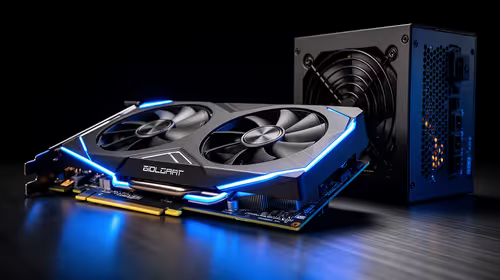
Never, ever cheap out on your power supply. A low-quality PSU can be inefficient, noisy, and at worst, fail catastrophically, taking your expensive CPU and GPU with it. Think of a high-quality, 80 Plus Gold rated PSU not as a cost, but as insurance for your entire R20,000+ investment. It's the foundation of a stable system.
How to Calculate Your AI System's Power Needs
So, how much power do you actually need? Forget simple TDP (Thermal Design Power) numbers. You need to look at the CPU's Maximum Turbo Power or Peak Power Consumption figures, which are often significantly higher.
Here’s a simple formula to get a baseline:
- CPU Peak Power: Find the max power draw for your chosen CPU.
- GPU Peak Power: This is often the biggest power consumer. Find its max board power.
- Everything Else: Add about 100W-150W for your motherboard, RAM, SSDs, fans, and RGB lighting.
- Add Headroom: Sum the numbers above and add another 20-30% on top. This headroom ensures your PSU isn't running at 100% capacity, which improves efficiency, longevity, and gives it the overhead to handle those nasty transient spikes.
A reliable power supply is the heart of any serious PC, especially one built for demanding AI tasks. When you're ready to build, you can browse a wide selection of CPU processors online to find the perfect brain for your new rig.
PSU Sizing Recommendations for AI Builds 🔧
To make it easier, here are some practical recommendations for South African builders:
- Entry-Level AI & Creative Build: For a rig with a Core i5/Ryzen 5 and an RTX 4060, a high-quality 650W - 750W 80 Plus Gold PSU is a solid choice. It provides enough clean power and headroom for stability.
- Mid-to-High-End AI Build: If you're running a Core i7/Ryzen 7 paired with an RTX 4070 Ti or 4080, you should be looking at an 850W - 1000W 80 Plus Gold or Platinum PSU. This tier is where power demands start getting serious.
- Enthusiast AI Powerhouse: For a top-tier Core i9/Ryzen 9 and an RTX 4090, don't even consider anything less than a 1000W - 1200W+ 80 Plus Platinum unit. These components are incredibly powerful and demand the absolute best in power delivery.
Meeting your PC's AI CPU power supply requirements isn't just about getting a big number; it's about getting a high-quality unit that delivers stable power when it matters most. Your AI ambitions depend on it. 🚀
Ready to Build Your AI Powerhouse? Understanding AI CPU power supply requirements is the first step to building a stable, high-performance rig. Don't let a weak PSU bottleneck your potential. Explore our massive range of PC components and find the perfect CPU and PSU combo to conquer your world.