Resolution names do not define the whole gaming target. Choosing a graphics card for 4K and 8K gaming requires the game, refresh goal, settings, display link and acceptable compromises to be written down before hardware is compared.
Quick Answer
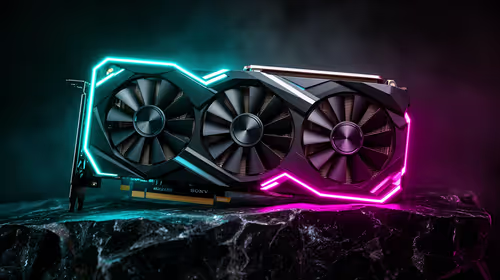
At R73,599, the ASUS TUF RTX 5090 offers 32GB memory plus two HDMI 2.1b ports beside three DisplayPort 2.1b outputs outputs. Those are relevant 4K or 8K resources, but only game-specific evidence can show whether a chosen resolution, refresh and quality target is practical.
🎯 Define the display experience
Begin with the monitor's native resolution and preferred refresh mode. Add the games, visual settings and minimum acceptable frame behaviour. "4K" without those details can describe very different workloads.
For 8K, decide why the resolution matters and which compromise is acceptable. A user may adjust settings, rendering scale or refresh target, but the decision must preserve the experience they actually want.
Distinguish competitive and cinematic priorities. Fast-response play may value frame consistency and refresh more than maximum image settings; slower games may invite a different balance.
Record the CPU and the rest of the planned system. A processor-limited game cannot use unlimited GPU capability, particularly when pursuing high frame rates.
Decide how the target will be tested. A built-in repeatable sequence is useful, but a saved gameplay route can better represent the demanding encounters that matter. Use more than one title when the PC serves a broad library.
Use Evetech's ASUS graphics-card category with that written target beside the shortlist.
🧠 Read memory and performance evidence together
The RTX 5090's 32GB GDDR7 can hold substantial game assets. Higher resolutions and detailed content may increase memory demand, but capacity alone does not guarantee smooth 4K or 8K play.
Seek results for the exact title, resolution and settings. Check frame-time consistency as well as average performance, and note whether any upscaling or frame-generation feature is active.
Compare the host configuration behind each result. Processor, game version, driver and memory can change the outcome, so an isolated number from another PC is not a promise.
Observe actual VRAM behaviour where possible. Allocation does not always equal productive need; connect the reading to stutter, settings limits or another repeatable symptom.
The 3352 AI TOPs rating describes supported AI processing, not a universal gaming score. Games may use AI-assisted features, but their benefit must be shown within the specific title and settings.
Review broader choices in Evetech's NVIDIA GPU selection after filtering results to the defined experience.
🔌 Prove the complete display path
The ASUS model provides two HDMI 2.1b ports beside three DisplayPort 2.1b outputs routes. Choose between them according to the monitor's input and the desired mode rather than assuming one standard always wins.
Confirm the cable's capability. GPU output, lead, monitor input and software-selected mode all have to agree. An adapter adds another link whose supported resolutions and refresh rates need to be understood.
After connection, open the operating-system display settings and verify resolution and refresh. Then check the game itself; it may select another screen or mode independently.
Confirm whether colour, scaling or other display changes accompany the selected mode. The highest available refresh entry is not automatically the best choice if another required aspect of the viewing experience is lost.
Five physical outputs can support a flexible desk, but they do not guarantee five simultaneous high-resolution panels at every demanding setting. Map the intended arrangement and confirm support.
Test wake, full-screen transitions and any mixed-refresh secondary monitors. A technically connected display can still create an awkward daily setup if windows move unpredictably.
🌬️ Prepare the supporting PC
High-resolution gaming can create sustained load, so cooling belongs in the selection. The card names ASUS's chamber-and-fan cooling. They move heat through the GPU cooler, while case ventilation must clear the warmed air.
Confirm chassis clearance and documented power needs before ordering. Include installed front fans, radiators and cable space when measuring.
PCIe 5.0 describes the host interface. Verify the motherboard slot and lane arrangement, but do not use the generation label as a substitute for game testing.
Create a post-build acceptance route in two or three demanding games. Preserve settings, observe frame times and note thermal behaviour after the system has warmed. Adjust only one setting between runs.
Save a second profile for a quieter or lower-power session if the software supports it, but do not mix its results with the maximum-performance test. Different goals deserve labelled configurations.
At R73,599, the purchase should serve more than the idea of the highest resolution. It needs to deliver the chosen quality and refresh balance often enough to justify the complete cost.
Check Evetech's GPU best-seller collection once the games and modes are fixed, then review current availability.
Frequently Asked Questions
What should be defined before shopping for 4K or 8K?
Name the games, monitor, target refresh, visual settings and acceptable performance or scaling compromise.
Do DisplayPort 2.1b and HDMI 2.1b guarantee every mode?
No. The GPU output, cable, display input and selected software mode must all support the result.
How can 32GB of GDDR7 help high-resolution gaming?
It provides space for large rendering data when a game and its chosen settings can use that capacity.
Why are game-specific results more useful than a GPU label?
Engines, settings, processors and features differ, so the same card can produce different experiences across titles.
What supporting components should enter the decision?
Include the processor, motherboard, power supply, chassis airflow, storage and display connection path.
How should buyers think about 8K compromises?
Decide in advance which settings, scaling or refresh changes preserve an acceptable experience for the intended game.
Why does the card's five-output layout matter here?
It offers several modern connection routes for a high-resolution gaming and secondary-screen desk, subject to mode support.
Choosing for a defined 4K or 8K experience? Lock the game, mode and acceptable compromises first, then compare Evetech graphics cards using evidence from that exact target.