You’ve just spent a small fortune on a shiny new Intel Core or AMD Ryzen CPU. You carefully unbox it, lower it into the LGA 1851 or AM5 socket, and clamp down the retention arm. But a tiny, nagging worry creeps in… is the cooler making proper contact? Are you leaving performance on the table? This concern, known as CPU bending, is real. Thankfully, the fix is surprisingly simple: a CPU contact frame.
What is CPU Bending and Why Does it Happen?
Modern CPUs, especially for sockets like Intel's LGA 1700/1851 and to some extent AMD's AM5, are larger and more rectangular than their predecessors. The standard Integrated Loading Mechanism (ILM)—that metal bracket you clamp down—applies pressure in just a few spots. This can cause the processor's body and Integrated Heat Spreader (IHS) to flex or bend ever so slightly in the middle.
You might not even see it, but this microscopic warping creates a concave surface. When you mount your cooler, it results in a gap between the centre of your CPU and the cooler's cold plate. This means less efficient heat transfer and, you guessed it, higher temperatures. It's a frustrating issue that can throttle the performance of your expensive new chip, no matter how many effective CPU coolers you throw at it.
Enter the CPU Contact Frame: The Simple Fix 🔧
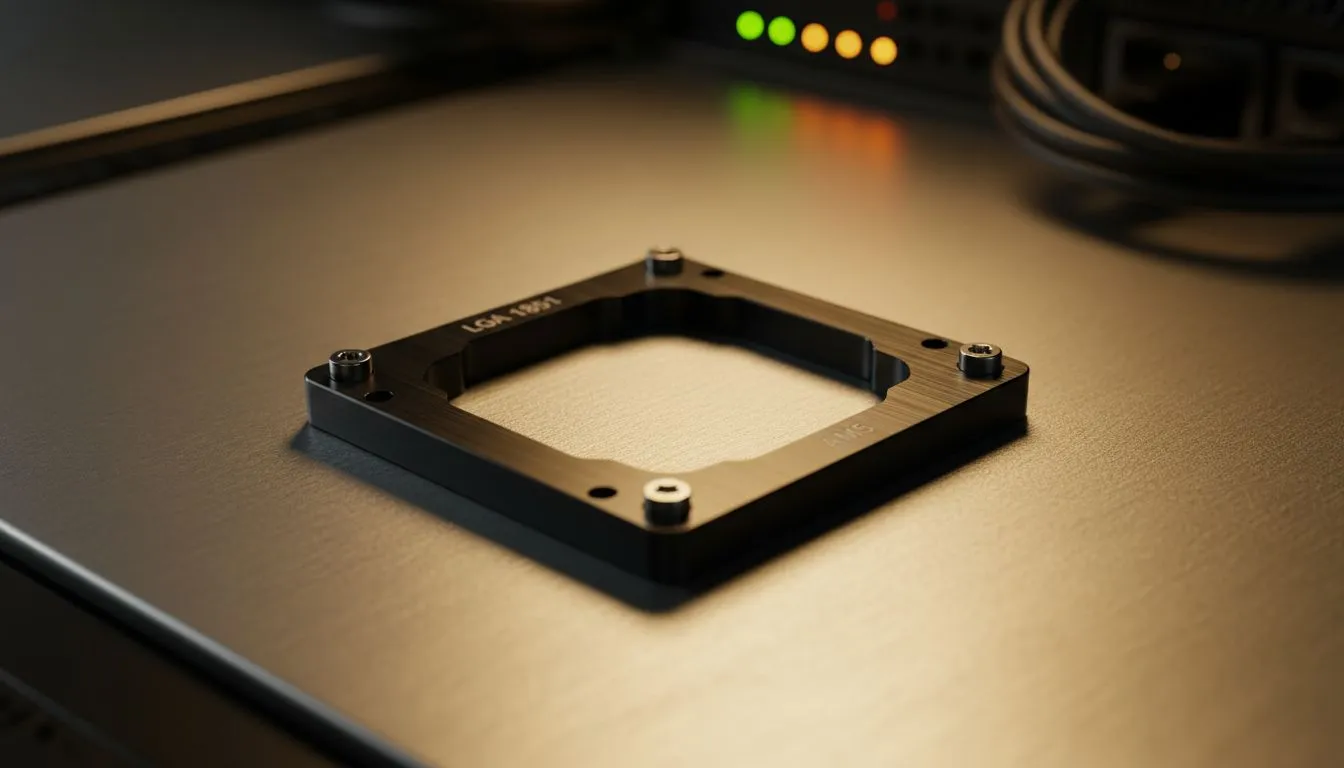
A CPU contact frame is a precision-engineered piece of metal that completely replaces your motherboard's standard ILM. Instead of applying pressure at just two or four points, it creates a perfectly uniform, distributed pressure across the entire perimeter of the CPU's heat spreader.
The result? The CPU stays perfectly flat. This ensures optimal contact with your cooler's base, allowing for a much better spread of thermal paste and dramatically improved heat transfer. For overclockers and performance enthusiasts in South Africa, installing a CPU contact frame is one of the most cost-effective ways to drop temperatures by a few critical degrees Celsius. It's a small tweak that helps your entire cooling system work as it should.
Thermal Paste Pro Tip ✨
With a CPU contact frame ensuring a flat surface, the classic "pea" or "X" method for applying thermal paste can be less effective. For best results, use a small spatula to spread a thin, even layer of high-quality thermal paste across the entire IHS. This guarantees zero air gaps and maximum thermal conductivity.
Is a Contact Frame Worth It for Your Build?
So, do you absolutely need one for your next-gen build? For a casual user, maybe not. But if you fall into any of these categories, a CPU contact frame is a brilliant investment:
- Performance Seekers: If you're running a high-end Core i7/i9 or Ryzen 7/9, you want every bit of performance you paid for. A contact frame ensures your cooling is not the bottleneck.
- Overclockers: When pushing your silicon to its limits, every single degree matters. Lower base temperatures give you more thermal headroom for higher clocks.
- Builders Seeking Peace of Mind: It’s a low-cost upgrade that protects your pricey CPU and motherboard from uneven long-term pressure.
A contact frame works wonders with any cooling solution, whether you're using one of the best high-performance air coolers or a beefy all-in-one (AIO) liquid cooler. Many PC builders find that pairing a CPU contact frame with a powerful cooling solution from top brands like Corsair is the ultimate combination for icy-cool temps.
The Long-Term Benefits of a Straighter CPU
Fixing CPU bending isn't just about getting lower temps today. It's about ensuring the long-term health and stability of your system. By providing even mounting pressure, a CPU contact frame reduces physical stress on the processor's substrate and the motherboard socket itself.
It's a simple, elegant solution that ensures your high-performance rig, whether it's built for 4K gaming in Cape Town or video editing in Joburg, runs at its absolute peak. When you're already investing in a top-tier CPU and perhaps a powerful 360mm radiator, adding a contact frame is the final touch that ties it all together for maximum performance. 🚀
Ready to Perfect Your PC's Cooling?
A CPU contact frame is a key part of the performance puzzle, but it works best with a killer cooler. Explore our massive range of CPU coolers and find the perfect match to keep your processor cool and your frames high.