Quick Answer
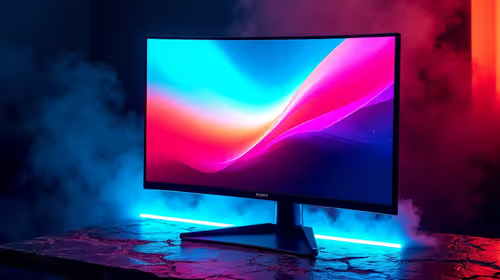
Most buyers should avoid overspending by setting the target first: 32GB RAM, strong CPU cores, enough VRAM and stable cooling for long solver runs. For a gaming monitor, the sensible spend band is usually R2,500-R4,500 for 1080p 144Hz, R5,000-R9,000 for 1440p high refresh, and far more for OLED or ultrawide; buy above that only when the extra spec changes fps, render time, noise or daily comfort.
Set A Real Target Before Spending More
Overbuying starts when the target is vague. Write down the resolution, refresh rate, game list or workload before comparing parts. A gaming monitor that handles 144Hz needs 144 fps to feel fully used, while 165Hz-240Hz is mainly for competitive players is enough for many South African homes and campus rooms. Spend above R2,500-R4,500 for 1080p 144Hz, R5,000-R9,000 for 1440p high refresh, and far more for OLED or ultrawide only when you can name the gain, such as lower noise, faster exports, more VRAM or a higher 1% low.
Specs Worth Paying For
Pay for specs that remove a measurable bottleneck. For this gaming monitor, focus on refresh rate, panel type, adaptive sync, HDMI 2.1 or DisplayPort, stand adjustment and desk depth. If two options are close, choose clearer warranty support, standard connectors and enough capacity for the next two or three years.
South African Fit Checks
Local fit matters because desk size, delivery timing, support and network quality vary across Joburg, Pretoria, Cape Town and Durban homes. For online play, test wired Ethernet or a strong 5GHz or 6GHz Wi-Fi link. For study or residence use, measure the desk and check whether fan noise is acceptable in a shared room.
FAQ
What is the safest budget range for this in South Africa?
Use R2,500-R4,500 for 1080p 144Hz, R5,000-R9,000 for 1440p high refresh, and far more for OLED or ultrawide as a cautious planning range, then check current Evetech stock. The higher tier should buy a clear gain such as more fps, more VRAM, quieter cooling or a better panel.
Which spec should I check first?
Check the part that controls the result: GPU and VRAM for graphics, CPU cores for simulation, and panel refresh for monitors. For this topic, the practical baseline is refresh rate, panel type, adaptive sync, HDMI 2.1 or DisplayPort, stand adjustment and desk depth.
When is it worth stepping up a tier?
Step up only when the next tier changes daily use. A move that delivers 144Hz needs 144 fps to feel fully used, while 165Hz-240Hz is mainly for competitive players or keeps noise lower in a shared South African room is worth more than a cosmetic upgrade.