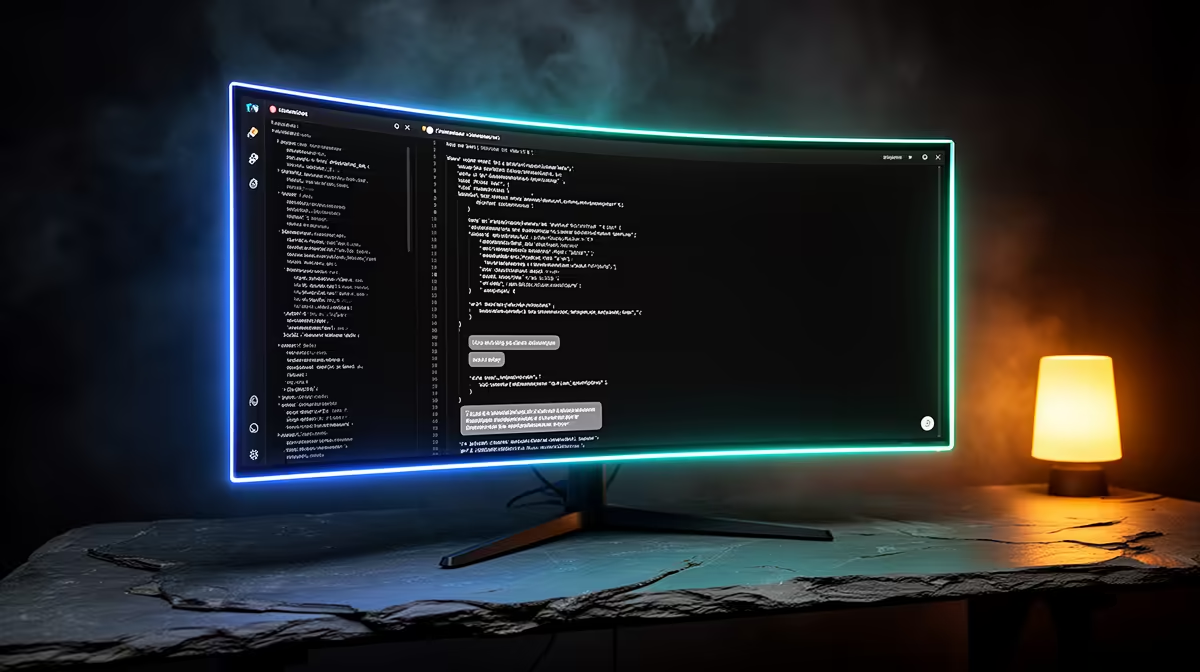
Ollama runs your local models well from the terminal, but typing prompts at a command line gets old fast. Open WebUI gives you a clean browser chat window for every model you have pulled, complete with conversation history, model switching, and document uploads. The single setting that makes them talk to each other is OLLAMA_BASE_URL, and getting it right is the whole job.
Quick Answer
Point Open WebUI at Ollama by setting the OLLAMA_BASE_URL environment variable to your Ollama address, usually http://127.0.0.1:11434 when both run on the same machine, or http://host.docker.internal:11434 when Open WebUI runs in Docker and Ollama runs on the host. Once that resolves, Open WebUI lists every pulled model automatically and serves them in a browser chat.
What each piece does
Ollama is the engine. It downloads, stores, and runs local language models, and it exposes them over an HTTP API on port 11434 by default. Open WebUI is the front end, a self-hosted web interface that calls that API and turns it into a usable chat experience. Neither sends anything to the cloud, the whole stack stays on your own hardware, which is the point of running local in the first place.
The only thing Open WebUI needs to know is where to find Ollama. That is the base URL. Get the address and the networking right and everything else, model lists, chat, and history, falls into place on its own.
Step by step: connecting the two
- Confirm Ollama is running. Open a terminal and run
ollama list. If you see your pulled models, the service is alive. Visit http://127.0.0.1:11434 in a browser and you should see the text "Ollama is running". If that fails, start the service before going further. - Decide how Open WebUI will run. There are two common paths. Running Open WebUI in Docker is the most common, since it ships as a container. Running it as a native Python install is the alternative. The base URL you use depends on which path you pick.
- Item
- Item
- For both running as Docker containers, put them on the same Docker network and use the service name instead of an IP. With Docker Compose set
OLLAMA_BASE_URL=http://ollama:11434, whereollamais the name of the Ollama service. Compose handles the internal DNS so the containers find each other. - Open the interface. Browse to http://localhost:3000 if you mapped that port, or http://localhost:8080 if you ran with host networking. Create the first admin account, that account owns the instance.
- Pick a model and chat. Open WebUI reads the model list straight from Ollama. If your pulled models appear in the top-left dropdown, the connection is live. Select one and send a prompt.
Fixing a connection error
If Open WebUI loads but shows an Ollama connection failure or an empty model list, the base URL is almost always the culprit. The classic mistake is leaving it on 127.0.0.1 inside a Docker container, which points the container at itself rather than the host. Switch to host.docker.internal for host-run Ollama, or the service name for a containerised Ollama. Running the container with --network=host is another fix that lets it share the host network directly. After changing the variable, recreate the container so it picks up the new value.
Hardware that makes local models worth running
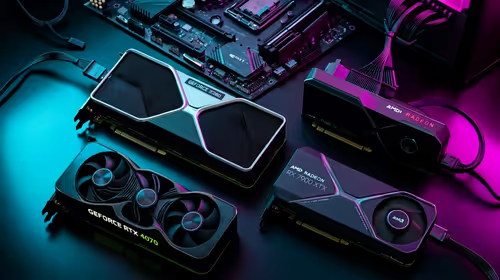
Local language models lean hard on memory and on the GPU. Small models run on modest machines, but anything in the 7B-and-up range wants plenty of RAM and a capable graphics card to respond quickly. A modern AI-ready PC with a strong GPU and generous memory turns a sluggish local chat into something genuinely usable, and the current best-selling PC builds at Evetech give a feel for what the SA market is buying for exactly this kind of work.
Frequently Asked Questions
Why does Open WebUI show no models?
The most common cause is a base URL pointing the wrong way. Inside Docker, 127.0.0.1 refers to the container, not your host, so swap it for host.docker.internal or the Ollama service name and recreate the container.
Do I need a GPU to run this?
No, small models run on CPU alone, just slowly. A dedicated GPU with enough VRAM is what makes mid-sized models respond at a comfortable pace, so it is the upgrade that matters most for daily use.
Can other devices on my network use the chat?
Yes. Once Open WebUI is running, point another device on the same network at the host machine's IP and the mapped port, for example http://192.168.1.20:3000. Everything stays inside your own network.
Is any of my data sent to the cloud?
No. Both Ollama and Open WebUI run entirely on your hardware, so prompts and responses never leave the machine. That privacy is the main reason people self-host instead of using an online service.
What port does Ollama use?
Ollama listens on port 11434 by default. That is the number that appears in every base URL above, and you only change it if you have deliberately reconfigured Ollama to use a different port.
Local AI is only as fast as the hardware under it. Browse the AI PC range at Evetech to find a build with the GPU and memory headroom that turns a local Ollama chat into a snappy daily tool.