Quick Answer
Gen 5 NVMe SSD does not directly cause colour banding, but a rebuild can reset GPU drivers, HDR, bit depth or display output settings. Fix the display chain first, then only revisit the Gen 5 NVMe SSD if the PC is unstable elsewhere. A clean test uses native resolution, 8-bit versus 10-bit colour checks, 60Hz and the target refresh rate, plus a known gradient image. For SA context, basic 1080p monitors can sit around R2,000-R4,000, while OLED, 240Hz and ultrawide models can move far above R10,000.
First Prove It Is Banding
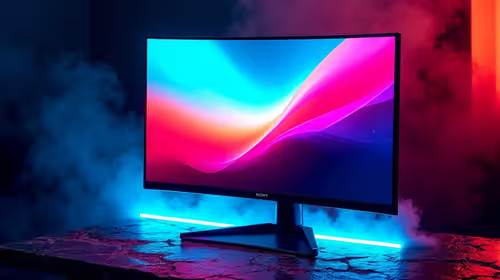
Colour banding looks like visible steps in a sky, shadow, smoke effect or dark gradient. Test a smooth gradient at the monitor's native resolution, then compare SDR and HDR if the display supports both.
Use the modern gaming PC as context, not as the automatic cause. A GeForce RTX 4070 Super, RTX 5080, Radeon RX 7800 XT or RX 9070 XT can all show banding if Windows is sending the wrong output format. HDMI 2.1 or DisplayPort bandwidth also matters at 144Hz, 240Hz and ultrawide resolutions.
Windows And Driver Checks
Open Windows display settings and confirm native resolution, refresh rate, HDR state and scaling. Then check the GPU control panel for output colour depth, RGB versus YCbCr, dynamic range and 8-bit or 10-bit output. RGB full range at the correct refresh rate is the cleanest baseline.
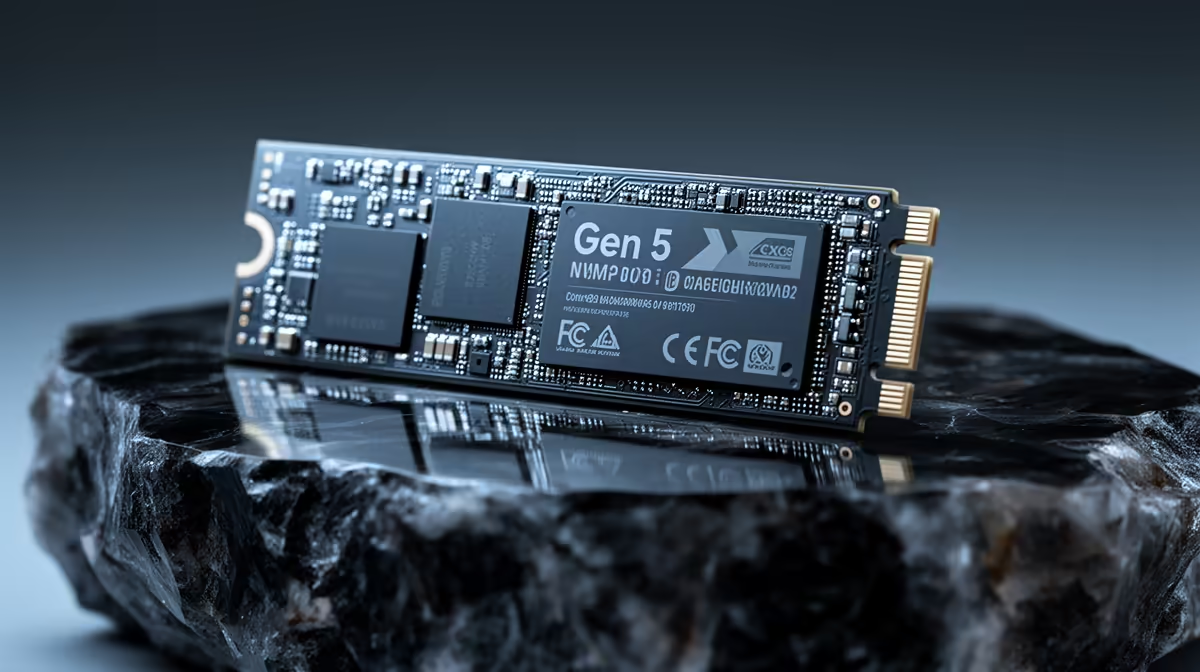
If the issue appeared after adding a Gen 5 NVMe SSD, the rebuild may have changed drivers, ports or monitor profiles. Reinstall the GPU driver, avoid old colour profiles, and test one direct cable. A weak cable can behave differently at 4K 120Hz, 1440p 240Hz or 3440x1440 ultrawide.
FAQ
Can Gen 5 NVMe SSD cause colour banding by itself?
Usually no. Colour banding is a display output or panel issue, so the monitor, GPU, cable, HDR mode and bit depth are stronger suspects than the Gen 5 NVMe SSD.
Should I use 8-bit or 10-bit colour in Windows?
Use 10-bit if the monitor, cable, refresh rate and GPU support it cleanly. If the screen flickers, loses refresh rate or looks worse, return to 8-bit RGB full range and test again.
Is colour banding a reason to replace a monitor?
Replace only after testing SDR, HDR, another cable and another input source. If the same gradients look stepped across sources, a better panel may be the only real fix.
Display check
For a Gen 5 NVMe SSD, test native resolution, RGB full range, HDR off, then HDR on; record the refresh rate and cable used before buying replacement parts.