Quick Answer
Long loading times on a gaming laptop usually point to storage placement, shader compilation, driver cleanup or background downloads. Keep at least 20% SSD free space, check NVMe temperature under heavy reads, and test the same game from a 1TB NVMe drive before replacing the main part. A ASUS TUF Gaming A15 or MSI Katana 15 class setup should not spend minutes loading normal PC games when Windows and the launcher are clean.
First Test To Run
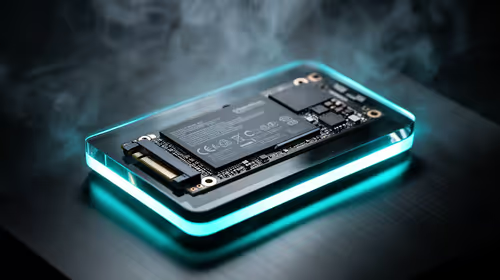
Time the same launch twice after a restart. The first run may build shaders; the second should be much closer. Keep 150GB free on a 1TB SSD where possible, pause launcher downloads, and check whether the game sits on a SATA drive, external drive or the correct NVMe slot. If the gaming laptop only slows after a patch, wait for shader work to finish before changing hardware.
The cheapest practical laptop floor is about R8,000, with gaming models often far higher.
Fix The Hardware And Driver Path
For GPU and PC builds, cleanly update the graphics driver, check power cables, confirm the game is using the dedicated GPU, and watch CPU or GPU temperature under load. ASUS TUF Gaming A15 or MSI Katana 15 class hardware should match 144Hz display, RTX-class GPU, 16GB to 32GB RAM when airflow, RAM and storage are configured correctly. If thermals climb into throttling territory, fix fans and dust before spending money.
Windows And Game Settings
Clear failed downloads, verify game files, and let shader compilation complete after a driver or game update. Keep launchers, cloud sync and antivirus scans quiet during the test. If the second launch is much faster than the first, the main issue was shader or cache work, not the gaming laptop.
FAQ
Why is my gaming laptop slow after an upgrade?
The common causes are shader rebuilds, game files on the wrong drive, low SSD free space, or background launcher downloads. Time the first and second launch before replacing parts.
How much SSD space should I keep free for games?
Keep about 20% free where possible, especially on a 1TB game drive. Full SSDs can slow writes and make patching feel worse.
Should I buy a Gen 5 SSD for faster loading?
Buy Gen 5 only if the platform supports it and cooling is sorted. Many games still feel fine on a healthy Gen 4 NVMe, so prove the current drive is the limit first.
Practical check
Write down the test scene, refresh rate, driver version and the one result that changed. That note tells you whether to tune, cool, reconnect or upgrade the gaming laptop.