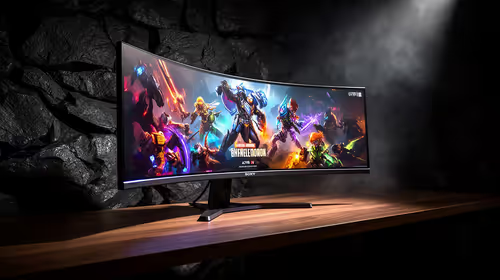
Before assuming hardware died, treat a no-signal screen as a diagnostic puzzle that runs cable, input, port, power, then driver, in that order. For South African builders the calm approach matters, since shipping a part back across the country costs days you do not need to lose.
Quick Answer
A no-signal screen on a 240hz setup is almost always a wrong input, a tired cable, the motherboard port, or a driver state, not a dead card. Trace the physical signal path first, then check Windows and drivers; budget around R6,500 to R28,000 only if a part truly fails. Replacement parts in this class run about R6,500 to R28,000, so the free checks below are well worth the few minutes first.
Confirm Windows actually sees the panel
Once any picture appears, open display settings and press Detect, then check whether the layout is set to duplicate, extend, or single. A driver update can silently save the wrong arrangement so a working monitor reads as missing. Device Manager will also flag a generic or warning-marked display adapter that needs a clean driver reinstall.
Set the correct primary output in BIOS
Some boards default display priority to onboard graphics, which leaves a discrete card silent. Enter BIOS, set the primary or initial display to the PCIe slot, and disable onboard video if the build has no use for it. Save, exit, and the picture usually returns on the next post.
Test with a second screen or cable
Borrow a known-good cable and a second display to split the problem in two. If the spare screen lights up, the original monitor or its cable is the suspect; if it stays dark, the output side is where to look. This single swap saves hours of guessing and stops you returning healthy parts.
FAQ
Is it safe to keep using the rig while I troubleshoot?
For display and settings issues, yes, it is safe to keep testing. If you see heat warnings, repeated shutdowns, or burning smells, power down and inspect before continuing, since those point at power or thermal faults rather than software.
Will a better cable really change this?
Yes, on a high-refresh or high-resolution panel the cable standard sets the bandwidth ceiling, so a certified DisplayPort or high-spec HDMI run can unlock rates a cheap cable hides. A good cable is a small spend against the cost of the rest of the build.
Could a faulty monitor cause a no-signal screen?
It can, which is why a second screen or a known-good cable is the quickest way to split the problem. If the spare display lights up, the original panel or its cable is the suspect rather than the PC.
Quick Win
Note the exact refresh rate, cable, and port that work today; a screenshot of your display settings turns any future regression into a thirty-second comparison.