




Fix stuttering on a Steam Deck in South Africa
Stuttering on a steam deck usually needs a settings, driver, thermal, or power check first. Work through safe SA troubleshooting steps before replacing parts or assuming a full upgrade.
Read moreA Raspberry Pi can run a lightweight Java or Bedrock Minecraft server, letting you host a private world for a small group without paying for a hosting subscription.
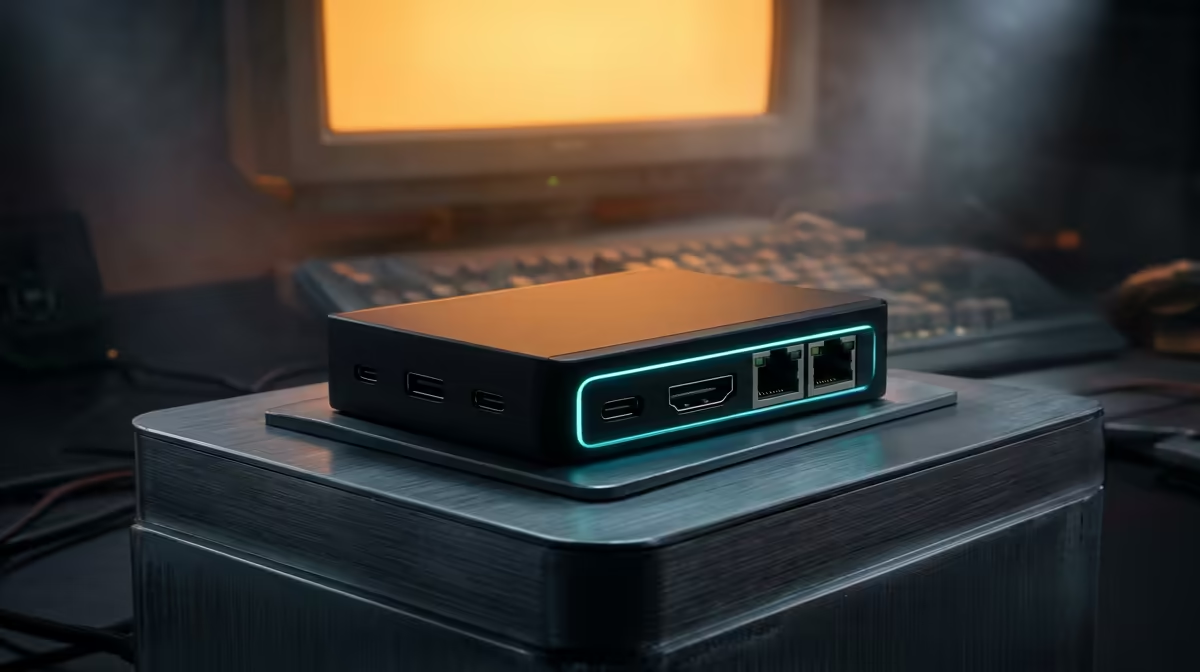
A Raspberry Pi 5 sitting quietly on a shelf can run a private Minecraft world for a small group of mates, with low ping for everyone on the same home network and no monthly hosting fee. Hosting a Minecraft server on a Raspberry Pi is one of the most satisfying weekend projects in the hobby, and a Pi 5 with 8GB of RAM comfortably handles a handful of players if you set it up the right way.
Use a Raspberry Pi 5 with 8GB RAM, boot the 64-bit Raspberry Pi OS from an SSD rather than an SD card, and run a Java server with PaperMC for the best performance. A Pi 5 on PaperMC realistically supports around 8 to 12 players at a view distance of 8, with no subscription required.
The hardware list is short but specific. Get a Raspberry Pi 5, ideally the 8GB model for a bigger group, with active cooling because the board works hard under a busy server. Skip the SD card for storage if you can: an NVMe or USB SSD is far faster and dramatically improves chunk loading and world saves. A wired Ethernet connection to your router beats wireless for stability.
On software, install the 64-bit version of Raspberry Pi OS. Then choose your server type. The official Bedrock Dedicated Server from Mojang is built for x86 hardware, so on the Pi it only runs through emulation, which is unreliable and slow on the Pi 5. The clean path is Java Edition with PaperMC, a high-performance fork that cuts CPU load substantially and supports plugins. The board itself is the heart of this build, and you can compare the current options in the mini PC and small-form-factor range at Evetech if you want something more powerful than a Pi as the world grows.
Flash 64-bit Raspberry Pi OS to your SSD, boot the Pi, and run the system update so you start on current packages. Confirm you are on a 64-bit OS, because the server software and the Java runtime need it to perform properly.
PaperMC needs a current Java runtime. Install a recent 64-bit version through the package manager, then verify it from the terminal so you know the server will launch against the right Java. This single step trips up a lot of first-time hosts, so confirm it before going further.
Create a dedicated folder for the server, download the PaperMC server jar into it, and run it once to generate the configuration files. Open the EULA file and accept it, then edit the server properties to taste. Keep the view distance around 8 for a Pi 5, since pushing it higher is the fastest way to bog the board down.
Launch the server with a sensible RAM allocation so it has room to work without starving the operating system. On an 8GB Pi, giving the server a few gigabytes leaves plenty for the OS. Allocate too much and the system swaps and stutters, so stay conservative and adjust based on how it runs.
On your home network, friends join using the Pi's local IP address on the default Java port. To bring in players from outside your house, you forward the Java port on your router to the Pi, which exposes the server to the internet, so apply a strong allowlist and keep the software updated. If you have console or mobile players, add the GeyserMC plugin and they can join the same Java world from Bedrock devices on the Bedrock port.
A Pi server rewards restraint. Avoid sprawling mob farms and complex redstone contraptions, which hammer the CPU and drag frame times down for everyone. Keep the view distance modest, run from the SSD, and make sure the active cooler is actually doing its job, because thermal throttling is a common cause of mysterious lag.
Back up your world folder regularly, especially before installing plugins or updating the server, so a bad change never costs you the map. If your group keeps growing past what a Pi handles comfortably, that is the signal to step up to a more capable always-on machine. The best-selling PCs at Evetech cover small, efficient systems that make excellent home servers when a Pi runs out of headroom.
Yes. A Pi 5 with 8GB RAM running Java Edition on PaperMC handles roughly 8 to 12 players at a sensible view distance. Use an SSD and active cooling, and keep redstone and mob farms in check for smooth play.
Run Java with PaperMC. Mojang's Bedrock server is built for x86 hardware and only runs on the Pi through emulation, which is unstable and slow. Java on PaperMC is fast and supports plugins, and GeyserMC lets Bedrock players join anyway.
Strongly recommended. SD cards are too slow for the constant reads and writes a server does, which causes lag and risks corruption. An NVMe or USB SSD makes chunk loading and saves far quicker and more reliable.
Around 8 to 12 with PaperMC at a view distance of 8 on the 8GB model. Heavy redstone, large farms, or a higher view distance will lower that number, so tune for your group.
Yes, with the GeyserMC plugin. It bridges Bedrock clients on Xbox, PlayStation, Switch, Android, and iOS into your Java world, connecting on the Bedrock port while Java players use the standard Java port.
Ready to host your own world? Whether you start on a Pi or want a more powerful always-on box, the mini PC range at Evetech has a quiet, capable machine to run it.
Yes. A Pi 5 with 8GB RAM running Java Edition on PaperMC handles roughly 8 to 12 players at a sensible view distance. Use an SSD and active cooling, and keep redstone and mob farms in check for smooth play.
Run Java with PaperMC. Mojang's Bedrock server is built for x86 hardware and only runs on the Pi through emulation, which is unstable and slow. Java on PaperMC is fast and supports plugins, and GeyserMC lets Bedrock players join anyway.
Strongly recommended. SD cards are too slow for the constant reads and writes a server does, which causes lag and risks corruption. An NVMe or USB SSD makes chunk loading and saves far quicker and more reliable.
Around 8 to 12 with PaperMC at a view distance of 8 on the 8GB model. Heavy redstone, large farms, or a higher view distance will lower that number, so tune for your group.
Yes, with the GeyserMC plugin. It bridges Bedrock clients on Xbox, PlayStation, Switch, Android, and iOS into your Java world, connecting on the Bedrock port while Java players use the standard Java port.
Stuttering on a steam deck usually needs a settings, driver, thermal, or power check first. Work through safe SA troubleshooting steps before replacing parts or assuming a full upgrade.
Read more
Quantity surveying students should prioritise a sharp ultrawide that keeps plans, schedules and cost sheets readable during long South African study sessions. Screen width helps comparison work, but PDF annotations, laptop output and native resolution matter just as much.
Read more
Watching rugby and sport does not usually need a podcast recording setup unless you also record commentary, reaction clips or a sports podcast. For this USB microphone record, the existing price facts are creator GPUs from RTX 5070 Ti 16GB R12,700 to RTX PRO 4000 24GB R16,700, plus RTX PRO 6000 96GB R151,700 for high-end workstation work.
Read more
A mid-range gaming PC is the sensible first build when South African buyers want gaming headroom without chasing the top tier. The given parts span RX 7600 around R4,650, RTX 5060 around R4,800, RTX 5070 around R13,100, Ryzen 5 5500 at R1,100 and Ryzen 7 7800X3D at R6,400.
Read more
Around R10,000, the home security angle should stay focused on whether a camera drone is the right tool for checking a property, not on replacing fixed security gear. Verify available drone SKUs in SA and think through where any captured footage will be stored.
Read more
Common SA content-creator drone problems often come from buying the drone before checking the footage workflow. Fix the risk early by verifying drone SKUs and planning SSD, NAS, portable SSD and creator rig capacity for 4K editing.
Read more
Word typing overwrites text when overtype mode replaces characters at the insertion point. Turn off overtype and its Insert-key control in Word options, then test on a spare line before editing the document again.

Audio-Technica ATH-AWX7000 is a closed-back wired headphone model with wooden housings. Its premium materials and supplied analogue cables make source compatibility, comfort and your actual listening needs more important than a launch-price conversion.

Lexar SILVER GO microSD is a UHS-I card family with a reader-dependent maximum transfer rate. Check the exact capacity, host compatibility and card reader before paying for a speed figure that your handheld or camera may not reach.

Windows AutoPlay settings control prompts and default actions when supported media or devices connect. Choose Ask me every time or Take no action where appropriate, then test with a trusted drive without formatting it.
Windows AutoPlay settings control prompts and default actions when supported media or devices connect. Choose Ask me every time or Take no action where appropriate, then test with a trusted drive without formatting it.
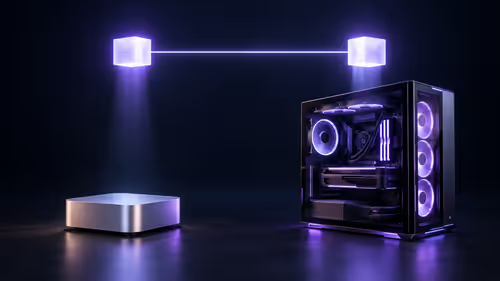
Mac mini M6 vs gaming PC for local AI: the 24GB Mac mini M6 at R25,599 gives about 18GB of AI memory, while an RX 9060 XT 16GB PC at R25,999 gives 16GB. Both reach the 14B tier; the PC games better and upgrades.
The best PC for local AI in South Africa depends on graphics memory: an Arc B580 12GB PC at R17,499 is the best value, a 16GB RX 9060 XT PC costs R25,999, and a 16GB Mac mini M6 at R17,699 reaches the same 14B tier.

The cheapest PC for local AI in South Africa is a Ryzen 5 5600 and Intel Arc B580 12GB system at R17,499, which reaches 14B models. An RX 9060 8GB PC costs R16,599 and the cheapest RTX 5060 PC R19,499.
Stuttering on a steam deck usually needs a settings, driver, thermal, or power check first. Work through safe SA troubleshooting steps before replacing parts or assuming a full upgrade.
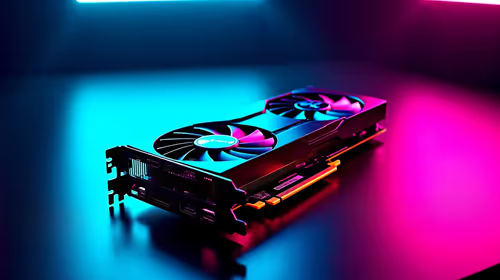
RX 7900 XTX Expedition 33 FPS across 1080p, 1440p, and 4K should be compared by preset, upscaling, VRAM use, and frame pacing. Use the guide to match settings to an SA gaming monitor.

Fallout 4 cloud sync between PC and Steam Deck should be shortlisted around the job it must do. South African buyers should compare fit, performance, compatibility, and upgrade room, warranty path, and upgrade room before treating any pick as best.

Buy now or upgrade later: gaming headsets should be shortlisted around the job it must do. South African buyers should compare audio quality, mic clarity, comfort, and connection type, warranty path, and upgrade room before treating any pick as best.