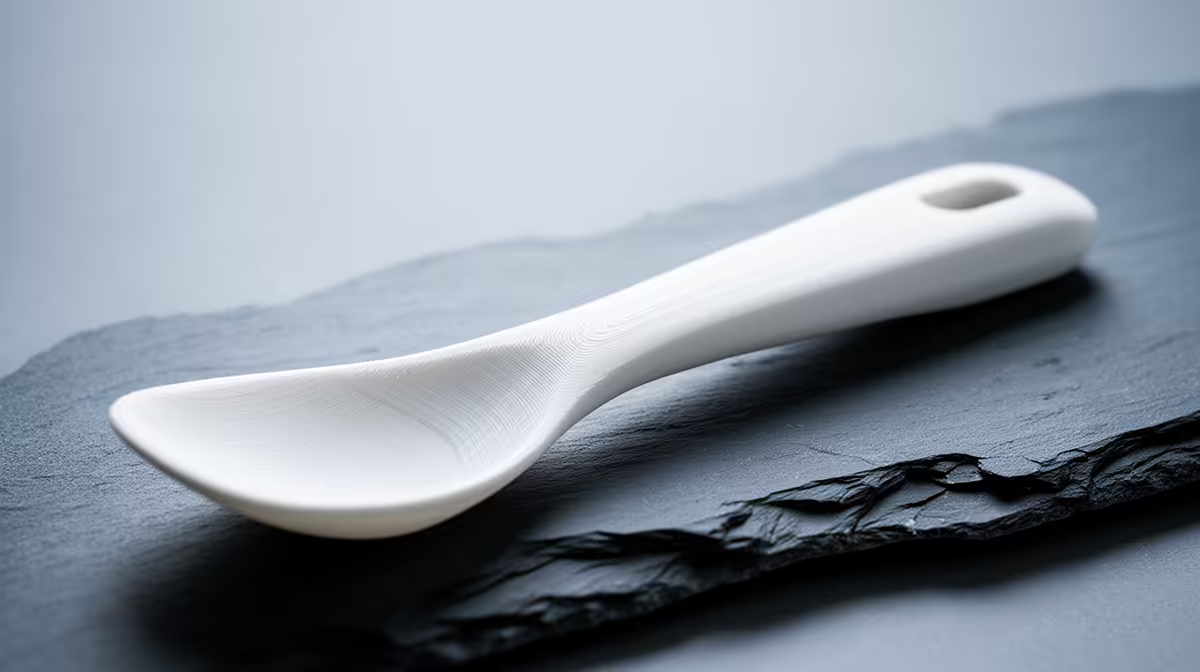
That cocktail-shaker lid or measuring scoop you sliced off a model and sent to the printer carries a problem you cannot see. Printing food-adjacent kitchen helpers safely means accepting one hard rule up front: treat every FDM print as non-food-contact, because the microscopic grooves between layers trap bacteria that no dishwasher cycle reliably clears. You can still print genuinely useful kitchen items. You just have to know which ones are safe and which materials to reach for.
Quick Answer
Print food-adjacent kitchen helpers as non-food-contact items only. FDM prints have micro-grooves between every layer that harbour bacteria standard washing cannot remove, so nothing printed should touch food that is then eaten. Use PETG rather than PLA for any kitchen-zone item because it tolerates higher heat and resists deforming near warmth.
Why FDM prints are not food-safe out of the printer
The issue is structural, not a matter of the filament alone. An FDM printer builds an object by stacking melted plastic lines on top of each other. Between every one of those lines is a tiny valley, and across the surface are thousands of them. Wash a print and water skims the peaks but never fully reaches the bottom of those grooves. Food residue and moisture settle in, and bacteria grow in a place a sponge cannot scrub and hot water cannot sterilise.
A second problem is the brass nozzle most printers ship with, which can contain lead, and the filament additives and colourants that were never tested for ingestion. Even a "food-safe" labelled filament loses that status the moment it passes through standard hardware and gains a porous printed surface. This is why the safe framing is simple: print things that help in the kitchen without ever touching the food itself.
The machines that handle kitchen-zone materials well, particularly the ones that print PETG cleanly, sit together in the 3D printers range if you want to compare what is currently stocked.
Why PETG beats PLA in the kitchen zone
PLA is the default beginner filament and it is fine for desk toys, but it is the wrong choice anywhere near a kitchen. PLA softens at a low temperature, roughly the warmth of a closed car or a sunny windowsill, which means a PLA print left near a kettle, a hob, or in a dishwasher can sag and warp. It also degrades faster with repeated washing.
PETG is the better pick for kitchen-adjacent helpers. It tolerates higher heat before it deforms, shrugs off moisture far better, and is tougher against the knocks of daily use. It still is not food-contact safe for the groove reasons above, but for items that live in the kitchen environment without touching food, PETG holds up where PLA quietly fails.
What is safe to print, and what is not
Safe: non-contact helpers
Print these freely in PETG:
- Drawer and cupboard organisers for utensils, lids, and spice jars.
- Bag clips and seal clamps for closing packets, since they grip the outside of packaging.
- Cable and appliance tidies that route the kettle or toaster cord.
- Jar openers and grip aids that touch the lid, not the contents.
- Shelf risers and tin stackers for organising a pantry.
- Recipe-card and tablet stands to keep a screen splash-free on the counter.
None of these contact food that gets eaten, so the groove problem never comes into play.
Avoid: anything that touches food
Do not print cookie cutters used directly on dough you will bake and eat, measuring scoops that meet loose food, funnels for liquids, drinking cups, or anything that holds food during prep. The risk is not theoretical. Those grooves harbour bacteria after the first use, and you cannot clean them out.
The exception that is not worth chasing
People ask about food-safe epoxy or resin coatings to seal the grooves. In practice this is fragile: the coating chips, scratches under a knife, and wears off with washing, exposing the porous plastic again. For a home kitchen the honest answer is to keep prints non-contact and use a proper food-grade container for the actual food.
Printing and cleaning these items well
Print kitchen helpers at a higher infill and with more wall lines than a decorative model, because they take real handling. A slightly thicker wall resists cracking when a clip flexes or an organiser gets knocked. Keep the print as smooth as your machine allows, since fewer surface defects mean fewer places for grime to collect even on non-contact items.
For cleaning, wipe these with warm soapy water and dry them rather than running them through a dishwasher, where the heat can deform even PETG over many cycles. If a helper looks worn or discoloured, reprint it. Replacements cost cents in filament, which is part of the appeal. A good supply of spare filament and the small accessories that keep prints consistent are worth keeping on hand, and the accessories best sellers is an easy way to track what is moving.
Frequently Asked Questions
Can I print anything that touches food I will eat?
No, not safely with a standard FDM printer. The grooves between print layers trap bacteria that washing cannot clear, so anything contacting food you then eat is a hygiene risk. Keep all prints non-contact and use proper food-grade containers for the food itself.
Why is PETG better than PLA for kitchen items?
PETG tolerates more heat before deforming and resists moisture far better than PLA, which softens near warmth and degrades with repeated washing. For helpers that live in a kitchen without touching food, PETG simply lasts longer.
Is food-safe filament actually food-safe once printed?
Not reliably. Even filament labelled food-safe loses that status after passing through a standard brass nozzle and gaining a porous, grooved printed surface. The label refers to the raw material, not the finished printed object.
Do epoxy or resin coatings make a print food-safe?
They are not a dependable fix for a home kitchen. Coatings chip, scratch under utensils, and wear off with washing, re-exposing the porous plastic. The practical approach is to keep prints non-contact entirely.
What kitchen items are genuinely worth printing?
Organisers, bag clips, cable tidies, jar-opener grips, shelf risers, and recipe stands. All of these help in the kitchen without ever touching the food you eat, which keeps them firmly on the safe side of the line.
Want a machine that prints PETG kitchen helpers cleanly and consistently? Browse the current 3D printers range at Evetech and stock up on the filament and add-ons that keep everyday prints sharp.