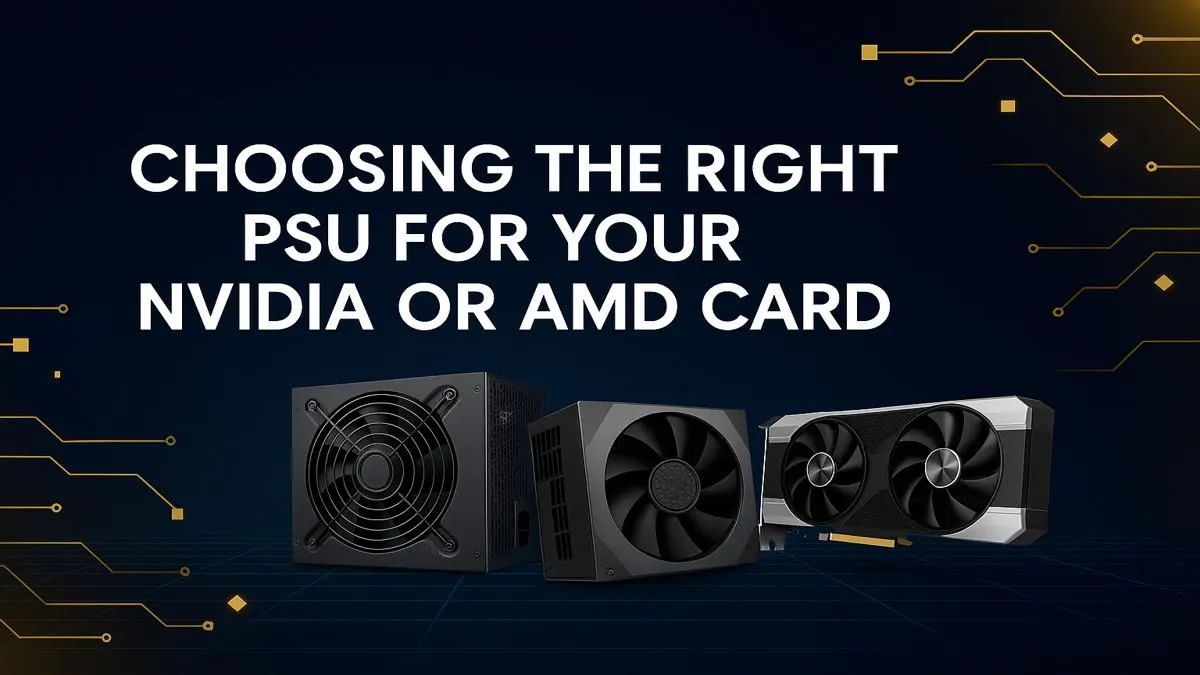
So, you’ve just dropped some serious ZAR on a shiny new graphics card. Awesome! But before you crank every setting to Ultra, there’s a critical question: can your Power Supply Unit (PSU) actually handle it? Skimping on your PSU is a classic PC builder mistake, leading to frustrating crashes or worse. This guide breaks down the real PSU requirements for your GPU, ensuring your beastly NVIDIA or AMD card gets the clean, stable power it deserves. 🚀
Why PSU Requirements for Your GPU Matter
Think of your PSU as the heart of your PC. A powerful graphics card is incredibly demanding, and if the heart can't pump enough power, the whole system suffers. Underpowering your GPU can cause random shutdowns during intense gaming sessions, blue screens, and even shorten the lifespan of your components. It’s not just about getting a high wattage number; it's about delivering consistent power when it's needed most. Understanding the correct PSU requirements for your GPU is the first step to a stable, high-performance rig, whether you're looking at the latest graphics card deals or upgrading an older build.
Decoding the Specs: More Than Just Watts
When you're checking the PSU requirements for a GPU, it's easy to fixate on the total wattage, but the details are what truly count. Here’s what to look for:
The Critical +12V Rail
This is the most important spec for modern components. The +12V rail is the primary power source for your CPU and, crucially, your graphics card. A PSU might be rated for 750W total, but if its +12V rail can only supply a low amperage, it will struggle under load. Always check the PSU's detailed specifications for the Amps (A) on the +12V rail. Multiply the Volts (12V) by the Amps to get the real power available for your GPU.
Efficiency Ratings Explained ⚡
An 80 Plus rating (Bronze, Silver, Gold, Platinum, Titanium) is a guarantee of efficiency. An 80 Plus Gold PSU, for example, is at least 87% efficient at converting AC power from your wall into DC power for your PC. A more efficient unit wastes less energy as heat, runs quieter, and often uses higher-quality components, providing more stable power. A cheap, unrated 750W PSU is not the same as a quality 750W 80 Plus Gold unit.
Check the Source! 🔧
Always check the official product page for your specific GPU model on the manufacturer's website (e.g., NVIDIA, AMD, MSI, Gigabyte). They provide the most accurate minimum PSU wattage recommendation. Forum advice can be outdated or based on different system configurations.
Finding the Right PSU for Your NVIDIA or AMD Card
Both Team Green and Team Red have different power characteristics. Knowing the general PSU requirements for your GPU family is a great starting point.
Powering Your NVIDIA GeForce GPU
NVIDIA's latest cards, especially the higher-end models, are power-hungry. The RTX 40-series also introduced the 12VHPWR power connector, which requires either a new ATX 3.0 compatible PSU or a reliable adapter.
- Entry-Level (RTX 4060): A quality 550W PSU is generally sufficient.
- Mid-Range (RTX 4070 / Super): Aim for a solid 650W-750W PSU.
- High-End (RTX 4080 / 4090): Don't even think about it without at least a premium 850W+ PSU, with 1000W being a safer bet for overclocking.
Matching the right power supply is key to unlocking the full potential of these high-performance NVIDIA GeForce cards.
Fuelling Your AMD Radeon GPU
AMD has made huge strides in efficiency, but their top-tier cards still need plenty of juice. Thankfully, most still use the standard 8-pin PCIe power connectors, simplifying builds.
- Entry-Level (RX 7600): A 550W PSU will do the job perfectly.
- Mid-Range (RX 7700 XT / 7800 XT): A 750W PSU is the sweet spot, giving you stability and some headroom.
- High-End (RX 7900 XT / 7900 XTX): You'll want a high-quality 850W PSU or more, especially for the flagship XTX model.
Ensuring you meet the PSU needs for these cards lets you enjoy stutter-free performance from a wide range of powerful AMD Radeon options.
A Final Word: Future-Proofing
Our advice? Always buy a little more PSU than you need right now. A good power supply can last you through multiple PC upgrades. Opting for 100-150W more than the recommended minimum for your GPU ensures the PSU isn't constantly running at its limit. This makes it run cooler, quieter, and more efficiently, giving you peace of mind for years to come. ✨
Ready to Power Up Your Rig?
Choosing the right PSU is the foundation of a stable and powerful gaming PC. Don't let it be an afterthought. Explore our range of high-quality Power Supplies and give your dream GPU the clean, reliable power it deserves.