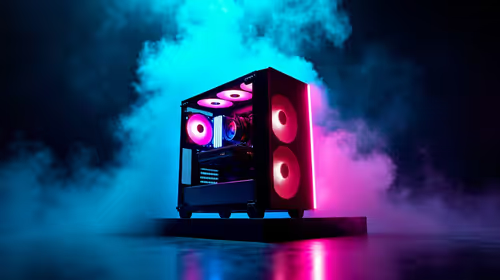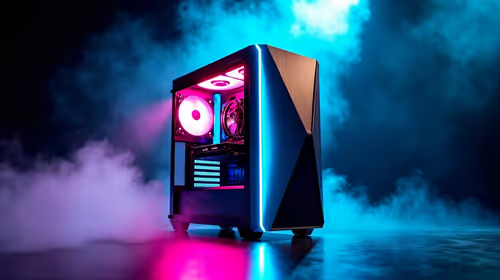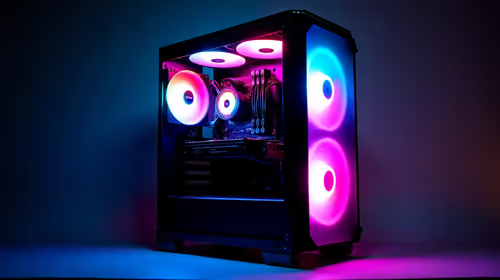
Sefako Makgatho Health Sciences University sits in Ga-Rankuwa, north of Pretoria, where most students are juggling demanding coursework and gaming on the same machine. A tight R10,000 res build has to handle both, so balance and reliability matter more than chasing peak frames.
Quick Answer
A practical SMU res setup runs about R10,000 for the tower: a Ryzen 5 5500 or Core i3-12100F, 16GB of 3200MHz DDR4, a 500GB NVMe SSD, and an RX 6600 GPU. It plays 1080p esports at 150-240 fps, handles AAA titles at 60 fps on tuned settings, and stays quiet enough for study sessions.
A Build That Studies and Games
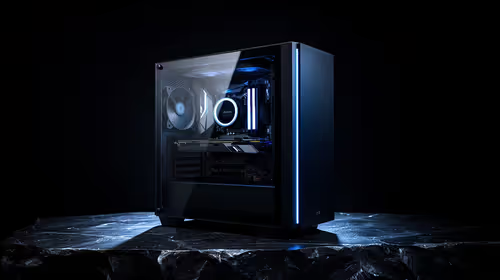
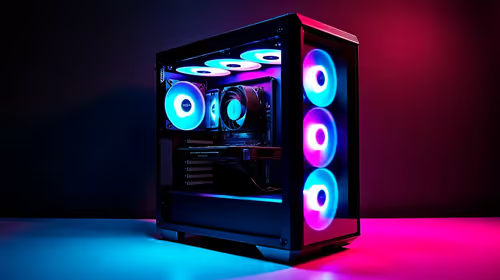
At a health sciences campus, your PC doubles as a study station, so 16GB of RAM and a snappy 500GB NVMe SSD keep dozens of browser tabs and a game alpha-tabbed without stutter. The RX 6600 (~R4,500) is the value heart of the build, delivering around 90 fps in Apex at 1080p High. A Ryzen 5 5500 and a 550W 80+ Bronze PSU complete a tidy, dependable machine in a compact mATX case that fits a standard Ga-Rankuwa res desk.
Pair it with a 24-inch 1080p 144Hz monitor (~R2,800) for smooth play, and you have a setup that earns its keep on assignment deadlines and ranked nights alike.
Network and Power Notes
Skip a UPS on a sub-R10,000 build; it would eat 15-20% of the budget that is better spent on storage or a faster GPU. For SMU's shared res Wi-Fi, a wired Ethernet run to your block's port keeps latency stable for ranked. One intake and one exhaust fan keep the 65W CPU and RX 6600 cool through a warm Gauteng summer.
FAQ
Can R10,000 build a PC that studies and games at SMU?
Yes. A Ryzen 5 5500 with 16GB DDR4, a 500GB NVMe and an RX 6600 handles heavy multitasking for coursework and runs 1080p esports at 150 fps-plus, all within a R10,000 tower budget.
Do I need a UPS for an SMU res PC?
No. With SA power supply stable, a UPS adds R1,500-R2,000 with no gaming benefit. Put that money into a 1TB SSD or a faster GPU instead.
How much storage do I need for study plus games?
A 500GB NVMe SSD is the minimum, holding Windows, your study apps and two or three games. Add a cheap 1TB SATA SSD later when your game library grows.
24-inch monitor to 144Hz in Windows display settings, not the default 60Hz, so the panel actually runs at the refresh rate you paid for during both ranked play and scrolling lecture notes.