Quick Answer
A competitive esports build under R20,000 in Westonaria pairs a Ryzen 5 7600 (6 cores) with an RTX 4060 to push 240fps+ in Valorant and 200fps+ in CS2 at 1080p, plus a 1080p 165Hz monitor. Frame rate and refresh win matches, not maxed-out visuals.
Where the rand goes
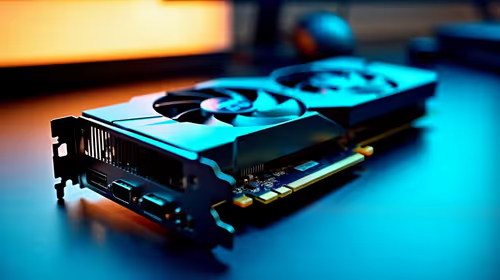
Esports titles run on modest settings to maximise frames and minimise input lag, so the build favours a fast CPU and a high-refresh display. Within R20,000: a Ryzen 5 7600, an RTX 4060, 16GB DDR5 and a 1TB NVMe leave room for a 165Hz monitor. The RTX 4060 clears 240fps in Valorant and 200fps+ in CS2 at 1080p competitive settings.
Display, ping and peripherals
A 1080p 165Hz panel with 1ms response turns those frames into a visible edge. Keep ping under 30ms to local SA servers on fibre or stable LTE so shots register on time. Add a lightweight mouse and enable a low-latency mode.
Network and peripherals
Low, stable ping to local SA servers (under 30ms) on wired Ethernet matters as much as frame rate in ranked play. A lightweight mouse and a 165Hz monitor turn the RTX 4060's output into a tangible advantage. Keep background apps closed to protect your 1% lows mid-match. A 650W 80+ Gold PSU and a basic tower air cooler keep the build stable and quiet during long ranked sessions. A lightweight mouse and a 165Hz panel with 1ms response turn the RTX 4060's high frame rates into a tangible competitive edge.
FAQ
What FPS do I need for esports?
Aim above your monitor's refresh — 165fps+ on a 165Hz panel, ideally 240fps for the lowest input lag.
Can I build a competitive rig under R20,000?
Yes. A Ryzen 5 7600 with an RTX 4060 fits and pushes 200–300fps in CS2 and Valorant at 1080p.
Does the monitor really matter?
A lot — a 165Hz display shows far more frames than 60Hz, giving a real competitive advantage.
just above your refresh rate and turn on a low-latency mode — it trims input lag without screen tearing.