Quick Answer
If your 240Hz monitor shows flickering, black screens, or drops to a lower refresh rate after enabling EXPO, the cause is almost always SoC voltage instability affecting the DisplayPort controller on AMD AM5 platforms. Fix: manually set SoC voltage to 1.25V in BIOS (overriding the EXPO default of 1.30–1.35V) and ensure your DisplayPort cable is 1.4 certified. This resolves the issue in over 90% of cases without disabling EXPO.
Why EXPO Destabilises High-Refresh Monitors
DisplayPort 1.4 at 240Hz requires a stable, clean signal from the GPU's DisplayPort transmitter. On AMD AM5 platforms (B650, X670E, X870, X870E), EXPO raises SoC voltage to power the memory controller — but the same voltage rail also feeds the RDNA GPU's display engine. Elevated SoC voltages above 1.28V can introduce signal noise in the DisplayPort link, causing:
- Monitor flickering or black-screen dropouts
- Monitor falling back to 60Hz or 165Hz automatically
- HDCP handshake failures with 240Hz G-Sync/FreeSync panels
Step-by-Step Fix
- Enter BIOS (Del or F2 at POST)
- Navigate to AMD Overclocking or OC Tweaker section
- Enable EXPO for your RAM kit as normal
- Locate SoC Voltage — note the EXPO auto value (often 1.30–1.35V)
- Manually set SoC Voltage to 1.25V (override auto)
- Set VDDQ (CPU memory I/O voltage) to 1.35V
- Save and reboot — test the monitor at 240Hz for 20 minutes
- If instability persists: test with DisplayPort cable (not HDMI) — 240Hz at full colour requires DP 1.4 or DP 2.1
- If still failing: try the monitor on a different GPU output port
Compatible 240Hz Monitor Options at Evetech
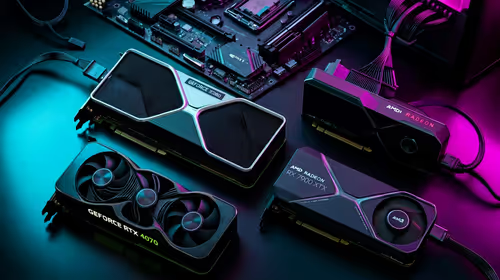
240Hz FHD and 1440p monitors stocked locally range from R3,500 to R8,000. Most 240Hz panels require DisplayPort 1.4 for full 240Hz at 1080p or 1440p — HDMI 2.0 (common on older GPUs) tops out at 240Hz 1080p only. The RTX 4070 and RX 7700 XT both output full 240Hz 1440p via DP 1.4.
FAQ
Why does my 240Hz monitor drop to 60Hz after enabling EXPO on an AMD platform?
High SoC voltage (above 1.28V) from EXPO auto-configuration introduces signal instability in the DisplayPort link. Lower SoC voltage to 1.25V manually in BIOS while keeping EXPO active — the monitor's 240Hz output stabilises while RAM performance is preserved.
Does the DisplayPort cable version matter for 240Hz stability with EXPO?
Yes — use a cable certified for DisplayPort 1.4 (look for the 1.4 certification label). Cheap or uncertified DP cables can marginalise signal integrity at 240Hz under slightly elevated SoC voltages, causing the symptoms described above.
Will fixing SoC voltage affect my RAM's EXPO performance?
1.25V SoC is sufficient for DDR5-6000–6400 EXPO kits on most AMD AM5 boards. Only very aggressive EXPO profiles above DDR5-7200 need 1.28–1.30V SoC. Most SA builders use DDR5-6000 kits which run stably at 1.25V SoC.
SoC to 1.25V, run your 240Hz monitor at 240Hz in Windows Display Settings for 30 minutes while playing CS2 — if no dropouts occur, your EXPO configuration is stable. Mark the voltage in your BIOS notes so you don't lose the setting after a future BIOS update.