The headline number on the M5 Pro and M5 Max MacBook Pro is not the chip, it is the trio of Thunderbolt 5 ports. Three of them, each pushing up to 120 Gbps, fundamentally changes what you can hang off one laptop. That is triple the bandwidth of the Thunderbolt 3 ports on older machines, and it turns a single cable run into a serious docking, display and storage backbone.
Quick Answer
The M5 Pro and M5 Max MacBook Pro carries three Thunderbolt 5 ports, each rated up to 120 Gbps. That bandwidth lets you drive 8K displays, daisy-chain fast NVMe enclosures and connect full Thunderbolt docks at the same time, all from cables sharing far more headroom than Thunderbolt 3 ever offered.
What three Thunderbolt 5 ports unlock
Thunderbolt 5 lifts the ceiling to 120 Gbps in its high-bandwidth mode, roughly triple Thunderbolt 3's 40 Gbps. With three of those ports, you are no longer rationing bandwidth between a monitor and a drive. You can run a serious workstation setup off a laptop without the connections starving each other.
That matters most for three jobs: high-resolution displays, fast external storage and full-feature docks. With three ports you can realistically do all three at once.
Displays: 8K and high refresh rates
The bandwidth headroom means a single Thunderbolt 5 port can drive an 8K display, or push very high refresh rates at lower resolutions for video and motion work. Across three ports you can run a genuine multi-monitor editing or design setup, with each screen getting the bandwidth it needs rather than fighting for scraps.
For anyone doing colour grading, multi-stream video or large-canvas design, that is the difference between a laptop that tethers to one screen and one that anchors a full desk. If you want to see how the current models are configured and priced, Evetech's MacBook Pro range lays out the M5 options.
Storage: daisy-chained NVMe enclosures
Thunderbolt 5's bandwidth lets a fast external NVMe enclosure read and write close to internal-drive speeds, which is a real win for video editors scrubbing through large 4K and 8K files off external storage. Because Thunderbolt daisy-chains, you can run a drive, then a second device, off a single port, then repeat across the other two.
That keeps your editing scratch disks, project archives and a dock all live at once, on cable runs that no longer bottleneck the moment you copy a large file.
Docks: one cable, full desk
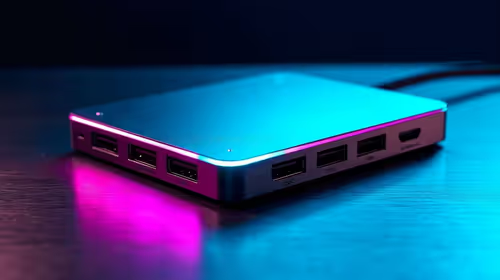
A Thunderbolt 5 dock collapses your whole desk into one cable to the laptop. Power delivery, several displays, wired Ethernet, extra USB ports and audio all run through that single connection. With two ports left over for direct display or storage links, the MacBook Pro becomes a clean single-cable docking machine while still keeping bandwidth in reserve.
Frequently Asked Questions
How fast is Thunderbolt 5 compared to Thunderbolt 3?
Thunderbolt 5 reaches up to 120 Gbps in its high-bandwidth mode, roughly three times the 40 Gbps of Thunderbolt 3. That extra headroom is what allows simultaneous 8K displays and fast external storage without contention.
Can I run an 8K display from one Thunderbolt 5 port?
Yes. The increased bandwidth of Thunderbolt 5 is enough to drive an 8K display from a single port, or to push high refresh rates at lower resolutions for video and motion work.
Will my old Thunderbolt 3 accessories still work?
Yes. Thunderbolt 5 is backward compatible, so Thunderbolt 3 and Thunderbolt 4 docks, drives and cables connect and function, though at their original speeds rather than the new 120 Gbps ceiling.
Do I need special cables for Thunderbolt 5?
To reach full Thunderbolt 5 speeds you need a certified Thunderbolt 5 cable. Older cables still work but cap the connection at their own rated bandwidth, so for 8K or fast NVMe runs use a proper Thunderbolt 5 cable.
Want a laptop that doubles as a full multi-display, multi-drive workstation? Explore the M5 MacBook Pro models and their Thunderbolt 5 connectivity at Evetech via https://www.evetech.co.za/laptop-best-sellers/x/1913 and see which configuration fits your workflow.