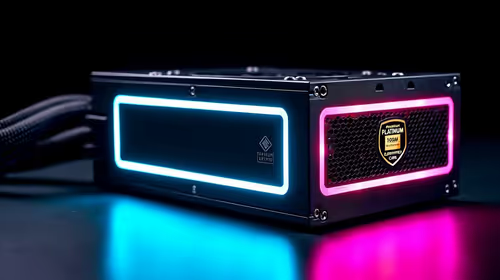
The RTX 5060 power supply requirements start with NVIDIA's 550W reference baseline, but the number is not a universal approval for every unit carrying a 550W label. The complete PC, cable arrangement, PSU quality and upgrade plans determine whether that capacity is comfortable.
Quick Answer
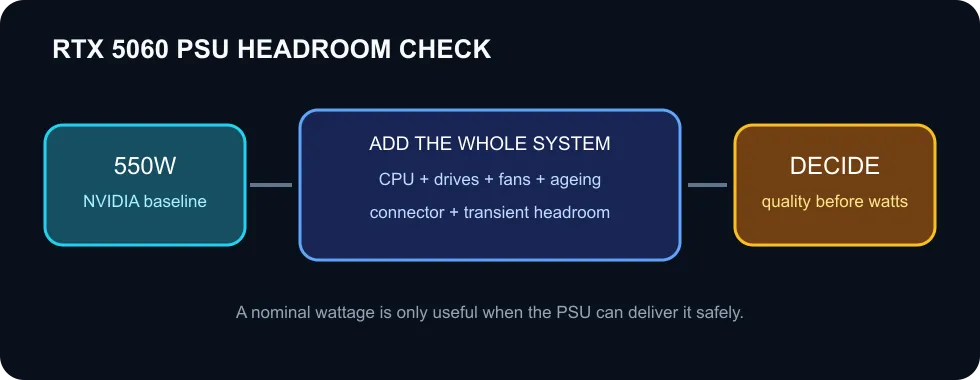
NVIDIA lists 145W total graphics power and 550W required system power for the GeForce RTX 5060 reference specification. The company bases that minimum on a system configured with a Ryzen 9 9950X and says requirements can vary. A sound 550W supply can be enough for a balanced build, while 650W can provide extra headroom. Use the exact graphics-card maker's connector and PSU guidance because partner models can differ.
What the 550W figure means
Required system power covers the full computer, not only the graphics card. The processor, motherboard, memory, storage, fans, pumps, USB devices and conversion losses all use part of the available capacity. NVIDIA's 145W graphics figure leaves substantial room inside a quality 550W design, but a nominal label does not describe voltage regulation, protection features, cable quality or age.
The footnote on NVIDIA's specification is useful. Its reference calculation uses a high-end Ryzen 9 9950X system and recommends a PCIe CEM 5.1 compatible power supply. A lower-power gaming processor may draw less, while aggressive boosting, many devices or manual overclocking can draw more. Treat 550W as a starting point for calculation rather than a promise.
Connector choice matters
NVIDIA lists one PCIe 8-pin cable or one PCIe Gen 5 cable rated for at least 300W for the RTX 5060 reference design. Board-partner cards can use a different connection, so inspect the exact product page and the socket on the card before installation.
Use the cable supplied or approved by the PSU manufacturer. Never substitute a modular cable from another power supply because the equipment-side pinout can differ. Seat the plug fully, leave room before the first bend and make sure the case panel does not push sideways on the connector.
When 650W is the calmer choice
A 650W unit can create extra operating margin for a stronger processor, future drives, more cooling hardware or a later graphics upgrade. Running farther from maximum output may also allow the PSU fan to stay quieter, depending on the model's efficiency and fan curve.
Extra wattage does not rescue poor construction. Compare platform version, warranty, protection circuits, efficiency certification, cable set and independent technical evaluation. An old 750W unit with degraded components can be a worse choice than a newer high-quality 550W model.
Current South African examples
The captured catalogue included Palit RTX 5060 8GB cards at R9,999. The PSU sample included a GameMax 550W ATX 3.1 model at R899, an Einarex 550W Bronze semi-modular unit at R999 and an Einarex 650W Bronze semi-modular unit at R1,099. Those are catalogue observations, not automatic pairing recommendations, and prices can change.
Compare the current RTX 5060 cards, power supplies under 650W and PSU best sellers. Confirm the exact card connector, the processor's real load and every planned device before selecting capacity.
Frequently Asked Questions
Is 550W enough for an RTX 5060?
It can be enough for a balanced system with a quality supply, but the complete configuration must be checked.
How much power does the RTX 5060 use?
NVIDIA lists 145W total graphics power for its reference specification.
Does every RTX 5060 use the same connector?
No. Check the exact board-partner model; NVIDIA's reference guidance lists either 8-pin PCIe or a suitable PCIe Gen 5 cable.
Use the PSU best-seller range to compare quality, connectors and warranty before adding wattage.
Size the power supply for the whole PC. Start at 550W, then add headroom for the actual processor and upgrade plan.