The OpenRGB 1.0 final code story needs one important qualifier: final-labelled changes are visible in the project's master branch, but the official tags page still showed 1.0rc3.1 as the newest packaged release at capture time. That makes this a development milestone, not a stable-download announcement.
Quick Answer
OpenRGB is preparing its long-running 1.0 milestone. Recent repository commits explicitly mention 1.0 final, while the official release tags have not yet moved beyond release candidate 3.1. If you want the least risky installation, wait for the project to publish and tag the stable package. Developers and testers can follow master, but they should expect change and keep a rollback path.
Why version 1.0 matters
OpenRGB aims to control lighting across supported components without requiring a separate utility for every brand. That can simplify a PC with memory, fans, a motherboard and peripherals from different vendors. Support is never universal, because each controller, USB device, firmware revision and operating system can behave differently.
The project's 1.0 roadmap gives the version number a clearer technical meaning. Major releases are intended to identify breaking changes to the RGBController plugin API. Minor releases can then add device support and fixes without changing that core interface. That should make plugin compatibility easier to understand than a stream of unrelated version labels.
The roadmap also lists work around translations, effects-only zones, hotplug behaviour and device support. A checked roadmap item does not prove every feature works on every machine; it means the project considers the required change addressed in its development process.
Master, release candidate and stable are different
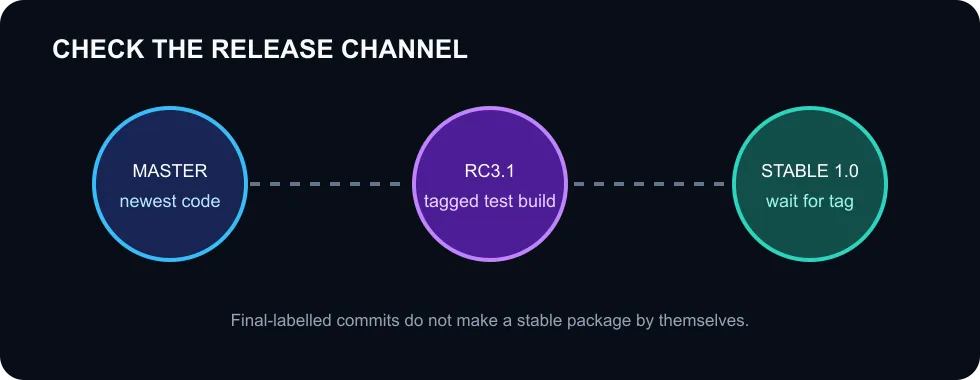
The master branch is where recent accepted development appears. It can contain code intended for the next release before maintainers create a stable tag. A release candidate is a packaged test milestone that is closer to release but can still expose bugs or compatibility changes. A stable tag is the point ordinary users should look for when they do not want to test unfinished packaging.
At capture time, the OpenRGB tags page listed 1.0rc3.1 dated 23 August 2026. The master page showed a much newer commit labelled as a translation update for 1.0 final. Those facts can both be true: code can be in finalisation while the public stable package is still pending.
Safe update checklist
Before changing an RGB control stack, record the current working version and export any profiles the software supports. Close vendor lighting utilities that could compete for the same controller. Check the project's supported-device list for the exact hardware revision, not only the product family name.
Development builds are best kept for users who can diagnose service conflicts, collect logs and revert. A lighting utility can communicate with low-level buses and embedded controllers, so an untested build is not a cosmetic risk only. If the current setup works, waiting for a stable package is a reasonable choice.
Local builders can compare case fans, case lighting and case accessories. Hardware compatibility still comes before software preference.
Frequently Asked Questions
Is OpenRGB 1.0 stable now?
Not in the captured official tags. The newest tagged package remained 1.0rc3.1.
What does final code mean?
It means repository changes are being labelled for the final milestone; it does not replace an official stable tag.
Should I uninstall working RGB software today?
No. Wait for a stable package and verify support for the exact controllers in your PC.
Review current RGB hardware by controller compatibility before rebuilding a lighting setup.
Follow the tag, not the headline. Stable users should wait for the project's official 1.0 package.