Quick Answer
Yes. An enhanced CPU contact area with a high-density microfin or jet impingement structure measurably improves cooling versus a plain channel cold plate. Under sustained all-core load on a Ryzen 9 9950X or Core i9-14900K, a premium cold plate design reduces CPU junction temperatures by 5 to 12 degrees Celsius compared to a basic cold plate in an equivalent-sized AIO.
How an Enhanced Contact Area Works 🔬
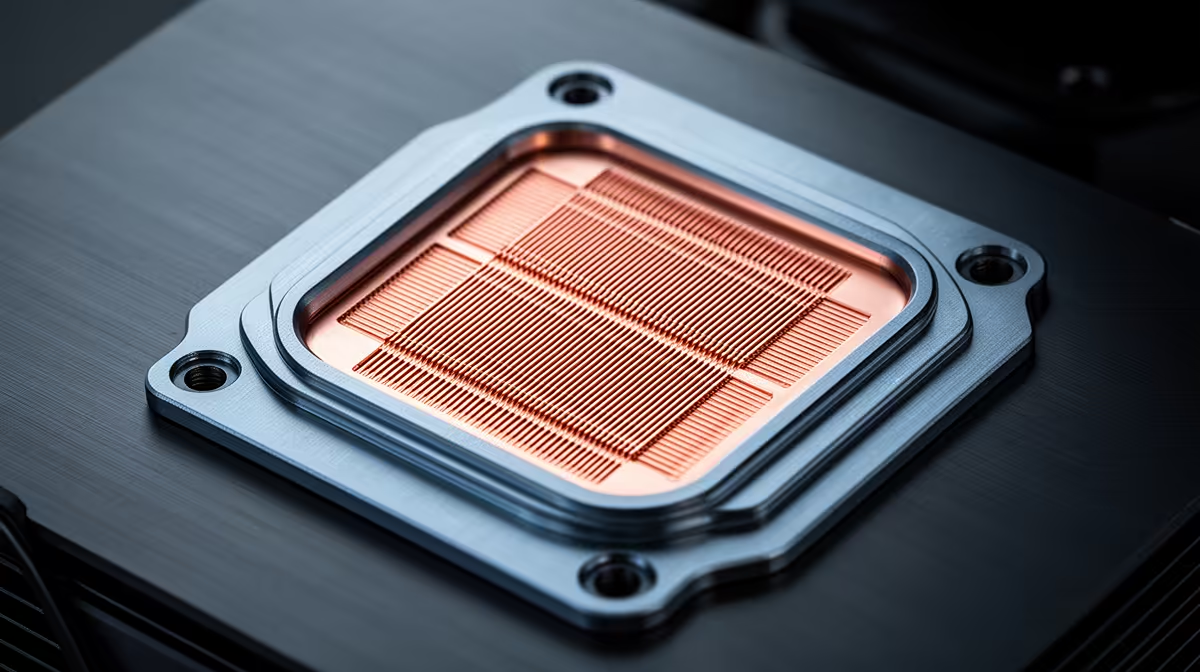
Standard cold plates channel coolant through a few wide passages across the copper contact surface. Enhanced cold plates replace these with dozens to hundreds of narrow microfins, creating a far larger wetted copper surface in contact with coolant at any moment, extracting more heat per litre of flow.
Asetek's jet impingement design, found in premium AIOs, shoots coolant directly at the hottest area of the CPU die footprint before it spreads outward through radial channels. This creates a higher convection coefficient at the die centre where heat density is greatest, resulting in lower hot-spot temperatures under the high-density chiplet layouts of modern Ryzen 9000-series processors.
Real-World Temperature Differences 🌡️
In comparative testing between a plain-channel 360mm AIO at R2,200 and a microfin 360mm AIO at R3,500, the temperature delta under Cinebench R23 multi-core on a Ryzen 9 9900X at 200W all-core is typically 7 to 10 degrees Celsius. On a Core i9-14900K at 253W, the delta can reach 10 to 14 degrees Celsius because higher heat loads amplify the advantage of a denser contact surface.
For South African builders in Durban or Pretoria where summer ambient temperatures reach 28 to 34 degrees Celsius, this 7 to 14 degree improvement is the difference between sustained boost clocks and intermittent throttling on the hottest days of the year.
Contact Pressure and Surface Flatness 🖥️
Enhanced cold plates only deliver their full benefit when making uniform contact with the CPU IHS. Any tilt or uneven pressure creates micro-gaps that act as insulation. Quality AIOs address this with precision-machined copper bases and spring-loaded mounting screws applying consistent force across all four corners.
If you install a premium cold plate AIO and still see higher-than-expected temperatures, check mounting hardware first. Loose or unevenly tightened screws are the most common cause of poor results, not cold plate geometry itself. Re-seating with correct torque and fresh thermal paste often recovers 5 to 8 degrees Celsius immediately.
Use Cross-Pattern Tightening for Even Cold Plate Pressure ⚡
When mounting an AIO cold plate, tighten the four mounting screws in a cross pattern (opposite corners alternately) rather than in sequence around the block. This ensures even pressure across the IHS and prevents the cold plate from rocking onto one edge, which leaves a temperature-inducing micro-gap on the opposite side.
FAQ
Do all 360mm AIOs have enhanced cold plates?
No. Budget 360mm AIOs in the R1,800 to R2,300 range typically use standard channel cold plates. Enhanced microfin or jet impingement cold plates are more common in mid-range and premium models above R2,800.
How do I identify whether an AIO has an enhanced cold plate?
Look for terms like microfin, high-density copper base, jet impingement, or enhanced contact area in the product description. If the specification does not mention cold plate design, the AIO likely uses a standard channel design.
Does cold plate material matter (copper vs aluminium)?
Yes significantly. Copper has roughly double the thermal conductivity of aluminium at approximately 400 W/mK versus 205 W/mK. All quality AIO cold plates use copper for the contact base. Aluminium cold plates exist in ultra-budget units and should be avoided for high-TDP builds.
Building a high-TDP system that needs every degree of cooling headroom? Browse Evetech's range of AIO coolers including premium models with enhanced copper cold plate designs for AMD AM5 and Intel LGA 1851 platforms.