Quick Answer
Yes, a redesigned CPU contact area (the cold plate base that touches the CPU integrated heat spreader) makes a measurable real-world difference. Improved contact plate designs can reduce CPU temperatures by 3 to 8 degrees compared to flat copper bases, particularly on chips with off-centre heat sources like the AMD Ryzen 7000 and 9000 series.
What the Contact Area Geometry Changes 🔧
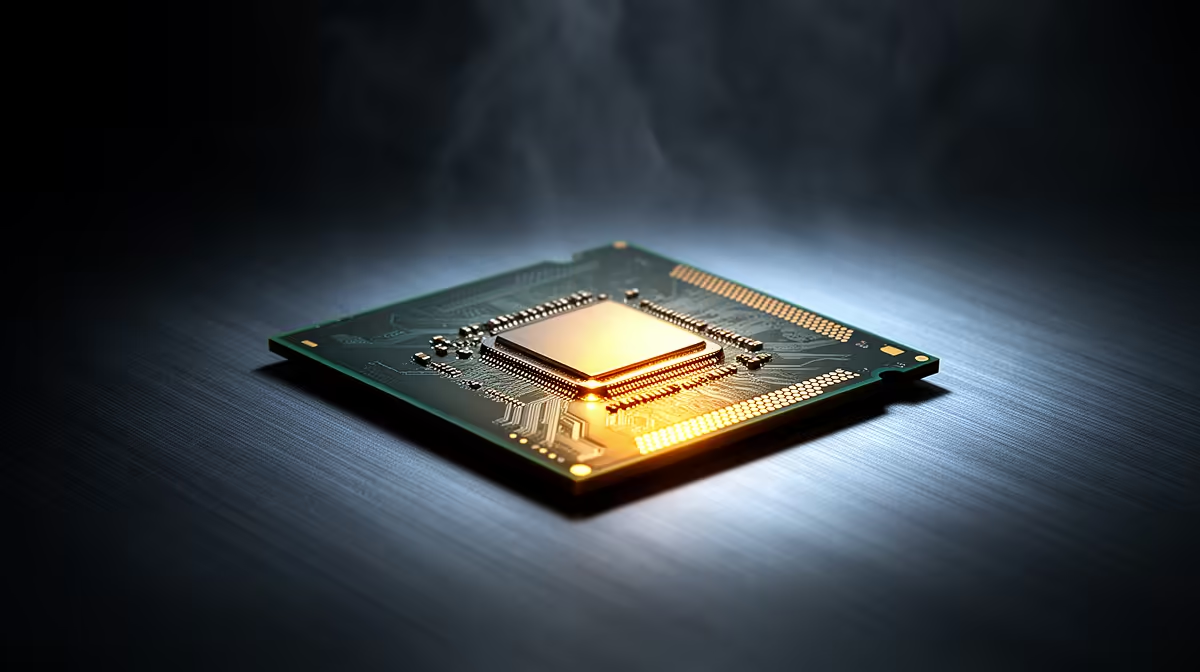
Traditional AIO cold plates use a flat copper or nickel-plated copper base that contacts the CPU's integrated heat spreader (IHS) uniformly. Modern CPUs like AMD's AM5 Ryzen chips have asymmetric heat distribution: the compute chiplet (CCD) is positioned to one side of the IHS, not centred. A flat cold plate distributes coolant contact evenly across the IHS surface, which means the area directly above the CCD does not receive proportionally more cooling attention. The result is 3 to 8 degrees lower peak temperature at the CCD, which directly extends time-at-boost frequency.
How Much of a Difference Is 3 to 8 Degrees? 🌡️
On a Ryzen 9 9950X with a Tj Max of 95 degrees, a 6-degree improvement through a better cold plate moves sustained gaming temps from 88 to 82 degrees. For Intel LGA 1851 chips, the IHS geometry is different and hot spot offset is less pronounced, so the advantage of a specialised contact area is smaller (typically 2 to 4 degrees) but still meaningful at high TDPs.
Cold Plate Material and Finish Quality 🖥️
Beyond geometry, the contact plate's material and surface finish affect thermal performance. Pure copper cold plates outperform aluminium ones (copper has roughly 60 percent higher thermal conductivity than aluminium). Nickel plating on copper protects against corrosion from coolant contact while minimally reducing thermal transfer. Micro-fin or micro-channel copper cold plates increase the internal surface area in contact with coolant, improving heat extraction rate even at the same coolant flow rate. Premium AIOs in the R3,000 to R4,500 range typically use the higher-quality cold plate designs.
Cold Plate Cleanliness Matters at Installation ⚡
Before installing your AIO, inspect the cold plate surface for oil contamination from fingerprints or factory residue. Even a thin oil film significantly degrades thermal paste bonding and can add 5 to 10 degrees to operating temperatures. Clean the cold plate with isopropyl alcohol on a lint-free cloth before applying thermal paste and seating the cooler.
FAQ
Does the contact area difference matter more for AMD or Intel CPUs?
It matters more for AMD AM5 chips due to the off-centre CCD heat source. Intel's IHS geometry distributes heat more evenly across the surface, reducing the advantage of asymmetric cold plate designs. For Intel chips, cold plate material quality and micro-channel density are more relevant than contact pattern asymmetry.
Can I improve contact area performance without buying a new cooler?
Partially. Using a higher-quality thermal paste with better conductivity (Thermal Grizzly Kryonaut or Conductonaut Extreme for extreme builds) and ensuring optimal mounting pressure through correct screw torque sequence improves the bond between IHS and cold plate. These steps recover some performance from an existing flat cold plate design.
Are cold plate upgrades available separately for existing AIOs?
A few brands sell upgraded cold plates as accessories, but this is not common for most AIO units. The cold plate is typically integrated into the pump head assembly. If your CPU is consistently running hotter than expected with a well-mounted AIO, upgrading to a premium unit with a better cold plate design is more practical than attempting a cold plate swap.
Want a cooler with a cold plate designed for your specific CPU socket? Browse Evetech's AIO cooler range and find units with advanced cold plate designs optimised for AM5 and LGA 1851 performance.