The phrase Minecraft frame generation now describes two ideas that are easy to confuse. Official Minecraft with RTX material discusses DLSS upscaling for the Bedrock edition. A current third-party FrameGen mod for Java uses a separate interpolation approach through Fabric. They are not the same feature, support path or installation.
Quick Answer
There is no single frame-generation switch that works across every Minecraft edition. The current CurseForge FrameGen release lists Minecraft Java 1.21.1 and Fabric, while official Minecraft RTX and DLSS support belongs to the Bedrock rendering path on compatible NVIDIA hardware. Back up the world, identify the edition and version, align the loader and mod, and establish a stable base frame rate before trying generated frames.
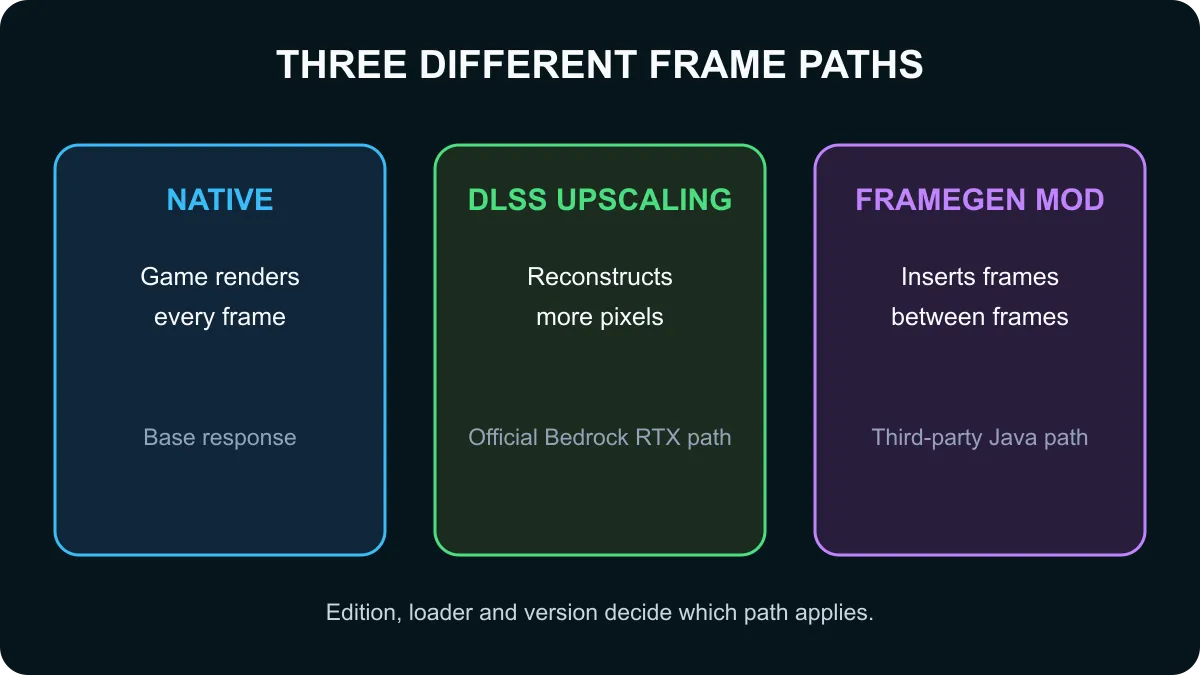
Three rendering ideas, not one
Native rendering creates each displayed frame from the game's normal graphics pipeline. Lowering render distance, reducing heavy shaders and controlling simulation load can improve that base result. This remains the most important layer because input response and frame-time stability begin with genuinely rendered frames.
DLSS upscaling renders fewer pixels and reconstructs a higher-resolution output. NVIDIA's Minecraft RTX material describes DLSS as part of the Bedrock path-tracing experience. Upscaling can reduce GPU load, but it does not insert a new frame between two completed game frames.
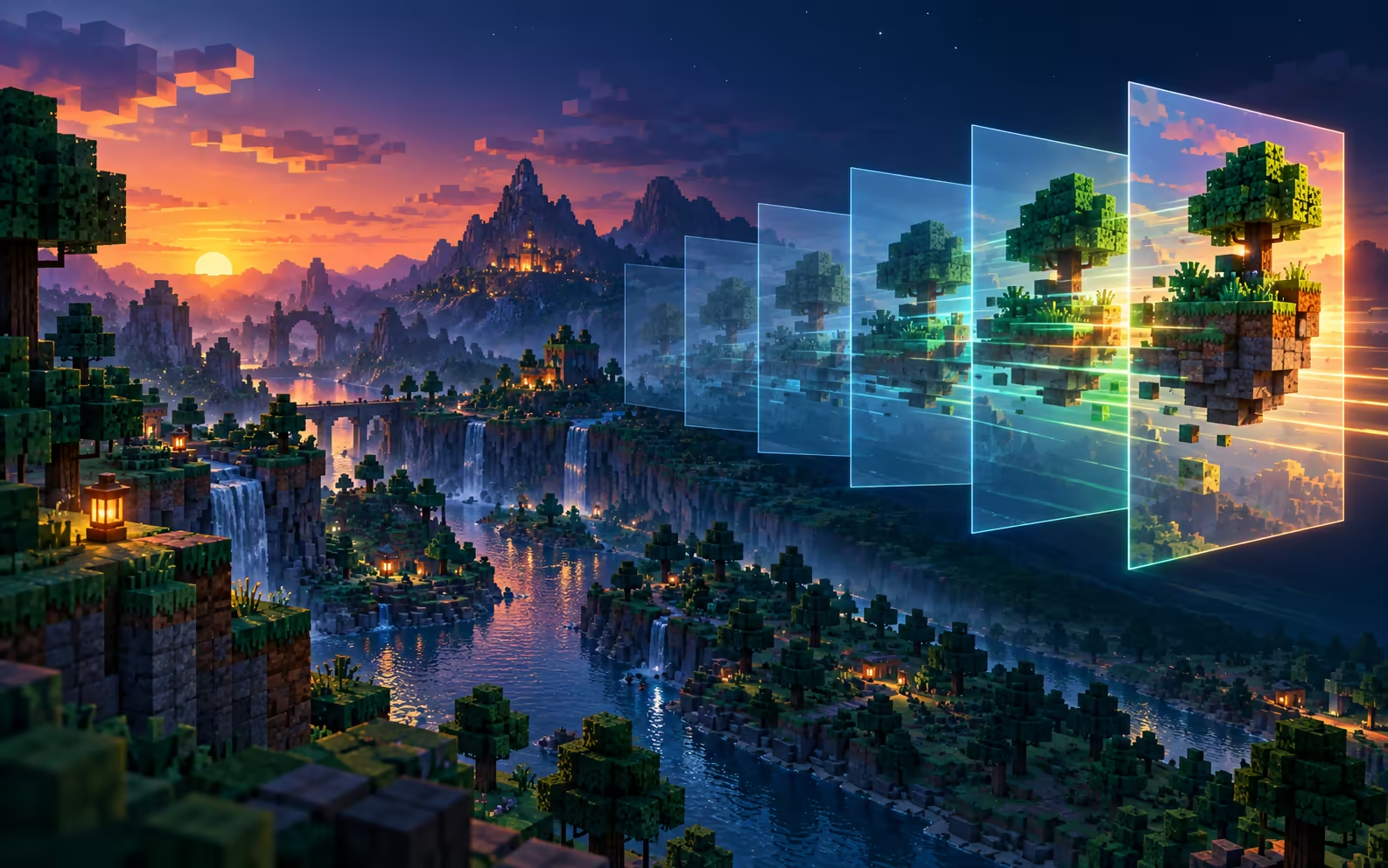
Frame generation uses motion information or interpolation to create additional displayed frames. The third-party FrameGen project describes an OpenGL path and currently lists a Fabric build for Java 1.21.1. Its page also distinguishes this from native NVIDIA DLSS Frame Generation, which has different hardware support.
Check the edition before the GPU
Open the launcher and confirm whether the world runs in Java or Bedrock. Java mod instructions do not apply to a Bedrock RTX world, and Bedrock graphics settings do not install a Fabric mod. The edition determines the rest of the path.
For Java, record the exact Minecraft version and loader. A mod built for Fabric 1.21.1 should not be assumed to work on Forge, NeoForge or a different game release. Keep the mod in its own test instance first. Back up the world and configuration before changing the working installation.
For Bedrock with RTX, use the supported game and driver path described by NVIDIA and Microsoft. DLSS availability depends on compatible hardware and the RTX rendering mode. Do not download unrelated DLL replacements or files from untrusted mirrors just because they promise more frames.
Why the base frame rate still matters
Generated frames can make motion look smoother, but they do not create new input samples from the game. If the base frame rate is low or erratic, controls can still feel delayed and visual errors become more obvious. Improve the native path first: trim excessive render distance, test without the heaviest shader pack, close background loads and check CPU temperatures.
Use a repeatable scene when comparing changes. Stand in the same location, follow the same camera movement and watch both average rate and frame-time consistency. A larger displayed number is not an upgrade when pacing, input response or image stability becomes worse.
South African buyers planning a new system can compare Minecraft gaming PCs, Minecraft gaming laptops and current RTX 5060 cards. The right budget depends on edition, shaders, resolution and target refresh rate, not the Minecraft name alone.
A safe test plan
Create a backup, duplicate the game instance, install only the loader and mod versions named by the project, and test without other graphics mods. Then add one component at a time. If crashes or corrupt visuals appear, remove the last change rather than stacking fixes from unrelated versions.
Frequently Asked Questions
Does Minecraft officially support frame generation?
The captured official RTX material describes DLSS upscaling, while the current frame-generation route covered here is a third-party Fabric mod.
Which Minecraft version does the mod list?
The current CurseForge release lists Minecraft Java 1.21.1 with the Fabric loader.
Does the mod require an RTX 40-series card?
The mod describes its own OpenGL interpolation path, while native NVIDIA DLSS Frame Generation is normally an RTX 40-series-or-newer feature.
Is frame generation the same as DLSS upscaling?
No. Upscaling reconstructs a higher-resolution image from fewer rendered pixels; frame generation inserts frames between normally rendered frames.
Will frame generation fix a very low base frame rate?
No. Low base performance increases input latency and visual errors, so optimise render distance, shaders and CPU load first.
What should I back up before installing a mod?
Back up the world and instance, then keep the mod, loader and Minecraft version aligned so you can remove the change cleanly.
Compare systems only after defining your edition, shader pack, resolution and target refresh rate.
Identify the render path before installing a performance tool. Edition, version, loader and base frame rate decide whether the change fits.