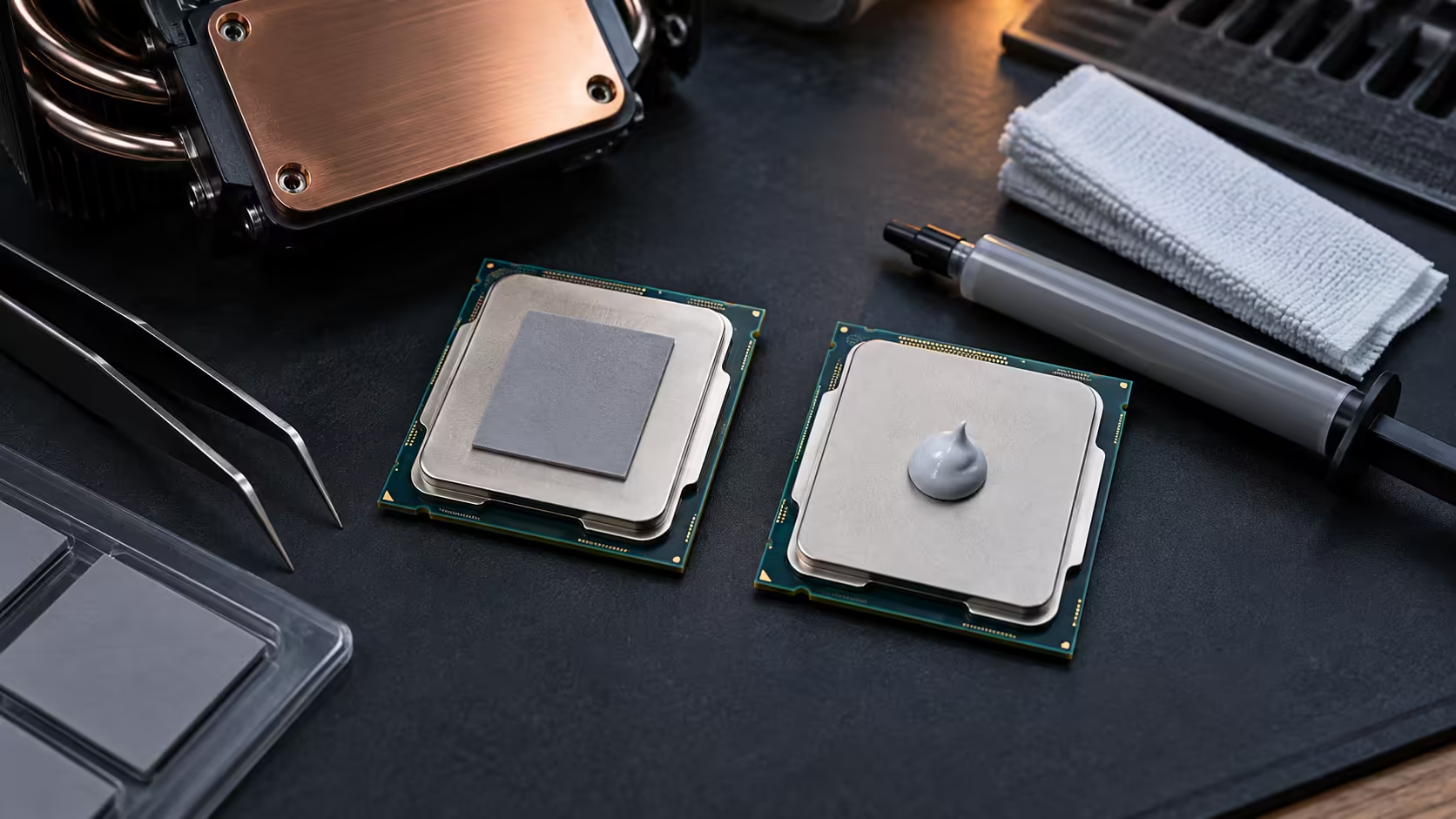
The PTM7950 vs thermal paste choice is not a simple contest for the lowest temperature. PTM7950 is a phase-change thermal interface material that softens as it warms, while conventional paste is applied as a viscous compound and is widely used on desktop processors. The correct material depends on the device, contact pressure and service plan.
Quick Answer
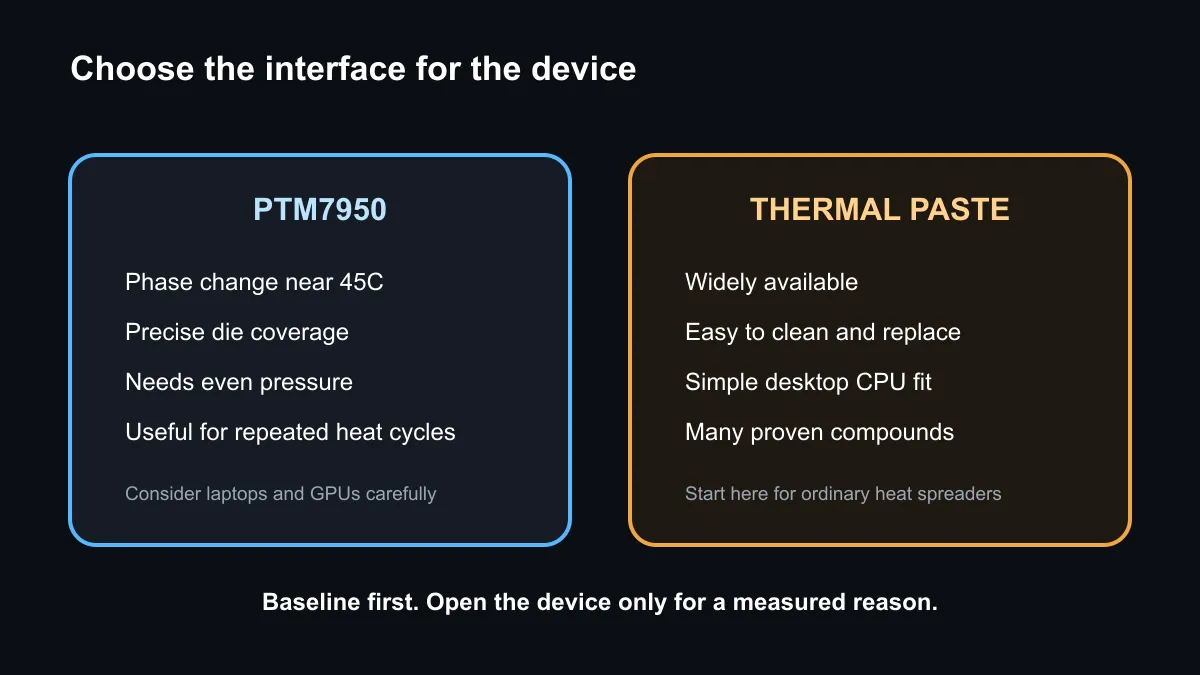
PTM7950 is attractive for compact devices and direct-die cooling where repeated thermal cycles can challenge ordinary paste. Honeywell lists a 45C phase-change temperature and supplies the material in pad and paste formats. Conventional thermal paste remains easier to buy, apply and replace on many desktop CPUs with heat spreaders. Neither option guarantees a particular temperature improvement in every machine.
How PTM7950 works
A thermal interface fills microscopic gaps between the chip or heat spreader and the cooler. Air trapped in those gaps resists heat flow. Honeywell describes its phase-change material as a polymer and filler system that softens during normal operating temperatures, wets the mating surfaces and reduces contact resistance.
The technical sheet lists a phase change at 45C. That does not mean the processor should run at 45C. It means the interface changes physical behaviour as the assembly warms. Several heat cycles may be needed before a new installation settles, and the final result depends on even coverage and mounting pressure.
PTM7950 pads can be easier to control on a bare rectangular die because the cut piece defines the covered area. They can also be awkward to handle when warm or stretched. Cooling the sheet slightly before removing its protective film can make placement easier, but avoid moisture and follow the device's service procedure.
Where conventional paste remains simpler
Desktop CPUs with integrated heat spreaders and conventional tower or liquid coolers are designed around paste. A small central amount spreads under cooler pressure, and replacement paste is widely available. It is easy to clean and reapply during a cooler change.
Paste quality and viscosity vary, but installation errors usually matter more than tiny catalogue differences. Too little can leave gaps; too much creates mess without improving heat transfer. Uneven cooler pressure, protective film left on the cold plate and a poorly seated pump can overwhelm any material advantage.
If a desktop system already has safe temperatures and stable boost behaviour, replacing a sound paste application with PTM7950 may add service risk without a useful outcome. Establish a baseline under the same room temperature and workload before opening the device.
Laptops, GPUs and warranty risk
Laptops and graphics cards often place the cooler directly on a bare die and may experience repeated thermal cycling. A phase-change interface can be a useful option in those conditions, but disassembly is more delicate. Thermal pads around memory and power components have specific thicknesses; disturbing or replacing them incorrectly can make contact worse.
Check warranty terms, obtain the correct tools and record the original pad locations before work. Authenticity also matters because products sold under a familiar material name may not match the original technical sheet. Buy through a traceable source and avoid judging authenticity from colour or thickness alone.
The captured Evetech catalogue included conventional Deepcool Z3 paste at R69, Deepcool Z5 at R99, Deepcool EX750 at R169 and OCPC Ice TG-4 at R199. These were active local options at capture time, not benchmark rankings.
Browse thermal paste and pads, CPU coolers and the broader cooler range.
Frequently Asked Questions
Is PTM7950 a normal thermal pad?
No. It is a thin phase-change interface material, not a gap-filling pad for memory or power components.
Is it always cooler than paste?
No. Contact pressure, surfaces, cooler design and installation determine the result.
Should I replace a stable paste application?
Only when there is a measured thermal problem or a defined service reason that justifies opening the device.
Compare the current thermal compounds, then choose the material that fits the hardware and service risk.
Solve a measured thermal problem. Choose PTM7950 or paste for the device, not for a universal temperature promise.