The G.Skill Trident Z5 Royal NeoX range brings a premium mirrored design to AMD-focused DDR5-6000 kits, with primary timings from CL36 down to CL26. The more interesting technical change is EXPO ULL, which adds tuned secondary timings to the familiar one-click memory profile.
Quick Answer
Trident Z5 Royal NeoX is a new DDR5-6000 range for supported AMD platforms. G.Skill lists CL36, CL30, CL28 and CL26 options and says its EXPO ULL profiles tune more than the headline frequency and CAS number. The lowest-latency kit is not guaranteed on every system: processor memory controllers, motherboard layouts and BIOS versions differ. Buy the capacity you need first, then verify the exact kit on the motherboard support list before paying for tighter timings.
What EXPO ULL is trying to change
AMD EXPO profiles store tested memory settings so a supported motherboard can apply them without manual entry. A normal product label highlights data rate and primary timings because those are easy to compare. Secondary timings also affect how quickly a memory operation moves through its sequence, but they are harder to summarise in a shop listing.
G.Skill says EXPO ULL adds tuned subtimings for supported processors and boards. That can improve effective latency without raising the DDR5-6000 data rate. It remains an overclocking profile, so stability depends on the complete platform and not only the memory module.
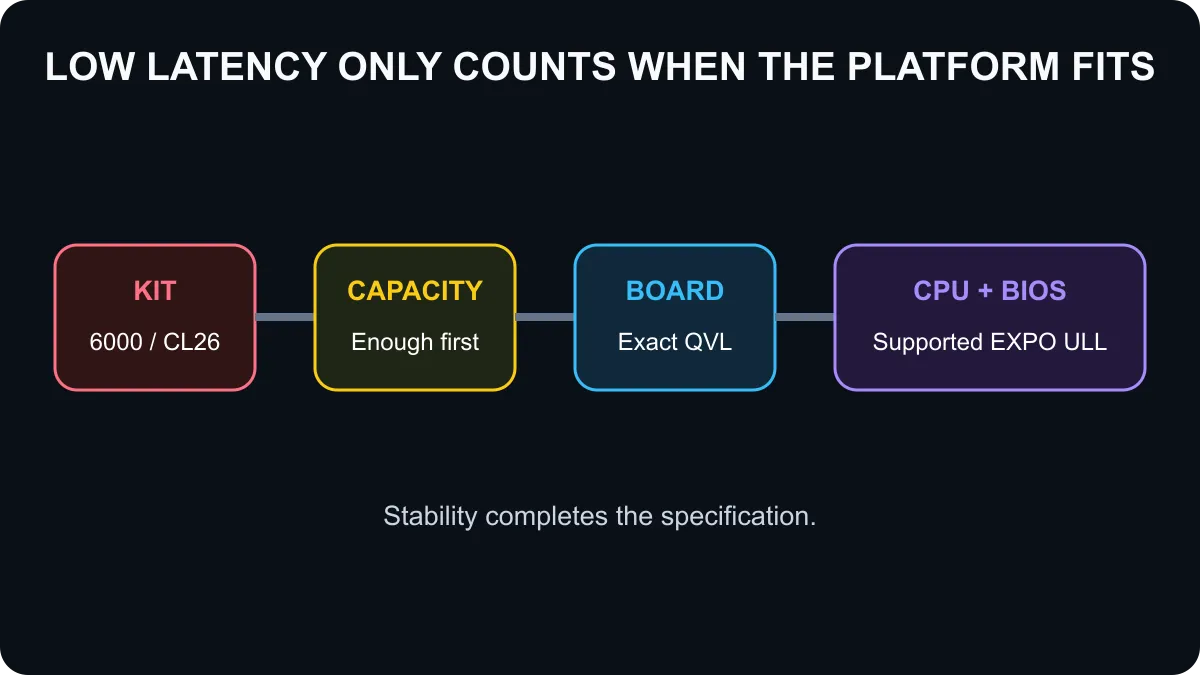
The CL number is only one part of latency. CL26 at DDR5-6000 is tighter than CL36 at the same data rate, but capacity and channel layout may have a larger effect on a real workload. A game that is running out of memory will not be rescued by a lower CAS figure. A 32GB or 64GB requirement should be settled before chasing the final timing step.
Compatibility before cosmetics
Start with the motherboard's qualified memory list and the exact part number, not only the Royal NeoX family name. Confirm the supported capacity, number of modules and BIOS revision. Two modules are generally easier on a desktop memory controller than four at the same high data rate.
The processor matters too. G.Skill explicitly ties ULL availability to supported AMD CPUs, motherboards and BIOS versions. If a kit boots only at its safe default, update the BIOS according to the board maker's instructions and test the EXPO profile. Do not mix separate kits and assume matching labels create one validated set.
The mirrored heatspreader is the visible selling point, but check cooler clearance and fingerprints in an open-display build. Appearance should not outrank capacity, stability or price.
Current South African DDR5 context
The exact Royal NeoX line did not appear in the live product-name search at capture time. The active DDR5 category started at R2,999 for a 16GB Corsair DDR5-5600 module. A 16GB KingSpec DDR5-6000 listing appeared at R4,099, and a 16GB ADATA DDR5-6000 CL36 module appeared at R4,699. These are category anchors, not like-for-like Royal NeoX alternatives.
Use the DDR5 memory category, memory best sellers and DDR5 upgrade kits to compare live choices. Recheck price, stock and specifications at purchase time.
Who should consider a low-latency kit?
It makes the most sense for a new, high-end AMD build where the required capacity is already funded and the motherboard has explicit support. It can also appeal to enthusiasts who are willing to validate memory stability with extended tests.
For a value build, spend first on enough memory, the right graphics card and a balanced processor. A premium heatspreader and a few timing steps are finishing choices, not substitutes for adequate capacity.
Frequently Asked Questions
What is Trident Z5 Royal NeoX?
It is G.Skill's new AMD-focused premium DDR5 range with mirrored heatspreaders and EXPO profiles.
What timings are announced?
G.Skill lists DDR5-6000 kits from CL36 down to CL26, with exact availability depending on the kit.
What does EXPO ULL change?
The ULL profile tunes secondary subtimings in addition to the main speed and primary latency settings.
Will CL26 work on every AMD PC?
No. G.Skill says support depends on the processor, motherboard and BIOS, so the memory list and firmware matter.
Is lower CAS latency always the best upgrade?
No. Required capacity, stability, dual-channel layout and total price can matter more than a small timing reduction.
What did local DDR5 cost in the captured sample?
The active in-stock DDR5 category started at R2,999 for a 16GB 5600MHz module, while 6000MHz listings began at R4,099.
Compare current DDR5 memory by capacity and exact part number before enabling an EXPO profile.
Buy enough stable memory before buying the lowest timing. Verify the exact kit, board, processor and BIOS together.