Holding out for Windows 12 before you upgrade sounds prudent until you check the calendar. Windows 10 stopped getting free security updates on 14 October 2025, and as of mid-2026 Microsoft has not announced Windows 12 at all, let alone a release date. Microsoft has in fact publicly said its next big announcement is not a new OS version. So the choice is not really Windows 11 now versus Windows 12 soon. It is a supported OS now versus an unpatched one for an unknown wait.
Quick Answer
Do not wait for Windows 12. There is no confirmed release date, with most analysts now pencilling in late 2026 to 2027 at the earliest, while Windows 10 already runs without free security patches. If your PC meets the requirements, upgrading to Windows 11 today is the safer, cheaper call. Waiting only makes sense if you have paid for Extended Security Updates and have a concrete reason to delay.
What actually changed in October 2025
Windows 10 reached end of support on 14 October 2025. Your machine still boots and your software still runs, but Microsoft no longer ships free security updates for it. Every new vulnerability discovered after that date stays open on a stock Windows 10 install, and that risk compounds the longer you stay put. Microsoft's own guidance is to move to Windows 11 if the hardware qualifies, or to enrol in the paid Extended Security Updates programme, which buys patches until around October 2026 as a bridge, not a permanent home.
The Windows 12 reality check
There is no Windows 12. Microsoft has not confirmed the product or a launch window, and in mid-2026 it clarified that its upcoming announcements do not include a new OS version. Industry watchers now lean toward 2027 as the more realistic timeframe if it appears at all in that form. Even when a new release does land, history says the smart move is to wait a few months for the first round of fixes before jumping on, which pushes any practical Windows 12 daily-driver date further out still. Betting your security on that timeline while running an unpatched OS is the weak position.
The practical move right now
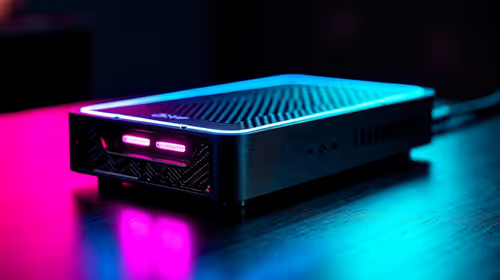
If your current PC meets the Windows 11 requirements, upgrade it and you are done. If it does not, that usually comes down to the TPM and CPU-generation checks, and it is worth confirming before assuming you need new hardware. For machines that genuinely cannot make the cut, a compact, modern replacement is often cheaper and quieter than people expect, and the mini PC range at Evetech is a tidy way to land on Windows 11 without a tower taking over the desk. For a full-size rebuild, the systems topping the PC best sellers already ship ready for Windows 11.
Frequently Asked Questions
Is it dangerous to keep using Windows 10 now?
It is risky for any internet-connected machine, because new security flaws found after October 2025 no longer get free patches. The longer you run it unprotected, the more unpatched vulnerabilities stack up.
When will Windows 12 actually launch?
Microsoft has not announced it or any date, and has signalled its next big reveal is not a new OS. Most estimates now point to 2027 at the earliest, which makes it a poor reason to delay a security upgrade.
My PC fails the Windows 11 check, what now?
First confirm it is genuinely incompatible, since the TPM and CPU requirements catch machines that can sometimes be enabled in firmware. If it truly cannot upgrade, a modern replacement that ships with Windows 11 is the clean fix.
What is Extended Security Updates and should I pay for it?
ESU is Microsoft's paid programme that extends Windows 10 security patches for about a year past end of support. It is a short bridge for people who cannot upgrade immediately, not a substitute for moving to a supported OS.
Stuck on Windows 10 and weighing your options? See whether a compact, Windows 11-ready machine from the mini PC range at Evetech fits your space and budget, and get back on a supported, patched system.