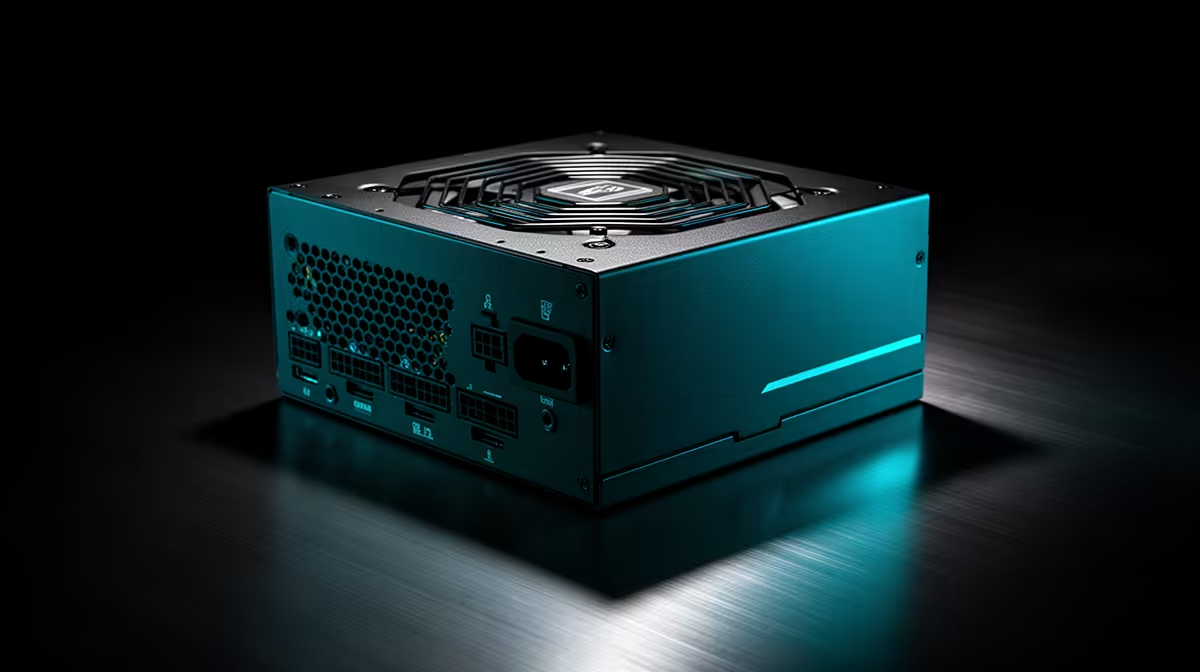
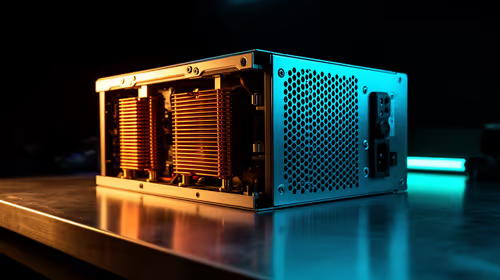
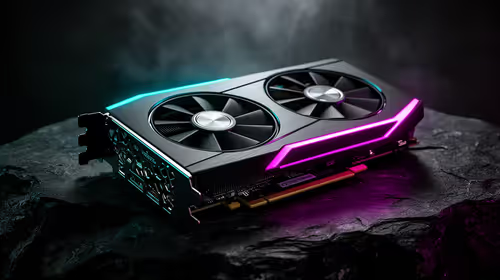
A quality 1000W power supply is the sensible baseline for most RTX 5090 gaming PCs. NVIDIA rates the card itself at 575W, while its RTX 5090 specification calls for 1000W at system level. The Founders Edition installation page also shows 850W minimum and warns that a system configuration may demand more. For a new flagship build, 1000W avoids living at that lower edge.
Quick Answer
Choose a well-tested ATX 3.1 1000W unit with a native cable rated for the exact RTX 5090 connector and enough CPU power connections for the motherboard. Verify the add-in-board maker's requirement because factory-overclocked models can differ. Move above 1000W for a high-power workstation CPU, raised limits or several demanding expansion devices. Do not put an RTX 5090 on an old unknown 1000W unit by label alone.
Why NVIDIA's pages appear to disagree
The RTX 5090 product specification states 575W total graphics power and 1000W required system power. NVIDIA's Founders Edition preparation page shows 850W minimum, with a note that the system configuration can require more.
Those figures are not interchangeable promises. The installation page describes a minimum Founders Edition path under its assumptions. The product table provides the broader required-system recommendation. A partner card has its own power limit and PSU guidance.
For a fresh flagship gaming build, 1000W is the cleaner planning point. It gives the 575W GPU room beside a modern CPU without depending on the most favourable interpretation of the minimum.
Open the RTX 5090 range and identify the exact board. Confirm its total board power, connector, physical clearance and PSU recommendation.
The 575W GPU changes system balance
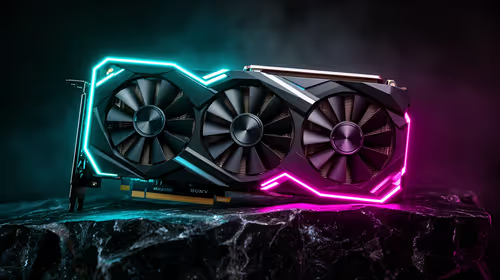
At 575W, the reference GPU can consume more than half of a 1000W nameplate before the processor and platform are counted. A gaming CPU may draw far less than a workstation flagship, yet combined stress, transient behaviour and cooling still need room.
Model the CPU from sustained real tests, not only its base-power number. Raised motherboard limits can let a flagship processor draw much more. Add pumps, fans, drives, capture devices and USB load.
The PSU must deliver the required output on its 12V design and stay within temperature and transient limits. A new 1000W platform designed for modern high-power GPUs is a different proposition from an older multi-rail unit with adaptors and aged capacitors.
ATX 3.1 and the cable path
ATX 3.1 power supplies are designed around current power-excursion and connector requirements, though exact implementation and product testing still matter. A native 12V-2x6-style cable can remove the bulky multi-8-pin adaptor when both PSU and card support it.
NVIDIA's product specification lists a 600W PCIe Gen 5 cable option for the reference RTX 5090, or the specified 8-pin adaptor path. Partner models may set their own requirement.
Use only the cable supplied or approved for the exact PSU. Modular pinouts are not universal. Do not move a cable from an older model because the connectors look the same.
Insert the plug until the latch engages and no visible gap remains. Provide the maker's required bend clearance and keep the side panel from pressing the cable sideways.
What a quality 1000W unit needs
Independent electrical testing should show regulation, ripple control, protection behaviour, transient response and thermal operation. Efficiency certification is useful but incomplete.
Check over-current and over-power protection on the relevant design, short-circuit protection and over-temperature behaviour. Read the warranty and support terms for South Africa.
Compare the Corsair PSU catalogue with the power-supply best sellers. Filter by capacity only as a first step. The exact model, platform and included cable decide suitability.
When 1200W or more is justified
A high-core-count workstation CPU rendering beside the GPU can make 1000W tight. Raised GPU limits, several add-in cards, many drives or a custom liquid-cooling system add load. The exact partner GPU may also call for more.
Build the power table and choose margin, rather than using 1200W as a prestige tier. A gaming-first system with a moderate-power CPU can remain well served by quality 1000W.
Acoustics can influence the step. A larger PSU may run at a lower load share, but fan curve and platform efficiency determine noise. Check measured results at the expected wattage.
850W can be a narrow exception, not the default
The Founders Edition page's 850W minimum explains why some carefully controlled builds can operate there. That path needs a suitable high-quality unit, lower-power CPU, default limits, approved cabling and full calculation.
It offers little margin for a buyer who still needs to ask which partner card or CPU is installed. The cost of the flagship GPU makes a new properly specified 1000W PSU the easier risk decision.
Do not transfer the 850W minimum to an overclocked partner board. Follow the board maker.
Cooling and cable space
An RTX 5090 releases enough heat to raise case and PSU intake temperature. Use a case with clear intake and exhaust. Keep the PSU drawing cool air in the orientation supported by the chassis.
Check card length, thickness and room for the high-power cable. NVIDIA's reference installation guidance includes additional cable clearance beyond card width. Partner coolers can be larger.
Do not force the side panel closed. Change the case or cable routing rather than bending at the plug.
Installation discipline
Disconnect mains power and follow the graphics-card, PSU and motherboard manuals. Use the number of cable runs specified for an adaptor. Avoid daisy-chained leads where separate cables are required.
Support the heavy card with an appropriate bracket. Make sure the bracket does not obstruct fans or short motherboard contacts. Recheck the connector after transport with the system disconnected.
Never open the PSU. Stop using any connector that shows heat damage, discolouration, melting or an electrical smell and follow the proper support process.
Verify under sustained load
Run the games and creator workloads the PC will use. Monitor GPU board power, CPU power, temperature, clock and fan behaviour. A combined stress test can expose a margin issue but may exceed normal game use.
An unexpected shutdown is not proof that 1000W is insufficient. Restore default CPU, GPU and memory settings, inspect cabling and review temperature and event data. Faulty or poor-quality 1000W hardware cannot be repaired by its label.
Frequently Asked Questions
Is 1000W always enough for every RTX 5090?
No. It is the broad reference-system recommendation, while partner-card and high-power workstation configurations can require more.
Why does NVIDIA also mention 850W?
Its Founders Edition preparation page lists 850W minimum and says configuration can demand a higher rating. The product specification lists 1000W required system power.
Does ATX 3.1 guarantee a good PSU?
No. It addresses current design requirements, while exact electrical quality, protections, cable implementation and testing still matter.
Use a tested ATX 3.1 1000W PSU as the RTX 5090 baseline, then verify the exact card, CPU and 600W cable path before assembly.