Quick Answer
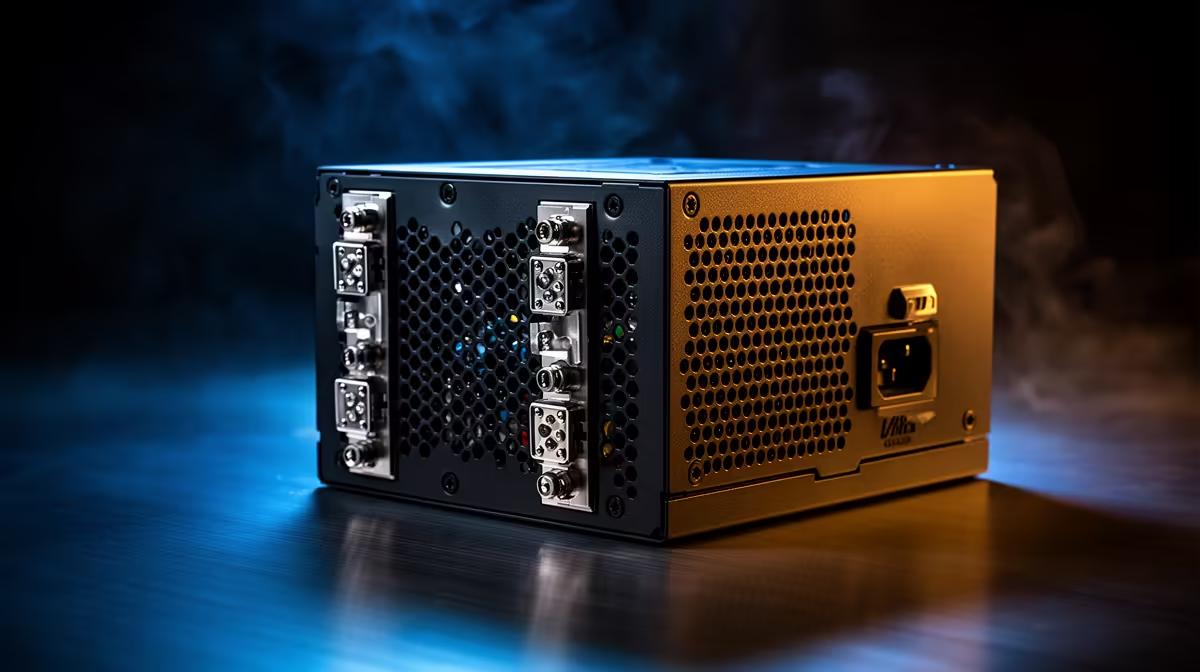
For most single-GPU builds using an RTX 5080 or below, a 1000W ATX 3.1 unit is sufficient. Choose 1200W specifically for RTX 5090 builds, dual-GPU workstations, or if you want one PSU to survive the next GPU generation without replacement.
Where 1000W Hits Its Limit 🔋
A 1000W ATX 3.1 unit covers the RTX 5080 (300W TDP) plus a Ryzen 9 9950X (170W TDP) with around 400W to spare for storage, fans, and efficiency losses. That margin is comfortable for gaming and light content creation. The situation changes with an RTX 5090. NVIDIA rates the card at 575W and recommends a 1000W minimum, but that leaves little room once you add a 200W-plus CPU and factor in transient spikes that briefly push the GPU 20% beyond rated TDP. Builders pairing the RTX 5090 with a Core Ultra 9 285K routinely see combined draw above 950W under load, meaning the 1000W unit runs near its ceiling continuously. That shortens component life.
The Case for 1200W in High-End SA Builds 💰
In South Africa, the price gap between a quality 1000W 80 Plus Gold ATX 3.1 unit and its 1200W equivalent sits at roughly R600 to R1,200 depending on brand and exchange-rate conditions. That premium buys an RTX 5090-capable system today, room for extra storage or fans, and the ability to hold the PSU across the next GPU upgrade. For a build already costing R40,000 or more, the incremental cost is minor insurance. Choose 1000W for RTX 5070 Ti or below; choose 1200W for RTX 5090 or intensive CPU-plus-GPU workloads.
Efficiency and Heat at High Loads ♨️
Both 1000W and 1200W PSUs are available in 80 Plus Gold and Platinum ratings. At 80% load, a Gold unit converts roughly 87% of input power to DC output. A 1000W Gold unit running a heavy RTX 5090 system near its ceiling operates less efficiently than a 1200W Gold unit running the same system at 80% capacity. The underloaded 1200W unit runs cooler, fans spin less aggressively, and it contributes less waste heat to the case. This matters in South African summer conditions where ambient temperatures in Gauteng regularly push 30°C or higher.
Use an Online PSU Calculator First ⚡
Run your planned component list through a PSU wattage calculator using the high-load scenario. Add 20% to that result as your target PSU wattage, then pick the available unit closest to that number. This is more accurate than matching PSU wattage to a GPU minimum recommendation alone.
FAQ
Will a 1200W PSU draw more electricity than a 1000W unit?
No. A PSU only draws what the system demands. A 1200W unit powering a 700W system pulls roughly 780W from the wall at Gold efficiency, identical to what a 1000W unit would draw for the same load.
Are 1200W PSUs physically larger than 1000W units?
Most ATX 3.1 1200W units use the standard 150mm ATX depth and fit any mid-tower or full-tower case without modification. Some high-wattage units extend to 160mm or 180mm depth, so always check PSU depth against your case's maximum clearance.
What should SA builders budget for a quality 1200W ATX 3.1 PSU?
Expect roughly R4,000 to R5,500 for a reputable 1200W 80 Plus Gold ATX 3.1 fully modular PSU locally. Platinum-rated equivalents add another R800 to R1,500 to that range.
Not sure whether 1000W or 1200W is right for your build?
Browse Evetech's full PSU range to compare wattages, efficiency ratings, and ATX standards side by side, with options stocked locally for immediate dispatch across South Africa.