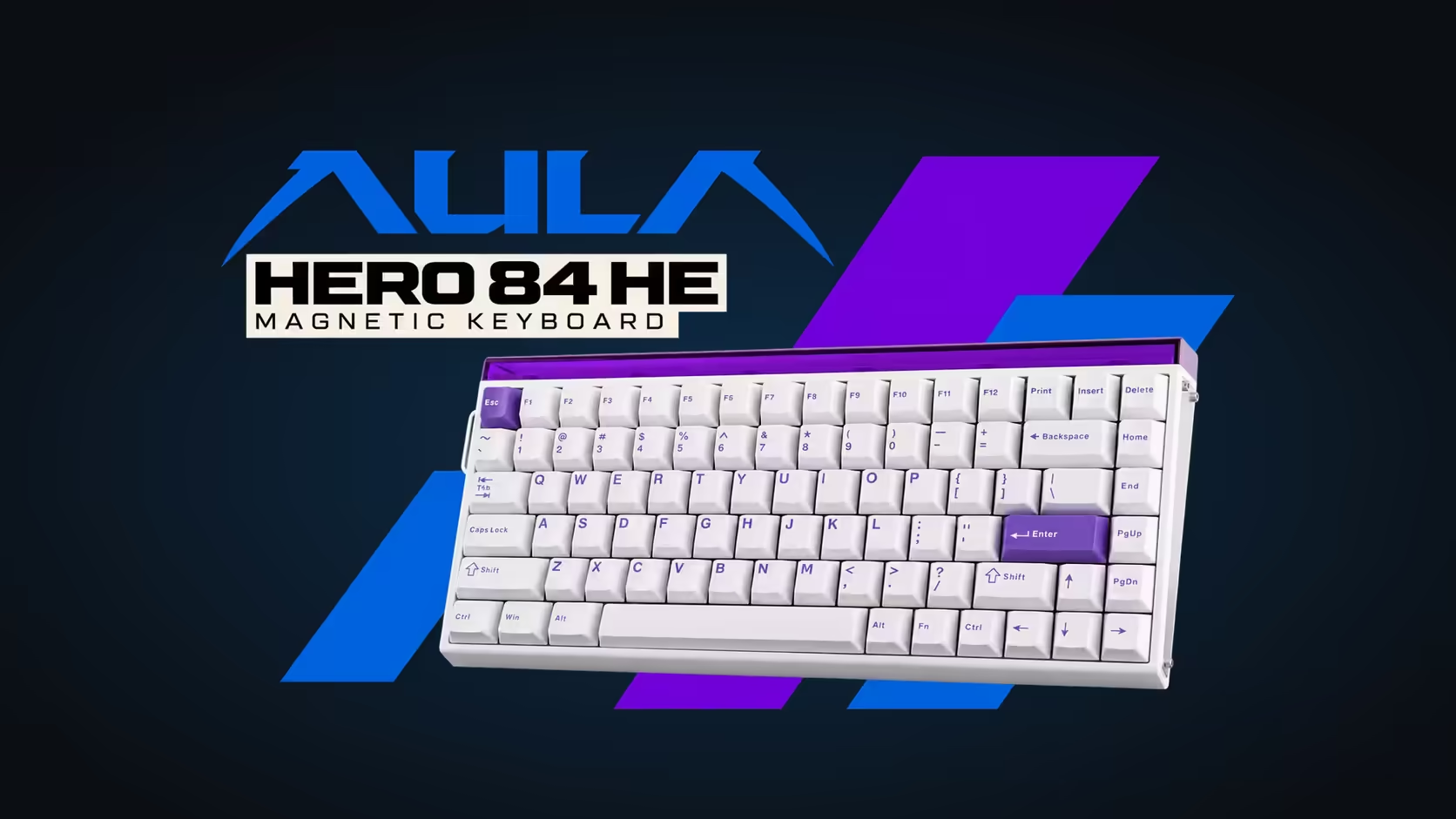
Two figures on the HERO 84 HE spec sheet end in "Hz", and it is tempting to read them as rival measures of the same speed. They are not. One tells you how often the keyboard checks its own switches, the other how often it hands news to your computer. Once you see key scanning versus polling rate as two stages of one relay, the 128kHz and 8000Hz numbers stop looking contradictory.
Quick Answer
On the AULA HERO 84 HE, 128kHz is the fastest rate at which the board can read a single key's sensor, and 48kHz is the rate when it reads all 84 keys. The 8000Hz figure is the polling rate: how many reports per second leave the board over its USB cable. The keyboard samples its keys many times between each report, so every report carries the freshest reading it has. Evetech sells the HERO 84 HE for R719.
🔬 Scanning: the keyboard looking at itself
Inside every Black King switch on the HERO 84 HE sits a magnet, and under it a Hall Effect sensor on the circuit board. The sensor does not simply say "pressed" or "not pressed". It reports how close the magnet is, which is how the board knows the key's position along its 3.4mm of travel.
Scanning is the controller walking around those sensors and taking readings. AULA gives two scan figures for this board:
- 48kHz for a full-key scan, meaning the whole board is read 48,000 times per second, roughly once every 21 microseconds.
- 128kHz for a single key, meaning one key read on its own can be sampled 128,000 times per second, about once every 8 microseconds.
Why two numbers? Reading one sensor is quicker than reading all 84 in turn, so the single-key figure is always the higher of the two. The full-key number is the more honest one for real play, where several keys are held or released at once.
Why position readings need speed
A magnetic board does more work per scan than an ordinary one. It has to compare each key's position with the actuation point you set, anywhere from 0.1mm to 3.4mm in 0.01mm increments, and with Rapid Trigger switched on it also watches for the moment a key starts rising. Frequent readings make those decisions track your finger closely instead of lagging behind it.
📡 Polling: the keyboard reporting to the PC
Polling happens on the other side of the relay. Your computer and the keyboard agree on a schedule, and at each slot the keyboard sends a report of what has changed. At 8000Hz there are 8,000 of those slots per second, so a fresh report can leave every 0.125 milliseconds.
For comparison, many ordinary keyboards run at 1000Hz, a report every millisecond. Moving to 8000Hz shortens the longest possible wait between a key changing state and the PC hearing about it.
The HERO 84 HE sends those reports down the angled lead AULA supplies, USB-A at the computer end and USB-C at the keyboard. A couple of general habits help a high report rate behave:
- Plug into a USB port on the motherboard itself rather than a front-panel port or an unpowered hub.
- Keep the cable seated firmly; an intermittent connection costs far more than any polling figure saves.
- If a game or older PC ever stutters, test with other background tools closed before blaming the keyboard. Very high report rates ask more of the computer than 1000Hz does.
🔁 Why read keys far faster than you report them
On paper this looks wasteful. If the PC only hears from the keyboard 8,000 times a second, why read the full board 48,000 times?
Think of polling as a bus that leaves on a fixed timetable and scanning as the passengers reaching the stop. The more often the controller checks its sensors, the more certain it is that a key press lands on the very next report rather than waiting for the one after. With six full-board reads per report, a change that happens just after one read is caught long before the next report goes out.
That margin matters most for the jobs a magnetic board does best:
- Rapid Trigger. A key resets as soon as it starts to lift. Catching that small upward movement quickly depends on dense readings.
- Fine actuation. With 0.01mm steps available, a slow scan would make a precisely set point feel vague.
- Dynamic Keystrokes and Mod-Tap. These features, set in AULA's web driver, turn one key into two actions based on depth or on tap versus hold. Both rely on the board judging the key's state correctly and quickly.
🎮 Which number matters more in a game
Neither figure works alone. Scanning decides how fast the board notices your finger; polling decides how soon your PC finds out. A fast scan feeding a slow report rate would waste its readings, and a fast report rate carrying stale readings would send the same old news more often.
The honest answer for most players is that both numbers on the HERO 84 HE are already well past the point where the keyboard is the slow link in the chain. Your monitor's refresh, the game engine and your own reaction time add far more delay than the gap between these figures. What you will notice day to day is the switch feel, the actuation point you choose and how cleanly Rapid Trigger releases keys when you strafe.
The HERO 84 HE sits in Evetech's gaming keyboards line-up with a 2 Years Local Warranty. Its switches are hot-swappable, and the keyboard switches category is worth a look if you later want a different feel, as long as you stay with a compatible magnetic family. Evetech will show pricing on the product page.
Frequently Asked Questions
Is 128kHz the speed I actually get when gaming?
It is the single-key ceiling. With many keys in use, the 48kHz full-board figure describes the reading rate more realistically.
What does 8000Hz mean in milliseconds?
One report every 0.125 milliseconds, compared with one every millisecond at the common 1000Hz.
Does a higher scan rate help Rapid Trigger?
Yes, in principle. Rapid Trigger reacts to a key beginning to rise, and more frequent readings catch that movement sooner.
Can my PC struggle with 8000Hz?
Very high report rates put more load on a computer than 1000Hz. Most modern systems cope, but a direct motherboard port is the safest place to plug in.
Do I need a special cable for the full report rate?
The supplied angled lead is the connection the board is built around, so start with that before trying anything else.
Should I choose a keyboard on these numbers alone?
No. Once both are this high, switch feel, layout and software features make a bigger difference to how the board plays.
Curious how fast-reading magnetic boards feel?
Explore Evetech's gaming keyboard range and compare the HERO 84 HE with other Hall Effect layouts before you choose.