Quick Answer
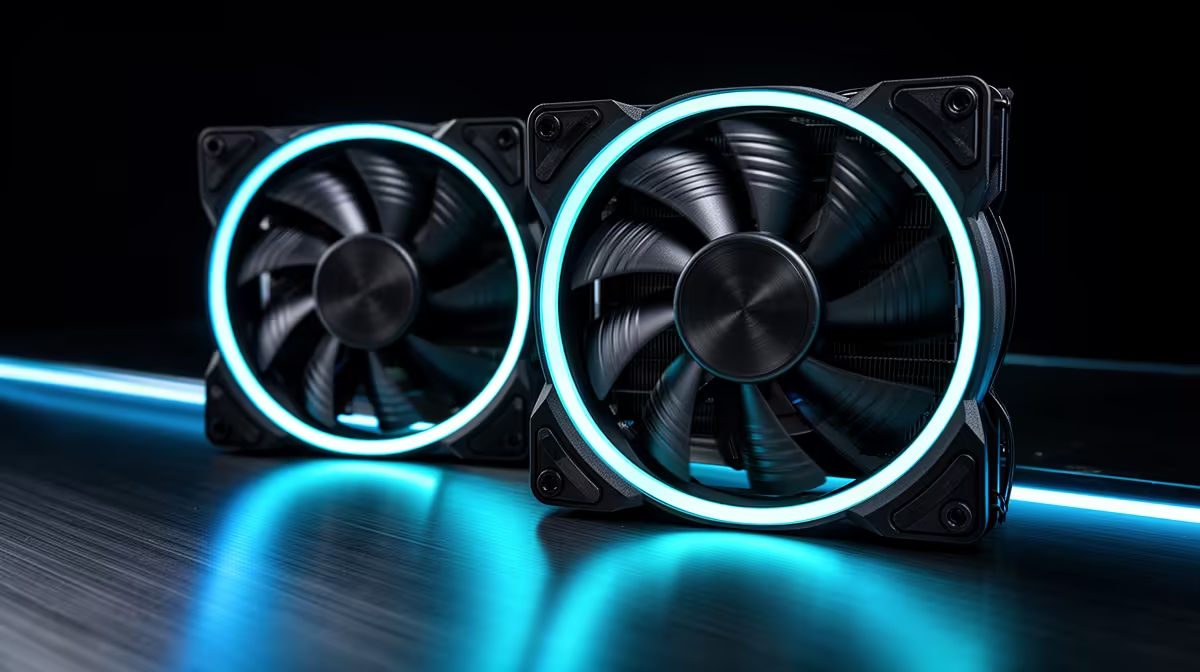
140mm fans move more air at lower RPM than 120mm fans, making them quieter for equivalent airflow. The trade-off is that 140mm fans require specific case mounts and cost slightly more per unit. For primary front intake or top exhaust positions, 140mm is the better choice for quiet, high-airflow builds.
Airflow and Static Pressure by the Numbers 💨
A typical premium 140mm PWM fan like the Noctua NF-A14 delivers around 82 CFM at 1,500 RPM. A comparable 120mm fan like the NF-A12x25 delivers 60 CFM at 2,000 RPM. To match the 140mm's airflow, the 120mm must spin 500 RPM faster, producing measurably more noise (approximately 3 to 5 dB higher). In a gaming PC running an RTX 5080, the front intake fans contribute directly to GPU temperature. Switching from three 120mm fans to three 140mm intakes typically reduces GPU hotspot temperatures by 4 to 8 degrees Celsius at the same noise level. For radiator use where static pressure matters more than raw CFM, the difference is smaller since fin density limits maximum airflow, but 140mm still performs better at low RPM.
When 120mm Makes More Sense 🔧
For rear exhaust positions, 120mm is the standard because most case rear fan mounts are 120mm. Virtually no consumer case has a 140mm rear fan mount. For radiator use, many AIOs use 120mm fans exclusively, and aftermarket 120mm radiator fans like the Noctua NF-F12 iPPC are specifically optimised for high static pressure through fin stacks. For compact mid-towers where the front panel only offers 120mm mounts, 140mm simply does not fit. The per-unit cost of quality 120mm fans is also R100 to R200 lower than 140mm equivalents from the same brand.
Noise Profiles for SA Gaming Environments 🇿🇦
In a typical South African home gaming room with ambient noise around 35 to 40 dB, a 140mm fan array running at 800 to 900 RPM is nearly inaudible. If you game late at night in shared student digs in Stellenbosch or Pretoria, the noise delta between 140mm at 700 RPM and 120mm at 1,100 RPM for the same thermal result is meaningful for housemates. Quality 140mm PWM fans from Noctua, be quiet!, and Lian Li are stocked at Evetech from around R300 to R650 per fan.
Mix Sizes Strategically in One Build ⚡
Use 140mm fans for front intake where airflow volume matters most, 120mm fans for radiator duty where static pressure is more important, and a 120mm fan at the rear exhaust where the mount size is fixed. This approach gives you the advantages of both fan sizes without compromise and is exactly what many high-end SA builders use on premium quiet builds.
FAQ
Can I use a 140mm fan in a 120mm mount with an adapter?
Some adapters exist but introduce minor compatibility issues. The more practical approach is to choose a case that natively supports 140mm at the positions where you want them. Most premium mid-towers and all full-towers support 140mm at front intake.
Do 140mm fans use more power than 120mm fans?
At equivalent noise levels, 140mm fans use slightly less power because they achieve airflow at lower RPM with less motor effort. At maximum RPM, 140mm fans can draw more wattage (up to 3W to 5W vs 1W to 3W for 120mm), but maximum RPM on a 140mm in a normal build is rarely reached.
Is there a CFM advantage in using 140mm fans on an AIO radiator?
For sealed AIO radiators with standard fin density, 140mm fans provide better performance at low RPM. However, high-static-pressure 120mm fans like the Noctua NF-F12 can match 140mm on a dense radiator because the restriction rewards static pressure over raw CFM.
Building a quiet, high-airflow setup?
Evetech stocks 140mm and 120mm PWM fans from Noctua, be quiet!, Lian Li, and Arctic in single units and multi-packs to complete any airflow configuration.