Quick Answer
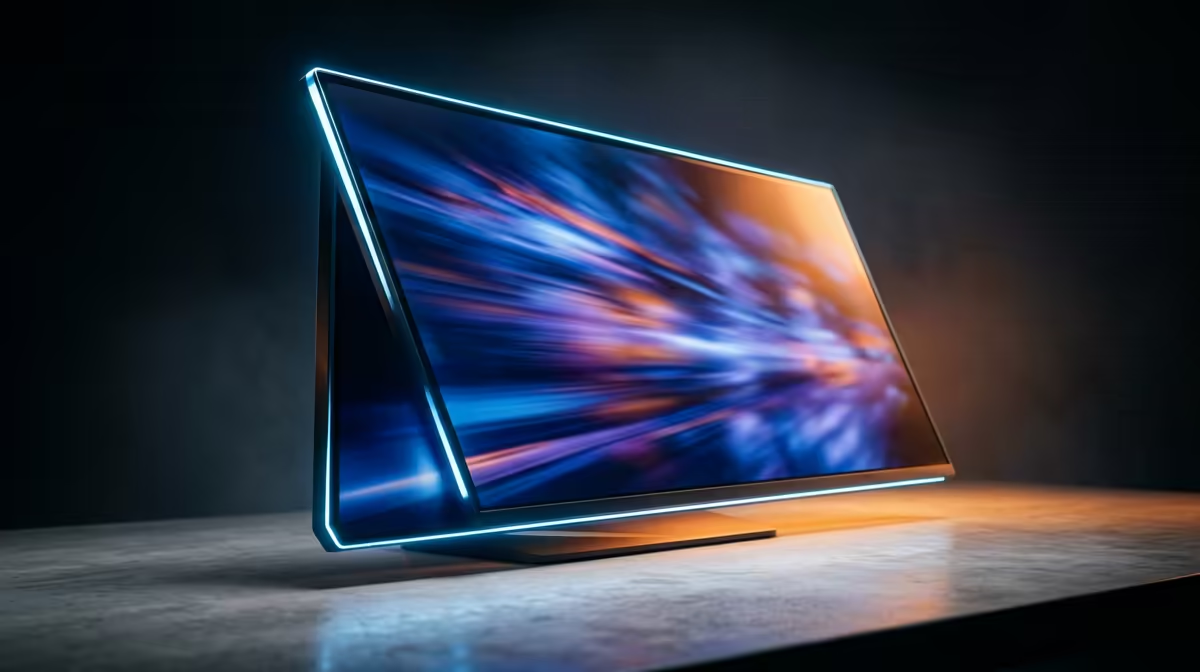
For Vereeniging buyers, 240Hz monitors start at roughly R4,500 for a 1080p IPS model and reach R14,000+ for 1440p 240Hz panels. The investment pays off only if your GPU can sustain 200+ fps — an RTX 4060 (~R5,500 at Evetech) achieves this in CS2 and Valorant at 1080p without issue. Evetech delivers to Vereeniging (southern Gauteng) in approximately 2–4 business days via standard courier.
When 240Hz Makes Sense for Vereeniging Gamers
240Hz is the go-to for competitive FPS players. The visual fluidity at 240fps versus 144fps is noticeable in fast tracking shots and peeking around corners — reaction window differences of 2–4ms at 240fps versus 6ms at 144fps are measurable in professional play and detectable to most gamers. If your game list is Apex Legends, Rainbow Six Siege, Valorant, or CS2, the upgrade is justified.
For predominantly single-player titles — RPGs, story games, simulation — a 1440p 144Hz monitor in the R5,200–R6,800 range is a better spend. Better image quality outweighs the frame-rate ceiling in those genres.
GPU and CPU Requirements for 240fps
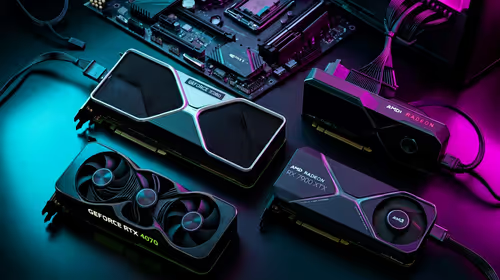
GPU: RTX 4060 or RX 7600 (R5,500–R6,500) for 200–300fps in CS2/Valorant at 1080p.
CPU: A Ryzen 5 7600 or Intel Core i5-13400F (R3,200–R4,000 at Evetech) prevents CPU bottlenecks in competitive games where CPU-bound frame rates are common.
Both components matter — a strong GPU with a bottlenecking CPU will cap you well below 240fps in CPU-heavy titles like CS2.
Delivery to Vereeniging
Evetech ships to Vereeniging residential addresses via Aramex and The Courier Guy. Allow 2–4 business days from dispatch.
FAQ
Is 240Hz worth the extra cost over 144Hz for casual gamers?
No — casual gamers who play mixed genres, single-player, or less than 10 hours per week won't see a meaningful return from 240Hz. The R1,500–R2,500 price premium over a 144Hz model at similar resolution is better spent on a stronger GPU or more RAM.
Can a PS5 or Xbox Series X run at 240Hz?
Current console generations are limited to 120Hz maximum output, so a 240Hz monitor shows no benefit over a 120Hz monitor for console gaming. For console use, a 120Hz 1080p or 1440p monitor is sufficient and costs less.
What response time should a 240Hz monitor have?
Target 1ms GtG (grey-to-grey) or better. Most IPS gaming monitors at 240Hz achieve this via Fast-IPS technology. TN panels also hit sub-1ms but have poor viewing angles. At the R4,500–R7,000 price range, Fast-IPS is the dominant choice offering good colour plus fast response needed at 240fps.
or G-Sync Compatible mode on your 240Hz monitor even if you regularly hit 240fps — variable refresh rate smooths out frame rate dips during explosions or complex scenes, eliminating micro-stutters.