Understanding 3 DoF AR: Native Degrees of Freedom for Better AR
Ever felt like your dual-monitor setup isn't enough for your late-night sessions? Imagine pinning a 130-inch virtual screen right above your desk while you relax. That is the magic of 3 DoF AR: Native Degrees of Freedom for Better AR. It is about more than just wearing glasses... it is about how virtual screens interact with your physical world right here in South Africa. 🚀
When we talk about Degrees of Freedom, we are looking at how a device tracks your movement. In a 3 DoF (Three Degrees of Freedom) setup, the sensors track your head's rotation along three axes: pitch (looking up and down), yaw (turning left and right), and roll (tilting side to side). Unlike basic "screen mirroring" where the image follows your eyes like a sticker on your glasses, native 3 DoF allows the display to remain fixed in space. This creates a much more natural viewing experience.
Why Native Tracking Changes Everything
The primary benefit of 3 DoF AR: Native Degrees of Freedom for Better AR is the elimination of motion sickness. When a screen is "locked" to your face, every tiny micro-movement of your head causes the image to jitter. This often leads to eye strain during long work or gaming sessions. By using native spatial tracking, the glasses allow you to "pin" your screen in mid-air. You can look away to grab your coffee or check your phone, then look back, and the virtual display is exactly where you left it.
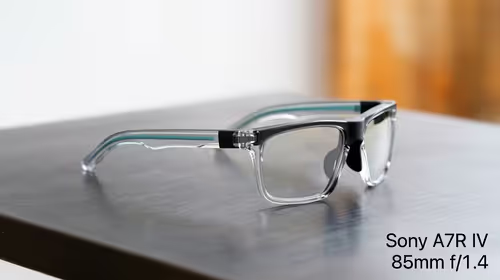
If you are looking to upgrade your mobile workstation, you can browse our full range of AR glasses to find a pair that supports this spatial pinning. It turns a cramped flight or a long commute into a private cinema experience.
Enhancing Productivity and Immersion
For South African professionals working in tight spaces, 3 DoF is a massive win. You can essentially have multiple virtual monitors without needing the physical desk real estate. It makes multitasking feel intuitive rather than cluttered. Whether you are coding, editing spreadsheets, or just watching YouTube, the stability provided by native tracking is essential.
Productivity Pro Tip ⚡
When using AR glasses for work, try using a dedicated spatial app like Nebula or Spacewalker. These apps leverage the native 3 DoF sensors to let you snap multiple virtual windows around you, effectively giving you a triple-monitor setup that fits in your pocket. It is perfect for staying productive while travelling between Cape Town and Jozi.
Finding the Right Fit for Your Setup
Not all hardware is created equal when it comes to spatial awareness. Some entry-level units only offer simple mirroring. To truly experience 3 DoF AR: Native Degrees of Freedom for Better AR, you need hardware with built-in IMU sensors that communicate effectively with your source device. You can find various ar glasses options that cater to different connectivity needs, whether you are using a USB-C DP Alt Mode smartphone or a dedicated gaming handheld. 🔧
For those who want the absolute best clarity and the most robust tracking sensors, exploring AR glasses in the premium price bracket is often worth the investment. Higher-end models usually offer better FOV (Field of View) and higher refresh rates, making the virtual screen feel even more solid and real.