


PCIe 5.0 vs PCIe 4.0 for Video editing in 4k in SA
PCIe 5.0 vs PCIe 4.0 for video editing in 4k is mainly about fit, features, compatibility, cost, and upgrade path, not one automatic winner. SA buyers should match the choice to the setup.
Read moreA 360-degree AI noise-canceling webcam mic can replace dedicated audio gear for everyday remote work by capturing voices while filtering keyboard noise. It will not match a USB condenser for podcasts, but for meetings it is enough.
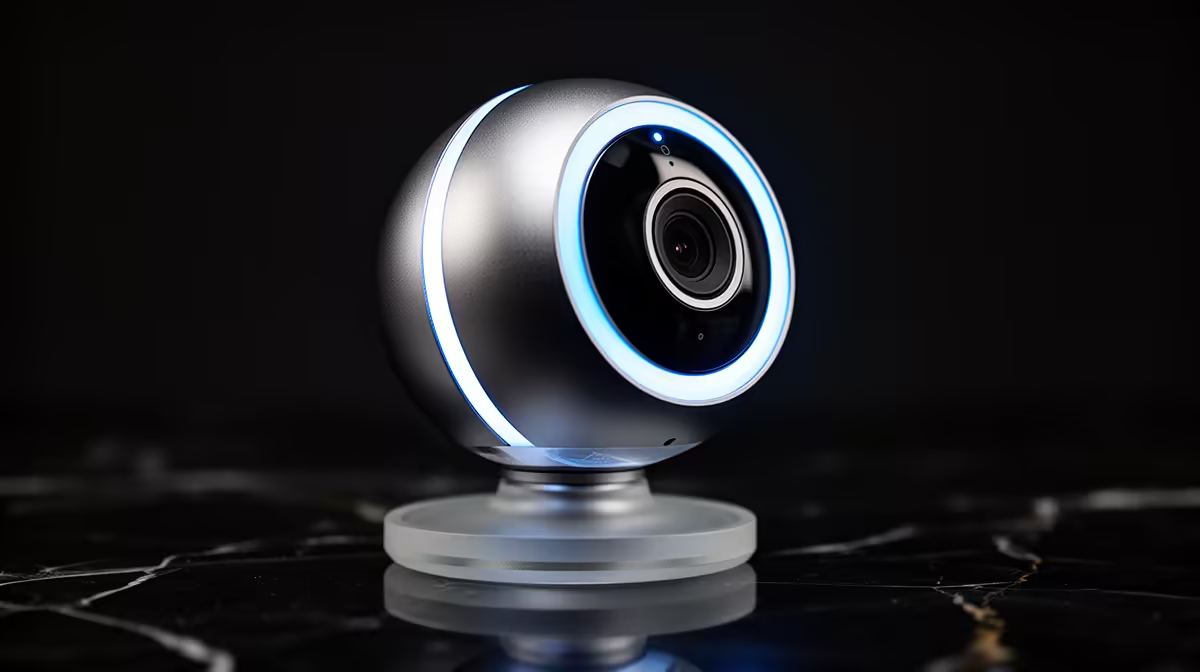
The question is not whether webcam audio has improved, because it clearly has. The real question is whether a 360-degree AI noise-canceling webcam microphone can hold its own against a dedicated desk mic often costing several hundred Rand more. For most remote workers, the honest answer is closer to yes than the audio gear community usually admits.
A 360-degree AI noise-canceling webcam mic is good enough to replace dedicated audio gear for daily meetings and remote work. It captures voices from multiple directions while suppressing consistent background noise like keyboard clicks and fan hum. For podcasts or published audio, a close-placed USB condenser still outperforms any built-in array.
A single-element microphone points at one direction. Everything off-axis arrives quieter, attenuated, and sometimes coloured by the angle. That works perfectly when one person sits directly in front of a dedicated desk mic, but falls apart the moment a second colleague joins from across a table or someone shifts position during a call.
A 360-degree array uses multiple capsule elements arranged around the camera body. The firmware reads the signals from each capsule and either blends them into a uniform omnidirectional pickup or, on more advanced models, uses delay-and-sum beamforming to identify where voice energy is coming from and emphasise it while reducing off-axis noise.
The practical effect is that a webcam placed on a monitor in the centre of a meeting room captures everyone at the table without anyone needing to lean toward it. For remote workers at a solo desk, the 360-degree pattern is less critical than the AI processing sitting on top of it.
The AI component is a trained audio processing model that runs on dedicated hardware inside the camera, analysing the incoming audio in real time. It has been trained to distinguish voice energy from common non-voice sounds, and it applies continuous suppression to the sounds it recognises as noise.
Keyboard typing is the most common example, and AI cancellation handles it well. The regular rhythm and frequency characteristics of key strikes are easy for a trained model to identify and reduce without touching the voice signal. Fan noise, air conditioning hum, and chair creaks also fall within what a good model suppresses reliably.
What it struggles with is transient or voice-frequency interference. A dog barking in an adjacent room, another person talking in the background, or music playing nearby shares too much of the frequency range with human voice for the AI to cleanly separate them. The model will attempt suppression, but voice-adjacent sounds either bleed through or cause audible artefacts as the system tries to remove them.
The result for a South African home office with a running PC and occasional street noise through a closed window is excellent. The result for an open-plan office with multiple conversations happening simultaneously is noticeably less clean.
The fundamental advantage of a purpose-built microphone is proximity and exclusivity. A USB condenser microphone placed 15cm from the speaker's mouth captures an enormous amount of voice signal relative to any background noise, which means the signal-to-noise ratio is high before any processing begins.
A webcam mic is physically further from the mouth, mounted on a monitor that might sit 60 to 80cm away. Even excellent AI processing cannot fully compensate for the dilution of voice signal that distance creates. The noise floor is higher, and the warmth of close capture that makes a voice sound natural on a podcast is simply not present.
For published audio, the tonal difference is audible on good headphones. Close-captured voice from a condenser has body, clarity, and presence that a webcam array cannot replicate. Webcam audio is clean enough to be professional in a meeting context, but it lacks the character that holds a listener's attention for 45 minutes of a podcast episode.
The cost gap is also narrowing. A decent USB condenser microphone sits around R1,200 to R2,500 in South Africa. If audio quality is genuinely important to your work output, that investment delivers a noticeable improvement over any built-in solution.
For a standard day of video meetings on Teams, Google Meet, or Zoom, the AI noise-canceling webcam array is more than sufficient. Call recipients hear clear, filtered voice without the keyboard intrusion, and the setup requires no additional desk hardware, no boom arm, no gain adjustment, and no positioning ritual before each meeting.
The webcam mic also suits remote workers who move between rooms or take calls from varied positions. A dedicated mic only works well from one sweet spot; the wider pickup of a webcam array adapts better to a less structured environment.
Students in res or koshuis attending online lectures benefit similarly. The AI filtering handles the ambient noise of a shared residence building, and the lack of extra gear keeps the setup portable.
Test the webcam mic by recording a 60-second clip of yourself speaking normally, then play it back on headphones at normal listening volume. If you can hear your own breath or room hum between sentences, the mic is operating at its limit for your environment. Add a small directional desk mic or move to a room with less ambient noise. Trust the playback, not how it sounds in your own head during the recording.
For video calls and online meetings, yes in most cases. The AI noise filtering keeps voice clear while suppressing keyboard and fan noise, and the omnidirectional pickup handles natural movement without requiring precise positioning. For podcasting, narration, or any audio where final quality is the product, a dedicated close-placed microphone produces warmer, more detailed sound that the webcam array cannot match at any distance.
On a solo desk, it means you do not need to stay perfectly centred in front of the camera for audio to be captured well. The full-circle array picks up voice from any angle, so turning slightly to look at a second monitor, or shifting position during a long call, does not cause your audio to drop off. The AI processing then works on whatever the array captures, regardless of direction.
Well enough that most call recipients will not notice typing during a conversation. Key noise has a consistent rhythmic and frequency profile that trained models identify reliably and suppress before the audio reaches the listener. Mechanical keyboards with louder switches still bleed through slightly on hard bursts of typing, but at normal conversational speaking volume the voice comfortably dominates.
Not for a professional podcast where audio is a primary listener touchpoint. The distance between a monitor-mounted webcam and your mouth creates a thinner, less present voice than close-placed microphone capture. For internal team recordings, video essays, or occasional podcast episodes where the content matters more than studio audio, webcam quality is acceptable. For regular listeners with good headphones, close-mic audio is a meaningful improvement.
Up to roughly 2 to 3 metres in a quiet room with low ambient noise. Beyond that distance the voice-to-noise ratio drops and the AI processing has less clean signal to work with, making output thinner and more artefact-prone. For a round-table meeting with multiple participants, keeping everyone within 2 metres of the camera gives the best collective result.
Ready to upgrade your meeting audio without adding clutter to your desk? Browse the webcam range with built-in AI noise cancellation and find the option that matches your room size and daily call volume.
For video calls and online meetings, yes in most cases. The AI noise filtering keeps voice clear while suppressing keyboard and fan noise, and the omnidirectional pickup handles natural movement without requiring precise positioning. For podcasting, narration, or any audio where final quality is the product, a dedicated close-placed microphone produces warmer, more detailed sound that the webcam array cannot match at any distance.
On a solo desk, it means you do not need to stay perfectly centred in front of the camera for audio to be captured well. The full-circle array picks up voice from any angle, so turning slightly to look at a second monitor, or shifting position during a long call, does not cause your audio to drop off. The AI processing then works on whatever the array captures, regardless of direction.
Well enough that most call recipients will not notice typing during a conversation. Key noise has a consistent rhythmic and frequency profile that trained models identify reliably and suppress before the audio reaches the listener. Mechanical keyboards with louder switches still bleed through slightly on hard bursts of typing, but at normal conversational speaking volume the voice comfortably dominates.
Not for a professional podcast where audio is a primary listener touchpoint. The distance between a monitor-mounted webcam and your mouth creates a thinner, less present voice than close-placed microphone capture. For internal team recordings, video essays, or occasional podcast episodes where the content matters more than studio audio, webcam quality is acceptable. For regular listeners with good headphones, close-mic audio is a meaningful improvement.
Up to roughly 2 to 3 metres in a quiet room with low ambient noise. Beyond that distance the voice-to-noise ratio drops and the AI processing has less clean signal to work with, making output thinner and more artefact-prone. For a round-table meeting with multiple participants, keeping everyone within 2 metres of the camera gives the best collective result.
PCIe 5.0 vs PCIe 4.0 for video editing in 4k is mainly about fit, features, compatibility, cost, and upgrade path, not one automatic winner. SA buyers should match the choice to the setup.
Read more
Wi-Fi 7 vs Wi-Fi 6e for competitive esports comes down to router support, latency goals, device compatibility, and coverage. SA buyers should match the choice to the real network setup.
Read more
ATX 3.1 vs ATX 3.0 for mMO and live-service games buyers - what changes is mostly about compatibility, budget, upgrade path, and setup fit. SA buyers should check device support and real needs before expecting a clear win from either option.
Read more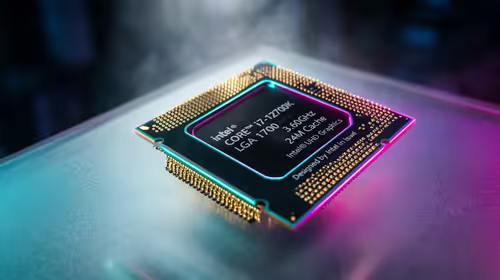
LGA 1851 vs LGA 1700 can affect Twitch and YouTube streaming when gaming and encoding share CPU resources. For SA creators, the real-world difference depends on encoder choice, memory support, motherboard cost, thermals, and upgrade plans.
Read more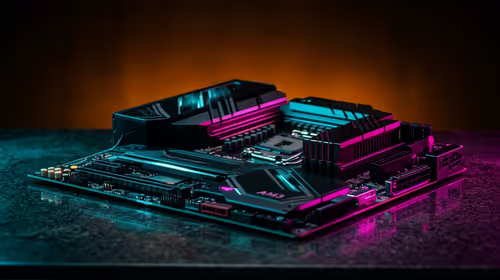
X870E vs X670E for aaa single-player gaming is mainly about fit, features, compatibility, cost, and upgrade path, not one automatic winner. SA buyers should match the choice to the setup.
Read more
Hall Effect switches vs Mechanical switches for mMO and live-service games is mostly about compatibility, budget, upgrade path, and setup fit. SA buyers should check device support and real needs before expecting a clear win from either option.
Read more
A fake 113GB GTA VI ISO reportedly used empty padding around a small malware payload. SA gamers should delete unofficial builds, keep Windows security active and wait for official channels.

Wi-Fi 6E vs Wi-Fi 6 matters for 4K video editing when files move across a network. The real-world difference between Wi-Fi 6E and Wi-Fi 6 for video editing in 4K depends on NAS access, cloud uploads, router range, and SA creator workflows.

The difference between PCIe 5.0 and PCIe 4.0 for SA gamers is mostly bandwidth headroom. Compare GPU slot needs, NVMe speed, motherboard support, and upgrade timing before paying extra for a newer platform.

Gaming PC stuck pixel checks in South Africa should confirm the monitor fault first. Use colour tests, screenshot comparison, cable swaps, display menu checks, and clear photos before deciding on support.

Shokz OpenFit Air 2 earbuds weigh 7.2g each and use a redesigned dual-driver open-ear layout. SA buyers should choose them for comfort and awareness, not maximum isolation.

AMD's current driver now lists a Radeon RX 9050 4GB, while product coverage details a narrowed memory system. SA buyers should weigh the low VRAM ceiling against current local Radeon options.

Samsung Display has demonstrated a 16-inch 2.5K OLED laptop panel running at 300Hz. SA buyers should wait for a named notebook, full panel specifications and a local price before planning an upgrade.

Microsoft says some Windows 11 game crashes after recent updates are linked to RGB-related drivers. Affected SA gamers should confirm the update and driver before using the published registry workaround.
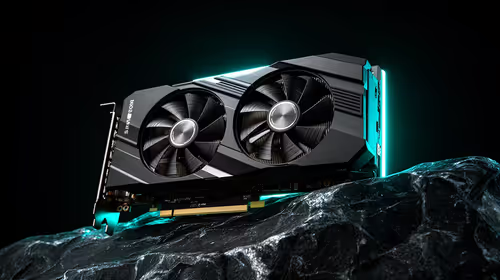
RTX 5090 on a 650W PSU is a tight pairing with very limited headroom. For SA gaming PCs, focus on total system draw, PSU quality, connector support, CPU choice, and avoid OC plans unless the full build is carefully power-limited.
PCIe 5.0 vs PCIe 4.0 for video editing in 4k is mainly about fit, features, compatibility, cost, and upgrade path, not one automatic winner. SA buyers should match the choice to the setup.
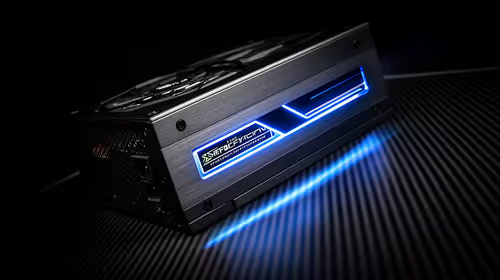
850W PSU safety for RTX 5090 is plausible with a quality unit and balanced parts. In SA, confirm connector support, CPU power draw, case airflow, PSU age, and spare capacity before building around 850W.
Wi-Fi 7 vs Wi-Fi 6e for competitive esports comes down to router support, latency goals, device compatibility, and coverage. SA buyers should match the choice to the real network setup.