Quick Answer
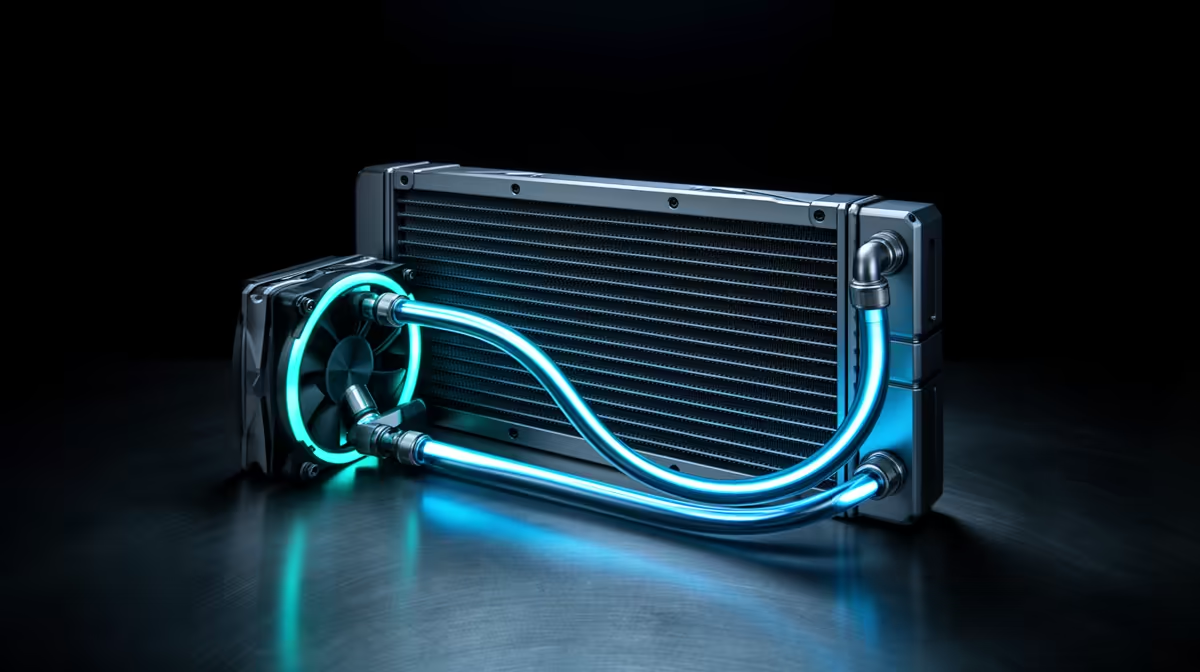
A 420mm radiator setup makes sense for CPUs with a sustained TDP above 170W such as the Ryzen 9 9950X or Core i9-14900K, where the extra fin area drops peak temperatures by 5 to 8 degrees Celsius compared to a 360mm unit at the same fan speed. For gaming-only CPUs like the Ryzen 5 7600X or Core i5-14600K, a 360mm radiator is more than sufficient and fits in a far wider range of cases.
What the Extra 60mm of Radiator Actually Delivers 🌡️
A 420mm radiator uses three 140mm fans rather than three 120mm fans. At identical RPM, a 140mm fan moves roughly 20 percent more air than a 120mm fan. Combined with the larger fin surface area, a 420mm AIO absorbs and dissipates more heat per degree of coolant temperature rise, keeping the CPU delta-T lower under sustained all-core workloads.
The performance gap between 420mm and 360mm narrows when fan speeds are increased on the 360mm unit. Running a 360mm AIO's fans at 1,600 RPM versus a 420mm at 1,000 RPM produces similar CPU temperatures, but the 360mm setup generates considerably more noise. The 420mm advantage is most apparent during silent operation, where its fans can run at 900 RPM and still maintain low CPU temperatures during sustained workloads like a two-hour Blender render or a 4K video export.
Case Compatibility: The Biggest Practical Difference 📐
This is where 360mm wins decisively for most builders. The number of cases in South Africa stocking 420mm front or top support is a fraction of those supporting 360mm. A quality 360mm-capable case is available at Evetech from R1,600, while 420mm-capable cases start around R2,500 and require a full-tower or large mid-tower form factor.
For South African builders with limited desk or floor space, the case size requirement of a 420mm build can be a dealbreaker. A full-tower case with 420mm front support typically measures 550mm tall or more. Budget the case at R2,800 to R4,200 for a 420mm-ready chassis with adequate GPU clearance to avoid the frustration of a radiator that fits but blocks GPU installation.
Noise and Longevity Considerations 🔧
Both radiator sizes use the same AIO pump mechanics and copper CPU cold plate design. Longevity differences between 360mm and 420mm AIOs from the same brand are negligible, with most rated for 50,000 pump hours. The practical difference is fan longevity: 420mm fans running at 900 RPM accumulate bearing wear more slowly than 120mm fans spinning at 1,300 RPM for equivalent cooling, extending their service life by an estimated 20 to 30 percent over a five-year period.
Radiator Size Decision Shortcut ⚡
your CPU's listed TDP from the manufacturer datasheet. Under 125W sustained TDP: a 360mm is the correct choice. Over 170W sustained TDP: a 420mm provides meaningful benefits. Between 125W and 170W: both perform similarly and case compatibility should drive your decision.
FAQ
Does a 420mm radiator fit in a standard mid-tower case?
Rarely. Most standard mid-towers support 360mm front and top radiators. Only large or high-end mid-towers with removable front cages accommodate 420mm. Always check the case spec sheet before purchasing.
Is the price difference between 420mm and 360mm AIOs significant?
Yes. A 420mm AIO typically costs R400 to R900 more than the equivalent 360mm model from the same brand. Combined with the higher case cost, a 420mm setup adds R1,000 to R2,500 to a build compared to the 360mm equivalent.
Can a 360mm AIO keep a Ryzen 9 9950X under control?
Yes, with the fans running at 1,200 to 1,400 RPM under sustained all-core load. The CPU will stay below 90 degrees Celsius in most scenarios, which is within AMD's safe operating range. For silent operation at 900 RPM, the 420mm is a better fit for sustained all-core workloads.
Choosing between a 360mm and 420mm AIO setup?
Evetech stocks both radiator sizes alongside compatible cases, so you can match the cooling system to your CPU, budget, and chassis in a single order.