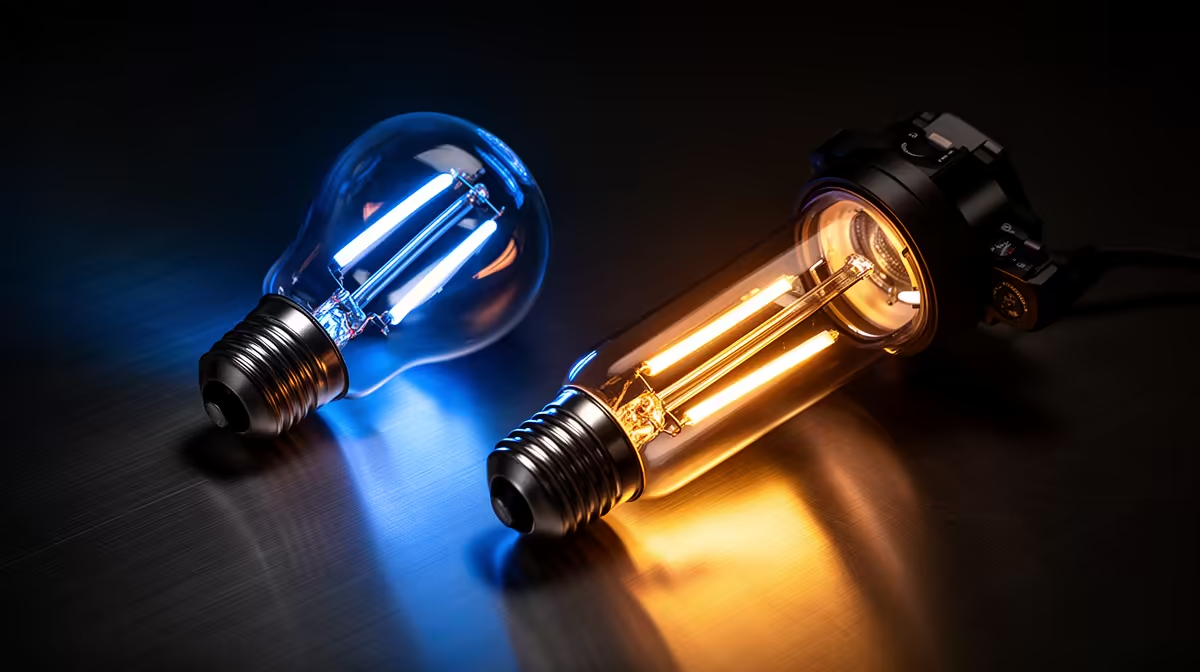
The question trips up every creator who moves from photography into video: if strobes produce such powerful, beautiful light for stills, why do they fail so completely for footage? The answer is fundamental rather than technical. Strobes and 45W continuous light bulbs are not competing approaches to the same problem. They are tools designed for different capture methods, and using the wrong one for video produces footage that is either dark, flickering, or impossible to expose consistently.
Quick Answer
Continuous 45W lights suit video because they stay on and light every frame equally. Strobes fire a single burst designed for a single still frame. For moving footage, a strobe cannot illuminate the frames between flashes, making it useless for video recording.
🎙️ Why Continuous Lights Are the Natural Video Choice
Video captures a sequence of frames, usually 24 to 60 per second. Every one of those frames needs to be lit at the moment the shutter opens, for that fraction of a second. A light that is consistently on for the full duration of the recording illuminates every frame equally and lets the camera meter the scene as a fixed, stable value.
A 45W CFL daylight bulb produces roughly 2000 to 2500 lumens of sustained output. That is not a massive figure compared to studio strobes at full power, but it is enough to light a talking-head shot at a reasonable ISO on most modern cameras, particularly when the source is placed within 60 to 90cm of the subject. The brightness is visible and controllable: if it is too dim, move the source closer. If it is too harsh, diffuse it through a softbox.
The other critical advantage is what you see is what you get exposure. The scene looks on the live view screen exactly as it will record, which means focus, depth of field, and highlight clipping are all visible before you press record. There is no estimating what the final exposure will look like, no test-firing strobes to check the histogram, and no guesswork on shadow placement.
The Colour Temperature Consistency Factor
Daylight 45W CFL bulbs sit close to 5500K, which falls in the same range as mid-morning window light. Cameras white balanced at 5500K read them accurately and consistently. Unlike strobes, which can shift slightly in colour temperature as the capacitor charge varies between shots, a CFL bulb produces the same colour from the first minute of operation to the last, making colour grading across a long recording session straightforward.
⚡ Where Strobes Genuinely Win
For still photography, a strobe's advantages are significant and real. A mid-range strobe dumps far more instantaneous light than a 45W CFL ever could, allowing the photographer to shoot at low ISO, small aperture settings, and high shutter speeds simultaneously. Freezing fast motion cleanly at f/11 requires a burst of light too brief and intense for any continuous source to match.
Strobes also run cooler during a session. Continuous bulbs generate heat proportional to their output, and a bank of 45W CFLs in an enclosed softbox warms up noticeably over a two-hour studio shoot. A strobe only fires heat for a millisecond at a time. For a photographer working a full day of portrait sessions, that thermal difference matters for comfort and for the models or subjects in the space.
The limitation is absolute for video purposes. A strobe cannot light the frames between its flash cycles at any practical trigger rate. High-speed continuous flash modes exist but are designed for burst photography, not for 30 frames per second video exposure. For anything that records motion continuously, continuous light is the only logical choice.
🔧 Managing Heat and Output in Small Spaces
A standard 45W CFL in a medium softbox generates gentle warmth during operation. Leave 15 to 20cm of air gap between the bulb and the softbox inner surface and the heat dissipates adequately. Two of them in a small room, around 3 by 3 metres, will warm the air by a few degrees over the course of an hour-long session, which is noticeable but not uncomfortable.
The ventilation factor is worth considering in South African summer conditions where rooms can be warm already. A desk fan positioned to circulate air in the room, rather than aimed at the subject, manages the thermal build-up without creating wind noise on the microphone. Studio photographers working through Cape Town summers or Johannesburg heat often schedule longer sessions for early morning before the room warms.
Pro Tip ⚡
If you shoot both video and stills from the same studio space, set up your continuous lights permanently and add portable strobes as a separate, packable kit. Never try to use strobes for video work. The two setups serve different workflows and should stay separate to avoid the frustration of setting up the wrong light for the job.
🌐 Mixing Continuous and Strobe Sources
Mixing the two in a single shot is not workable. Their colour temperatures can differ, their timing is fundamentally incompatible, and the exposure calculation for the camera changes entirely between a continuous reading and a flash sync. Set up for one or the other per session and pack away the other kit.
For a hybrid creator who does both portrait photography and video content, the practical workflow is two distinct setups: a strobe kit with portable heads for photography sessions, and a pair of continuous CFL softboxes that stay rigged for video recording. The softboxes take no time to re-aim between sessions, and the strobes break down into cases when the video camera goes on.
Frequently Asked Questions
Why can a video camera not simply use a strobe on every frame?
Camera shutter speeds for video are tied to the frame rate, typically set at double the frame rate value. At 30 frames per second the shutter is open at 1/60 of a second per frame. A strobe would need to fire in perfect sync with every one of those frames, which no standard strobe system is designed to do. Even high-speed multi-flash triggers do not match the continuous per-frame requirement of video recording.
How bright is a 45W continuous CFL bulb in practical terms?
Roughly 2000 to 2500 lumens, which is comparable in perceived brightness to a 200W incandescent bulb. For a talking-head shot with the light source 60 to 80cm from the subject, it produces a clean, workable exposure at ISO 400 to 800 on most camera sensors. Moving the source closer raises the effective light level without any power change.
Will two 45W CFL softboxes overheat a small home studio?
They add warmth but not dangerously so. A 3 by 3 metre room with two 45W CFLs running for 90 minutes will be noticeably warmer, a few degrees. Open a window or run a quiet desk fan to circulate air. For South African summer shoots, schedule longer sessions in cooler morning hours to avoid stacking the room temperature with ambient heat.
Can I get the look of a strobe portrait using continuous lights?
You can approximate it with positioning and modifiers. A small, hard continuous source creates contrast similar to a single-head strobe portrait. The difference is that a strobe's output measured in watt-seconds gives you more control over the depth of field and motion freeze available. For a natural-looking, diffused portrait style, continuous lights with softboxes match strobes closely enough that the result is indistinguishable to most viewers.
Is colour temperature consistency better with CFL bulbs than strobes?
CFL bulbs rated at 5500K are highly consistent from startup to shutdown and from one shoot to the next. Strobe colour temperature varies slightly with capacitor charge level and recycling time, particularly at lower power settings. For multi-hour video recordings where consistent colour grading is important, CFL continuous sources offer a more predictable colour profile with no need to compensate for shot-to-shot variation.
Ready to light your video work with a source that actually stays on?
Browse the continuous lighting range including 45W CFL softbox kits built for South African video creators and home studio photography setups.