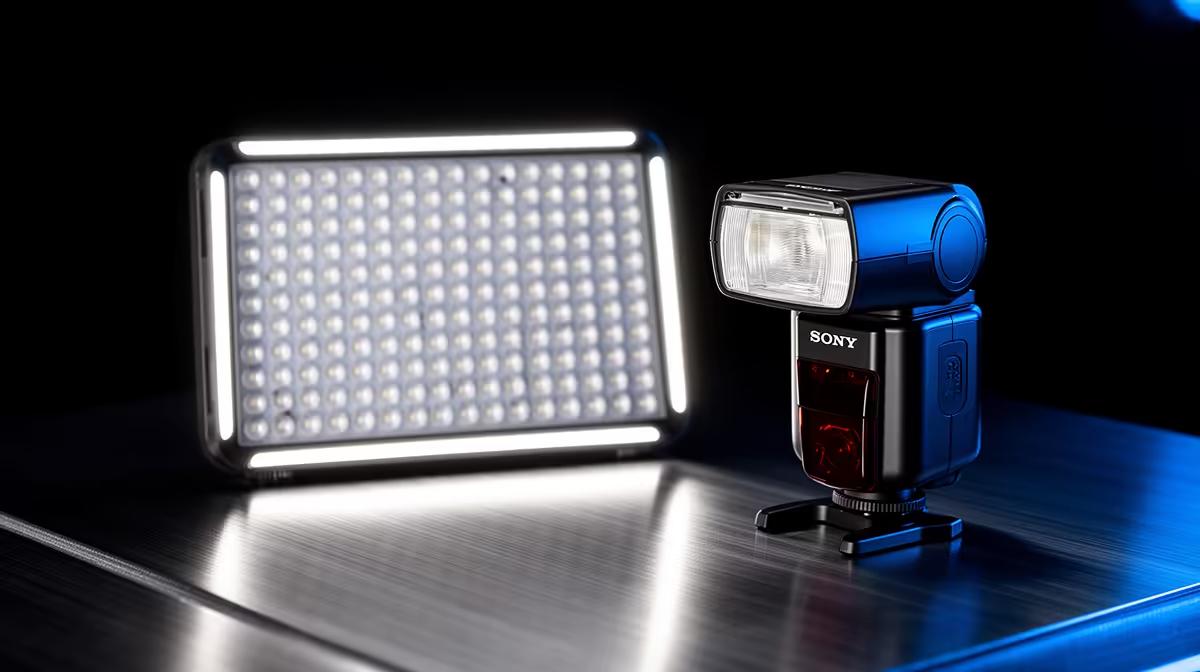
The choice between 45W continuous lighting and strobe flashes matters less than most gear guides suggest -- until you try to use the wrong one for the job and it becomes very obvious very fast. A strobe fires a single burst of light for a fraction of a millisecond. A 45W continuous bulb stays on. Those two facts determine almost everything: what each is built for, where each fails, and why most home studios that do any video at all will find continuous lighting the more practical starting point.
Quick Answer
45W continuous lighting suits video because it illuminates every frame consistently throughout a recording. Strobe flashes are optimised for still photography and fire bursts too brief to expose a video frame evenly. For a home studio that shoots both, continuous lighting covers the majority of use cases and strobes add value only if you specifically need to freeze fast motion in stills.
🎙️ Why Continuous Light Works for Video
A video camera at 25 frames per second is capturing 25 separate exposure windows every second. Each frame needs to be lit for its entire duration -- at 1/50 second shutter speed, that window is 20 milliseconds long. A 45W continuous bulb stays on through all of those windows identically. Every frame receives the same amount of light, which is why the footage looks stable.
This constant output also lets you see your exposure before you record. What you see on the live preview is what lands on the file, so you can adjust stands, reposition the subject, and confirm the shadow structure in real time. There is no guessing, no test flash, no meter required. For a solo creator who is also operating the camera, this immediate feedback loop saves significant setup time on every session.
Lock exposure and leave it
With continuous bulbs and a camera in manual mode, setting exposure is a one-time task per session. Once ISO, shutter, and aperture are locked against the lit scene, the values do not change unless the lights move or the bulbs warm up further. The footage from the first take and the twentieth take will match without a single camera touch in between.
🔥 What Strobes Were Built For
Strobe flash heads are designed to produce a very large quantity of light in a very short time. A studio strobe firing at a moderate power level might deliver its full output in 1/500 to 1/1000 of a second -- far faster than any shutter speed a camera can produce. This brief, intense burst freezes motion completely. A cricketer mid-swing, a water balloon at the moment of burst, a dancer mid-leap: these shots require more light than any continuous source can deliver in a normal shutter window, and they need that light delivered fast enough to freeze the motion.
For still photography where maximum sharpness and frozen action are priorities, strobes at their upper power settings outperform any continuous source. The peak brightness available from a moderately priced strobe head is far beyond what a 45W CFL can sustain continuously.
The video problem for strobes
A strobe does not fire continuously. It fires once per shutter actuation, at a pulse duration shorter than a single video frame. For video, this means the strobe would need to fire 25 times per second at perfectly consistent power and timing to expose footage evenly -- a configuration called high-speed sync that consumer-grade flash heads are not built to maintain without overheating or inconsistent output.
In practice, strobes simply do not work for video. Pointing a strobe at a video recording produces either a completely dark frame, a single bright frame from the one moment of firing, or an unpredictable mix depending on timing. This is not a compatibility issue that settings solve -- it is a fundamental mismatch between how the flash fires and what video exposure requires.
💰 Cost and Setup Complexity
A basic 45W softbox kit with two heads, stands, and bulbs costs in the range of R1,200 to R2,500 in South Africa depending on size and build quality. This is an entry-level investment that covers most content creator video needs without additional accessories.
Entry-level strobe flash heads, by contrast, require a head, a power pack or monolight design, at least one trigger (for wireless firing), and a sync cable or radio system to connect with the camera. A basic one-strobe-and-trigger kit starts around R3,000 and above for genuinely reliable gear. Two heads with stands, modifiers, and triggers for a standard two-light portrait setup brings the cost considerably higher.
Neither option is expensive relative to what professional versions cost. But for a home studio where video is a significant use case, spending more on strobes and then not being able to use them for video is a poor allocation of limited budget.
Pro Tip ⚡
If you do eventually add strobe flashes to a continuous setup, use the continuous lights as modelling lights during the strobe session rather than removing them from the set. Many strobe heads include a low-power continuous modelling lamp specifically for this purpose. Having your 45W softboxes already positioned means you can see the shadow structure before committing to a test flash.
🧠 Choosing for a Home Studio Context
For a creator in South Africa who shoots tutorials, reviews, talking-head content, or podcast video, 45W continuous lighting is the better starting point. The setup is simpler, the exposure feedback is immediate, the output is compatible with every recording scenario, and the cost of entry is lower.
Strobes become relevant when the work is primarily still photography and freezing fast action is a genuine requirement -- sports, action, macro work, or high-end fashion where the burst output and freeze capability justify the additional cost and complexity. For a mixed studio doing some stills and a lot of video, continuous lighting handles the video reliably and can still produce excellent portrait stills when combined with a fast enough aperture to compensate for the lower peak brightness.
The common mistake is assuming strobe flash gear is universally superior because it costs more and professionals use it on certain jobs. Professionals also use continuous lighting on the jobs that call for it. The tool fits the task.
Frequently Asked Questions
Which type of light suits video recording better, continuous or strobe?
Continuous lighting suits video because it remains on throughout every frame, giving consistent exposure across an entire recording. A strobe fires a single brief burst that cannot expose a video frame evenly -- it is built for still photography where each shutter actuation gets one flash. For any recording that runs longer than a single frame, continuous is the correct choice.
Do strobes have any practical application in video work?
Almost none in a standard home studio context. Some broadcast and film productions use specialised flash systems for specific effect shots, but these are purpose-built tools well outside consumer equipment. A standard studio strobe flash head connected to a video camera produces no usable footage under normal operation.
Is 45W continuous lighting bright enough to match a strobe for portrait stills?
For stationary subjects, yes -- with appropriate exposure settings. The lower peak output of a 45W continuous source compared to a strobe is compensated by opening the aperture wider, which is generally fine for portrait work where shallow depth of field is desirable anyway. For freezing fast motion with a high shutter speed, a strobe's peak output is genuinely necessary and continuous lighting cannot substitute.
Which is cheaper to start with for a home studio?
A basic two-softbox continuous lighting kit is typically available for R1,200 to R2,500 in South Africa. A comparable two-strobe setup with heads, stands, modifiers, and triggers costs considerably more. For a home studio starting out, continuous lighting offers more practical utility per rand spent, especially if video is part of the workflow.
Can beginners set up continuous lighting without experience?
Yes. Continuous lighting removes the need for test flashes, meters, and timing knowledge. You position the lights, switch them on, and see the result live on your camera's preview. Adjustments are immediate and visual. Strobe photography requires understanding sync speeds, guide numbers, and power-to-aperture relationships before you can interpret a test frame confidently.
Ready to set up a home studio that handles video and stills without overcomplicating the gear?
Browse the continuous lighting and softbox range at Evetech to find a kit that covers your full content workflow from day one.