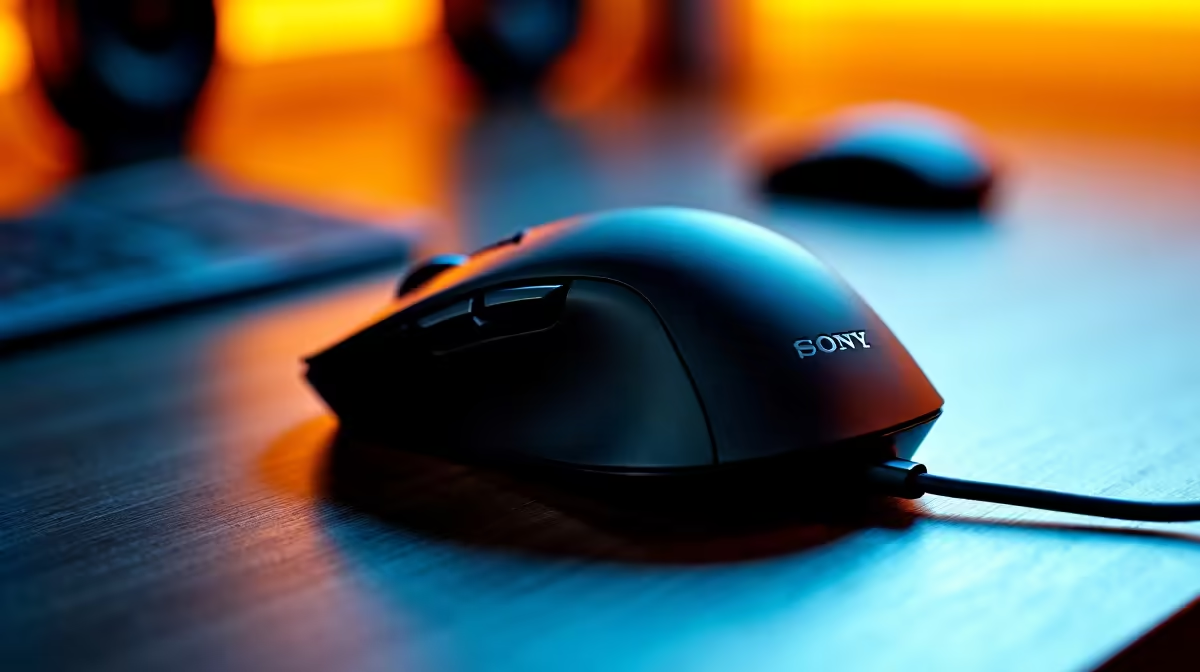
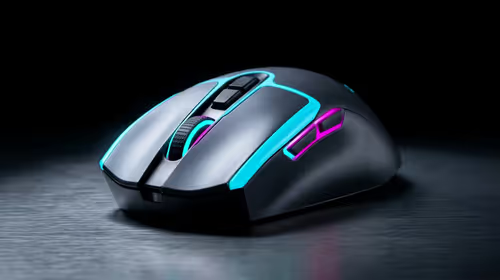
Every new professional mouse generation pushes the sensor ceiling higher, and the spec sheets follow. 4K DPI optical sensors are now standard in mid-range and above mice, positioned as an upgrade over older 1600 and 3200 DPI hardware. For SA professionals considering whether to spend on a sensor upgrade, the honest answer depends almost entirely on what the workstation looks like, not on what the specification number says.
Quick Answer
For most professional tasks, a 4K DPI sensor is not worth prioritising. Admin, writing, and data work stay well below 1600 DPI in daily use, so the extra ceiling sits idle. The upgrade earns its keep only on 4K monitors or wide multi-screen analyst and design setups where higher pointer speed reduces hand travel across a large canvas.
🔆 What the Upgrade Actually Delivers
A sensor rated to 4000 DPI can move the cursor 4000 screen pixels per inch of mouse travel. At face value that sounds like a significant leap over an 1800 or 2400 DPI sensor. In practice, few users run any optical sensor at its rated maximum. A professional on a 1080p display who sets their mouse to 4000 DPI will find the cursor jumps across the full screen width with roughly 12mm of hand movement. That is not useful for document editing or spreadsheet navigation; it is uncontrollably fast.
The real-world operating range for a productivity professional is 800 to 1600 DPI. Writing, emailing, navigating project management tools, and working through document reviews all happen comfortably in this band. A mouse with a 1800 DPI maximum and a 1600 DPI maximum are functionally identical for those tasks.
Where the upgrade delivers something tangible is in two scenarios. On a 3840 by 2160 display, the pixel density is four times that of 1080p, and crossing the screen at 800 DPI requires a significant arm sweep. A higher DPI ceiling lets the user step up to 2400 or 3200 DPI without the pointer becoming erratic, making wide-canvas navigation faster without sacrificing control. The same logic applies to triple-monitor analyst workstations where 5760 or more horizontal pixels need to be traversed regularly.
📊 The Professional Categories Where It Helps
Graphic Designers and Visual Professionals
Designers working in applications like vector editing tools or photo editing software at 4K resolution benefit from a higher DPI ceiling because they regularly switch between macro navigation, scrolling across a large canvas, and micro precision work zoomed into detail. A sensor that steps cleanly from 800 DPI for detail work to 3200 DPI for wide navigation without jitter at either end serves this workflow.
The key word is "cleanly." A 4K-capable sensor only helps designers if the sensor quality at low DPI settings is also good. A sensor rated to 4000 DPI that exhibits acceleration or jitter at 800 DPI is worse than a well-engineered 1800 DPI sensor with clean low-setting tracking. The ceiling is secondary to the floor.
Data Analysts and Financial Professionals
Analysts running wide data tools, multiple monitors displaying dashboards, and split-screen financial models may find that a higher DPI ceiling reduces the arm fatigue that comes from repeatedly crossing large monitor real estate. On a desk with a 4K primary and a secondary 1440p monitor beside it, the combined workspace genuinely benefits from a pointer that can cover distance efficiently.
For a data professional on a single 1080p or 1440p screen, however, the same upgrade adds nothing. The workstation, not the job title, is the determining factor.
💰 The Upgrade Cost vs. the Alternatives
The price step from a mid-range office mouse with a 1600 to 2400 DPI sensor to one with a 4K or higher sensor is typically R200 to R400 in the SA market. Whether that increment is justified depends on what else the money could improve.
An ergonomic shell that fits the user's hand better, more durable switches rated for 20 million cycles rather than 5 million, or a wireless connection via a dedicated 2.4GHz dongle all deliver daily-use improvements that are perceptible from the first session. A DPI ceiling upgrade on a single-display workstation delivers nothing noticeable from the first session onward.
For admin staff, writers, operations managers, and coordinators whose work stays on one screen, the R200 to R400 premium for a 4K sensor is genuinely better spent on ergonomic quality or switch longevity. For designers and analysts on high-resolution setups, the same R200 to R400 is well targeted.
Pro Tip ⚡
Before deciding on the sensor upgrade, check your current DPI setting in your mouse software or Windows pointer settings. Most professionals who test this find they are running between 800 and 1200 DPI daily. If your current setting is already well below your current sensor's maximum, a higher ceiling will not change your experience at all.
✨ Sensor Quality vs Sensor Ceiling: the Distinction That Matters
A 4K DPI sensor from a reputable manufacturer typically includes secondary improvements beyond raw DPI headroom. These include a lower lift-off distance, meaning the sensor stops tracking sooner when you lift the mouse, which prevents accidental cursor jumps when repositioning. Improved surface compatibility, tracking reliably on glass, cloth, and hard mats. Reduced angle snapping, where the sensor corrects perfectly straight line movement, is sometimes tunable in software.
These secondary quality improvements are worth considering regardless of the DPI ceiling. They improve daily tracking feel at any sensitivity setting. The question is whether the mouse that carries them is priced correctly for those improvements or priced primarily for the headline DPI number.
A well-chosen sensor at 2400 DPI with excellent low-DPI tracking and precise lift-off detection outperforms a poorly implemented 8000 DPI sensor in every office task. Read reviews that specifically assess low-DPI behaviour and tracking consistency rather than benchmark DPI numbers.
Frequently Asked Questions
Do most professionals actually notice a 4K sensor upgrade?
Rarely, on standard single-display setups. Professional tasks including writing, emailing, spreadsheet work, and project management all run at settings well under 2000 DPI. The sensor ceiling that would make a difference sits above what the daily workflow ever reaches.
Which professionals genuinely benefit from a 4K DPI sensor?
Graphic designers and visual editors on 4K displays, and data analysts running multiple monitors where the combined screen width creates genuinely large pointer travel distances. For these users, a higher DPI ceiling reduces the arm fatigue of constantly sweeping across wide workspaces.
Is the upgrade price justified for office and admin staff?
Usually not. The same R200 to R400 that separates a standard-sensor mouse from a 4K-sensor model is better invested in ergonomic shell quality or switch durability for most admin and operational roles. Those improvements are felt every single day; the DPI ceiling is not.
Does a higher DPI sensor improve precision in detailed tasks?
Not directly. Precision comes from sensor optical quality, lift-off detection, and surface tracking consistency at low DPI settings. A high DPI ceiling adds speed, not accuracy. For precise work, sensor behaviour at 800 and 1000 DPI is the measurement to scrutinise, not the maximum figure.
Can software reduce a 4K sensor down to the settings I actually use?
Yes. Vendor applications and Windows pointer settings both allow the sensor to run at any DPI below its maximum. A 4K sensor mouse configured to 1000 DPI performs identically to any other quality sensor at 1000 DPI for office tasks. The ceiling only matters if your workflow reaches it, which most professional tasks do not.
Should I buy a 4K sensor mouse to future-proof my setup?
Only if a 4K monitor is a near-term purchase. If you are planning to upgrade your display within the next year, a sensor with headroom above 1600 DPI is a reasonable forward-looking choice. If your screen is staying at 1080p or 1440p for the foreseeable future, comfort and switch durability provide more return over the same period.
Ready to find a professional mouse that matches your actual workstation?
Browse the office and productivity mouse range at Evetech to find the sensor quality, ergonomic build, and wireless reliability that fits your desk setup rather than just your spec-sheet wishlist.