Quick Answer
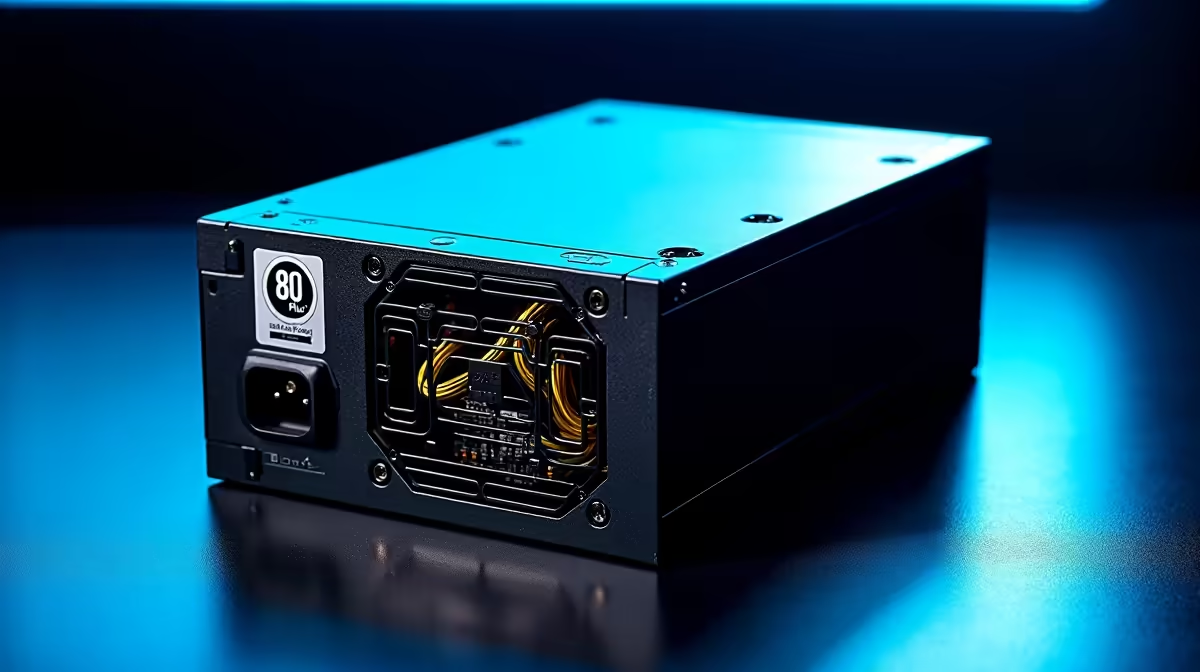
80 Plus Platinum hits 92% efficiency at 50% load versus 87% for Gold. The 5-percentage-point gap means a Platinum 850W unit wastes roughly 40W less heat at typical gaming load than an equivalent Gold unit. Over a year of daily use in South Africa at current electricity tariffs, that saving is real money and a meaningfully cooler system.
Breaking Down the Efficiency Numbers 📊
The 80 Plus certification is measured at three load points: 20%, 50%, and 100% of rated wattage. At the critical 50% load point, Gold must achieve 87% efficiency, Platinum must achieve 92%, and Titanium must achieve 96%. For a 1000W PSU delivering 500W to the system, Gold loses 66W as heat while Platinum loses only 43W. That 23W difference is not trivial inside an enclosed PC case. Heat raises the ambient temperature around your CPU cooler, GPU, and storage drives, which in turn raises noise levels as fans compensate. In a South African summer, where ambient room temperatures regularly reach 28 to 35 degrees Celsius in Gauteng and the Western Cape, the stack effect of PSU heat on overall system temperatures is amplified compared to a European or North American environment.
Long-Term Electricity Cost Difference 💡
At Eskom's residential tariff of roughly R3.50 per kWh (2025 rate), a system running 500W at 50% PSU load for six hours daily generates the following: a Gold PSU wastes about 144Wh daily, costing approximately R0.50 per day. A Platinum PSU wastes about 94Wh, costing roughly R0.33. The R0.17 daily saving amounts to about R62 per year. That sounds modest, but a Platinum PSU typically costs R500 to R1,200 more than an equivalent Gold unit in SA. At heavy workstation use of eight to ten hours daily, the payback period tightens to two to three years. For gaming PCs that also run render tasks or run 24/7 as a home server, Platinum earns its premium. For a rig used four hours a day for gaming only, Gold remains entirely sensible.
Choosing Between Gold and Platinum for Your SA Build 💰
Gold-rated PSUs from reputable brands like Seasonic, Corsair, and be quiet! are available locally for around R2,200 to R4,000 in the 650W to 1000W range. Platinum units in the same wattage range run R3,500 to R6,500. If you are building a gaming rig centred on an RTX 5070 Ti or RX 9700 XT with a Ryzen 7 9800X3D, a Gold 850W unit is adequate and cost-effective. If you are adding a Ryzen 9 9950X and plan to leave the machine rendering overnight, the Platinum investment makes sense. Titanium, which runs R7,000 and above for a 1000W unit, is best justified for professional workstations running around the clock.
Match Wattage Capacity to Your Actual Load ⚡
Efficiency ratings peak at 50% load, so a 1000W Platinum PSU running at only 20% load is not dramatically more efficient than a Gold at 50%. Right-size your PSU first, then choose the certification tier. A 650W Gold running at 50% often beats a 1200W Platinum running at 17% in real efficiency terms.
FAQ
Does an 80 Plus Platinum PSU run noticeably quieter?
Usually yes.
Is the Platinum certification guaranteed by 80 Plus or the manufacturer?
The 80 Plus organisation tests and certifies PSUs independently. Look for the official 80 Plus Platinum badge on the unit and confirm the specific model is listed on the 80plus.org database. Some products advertise "Platinum-grade" components without holding the actual certification.
Can I trust third-party efficiency ratings from YouTube reviews?
Yes, with caveats. Channels like Gamers Nexus and Hardware Busters measure efficiency under real-world load profiles rather than 80 Plus lab conditions. Their numbers can be 1% to 3% lower at extreme loads. These reviews give a more realistic picture of efficiency under gaming spikes than the certification alone.
Comparing Gold and Platinum PSUs for your next build?
Evetech stocks both tiers from trusted brands at every major wattage, with detailed specs online to help you match efficiency to your actual power draw.