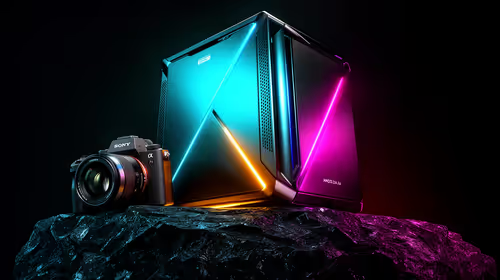
A movable home projector needs to solve three geometry problems repeatedly: where it points, whether the image is rectangular and whether detail is sharp. ToF auto focus, keystone and an adjustable projector stand address those tasks in different ways. The WANBO Cube 2 Pro brings them together at R3,999, with a 230-degree stand and a 0.1-second automatic process.
Quick Answer
The Cube 2 Pro's stand rotates through 230 degrees, and ToF calibration automatically restores focus and keystone alignment whenever that angle changes.
The stand sets the Cube 2 Pro's physical aim, keystone corrects trapezoidal geometry and focus controls detail. At R3,999, the projector uses ToF to perform auto focus and keystone in 0.1 seconds. Buyers should still establish square placement, confirm throw distance and inspect corners after every significant move.
🧭 Give each setup tool one clear job
The 230-degree stand changes the direction of projection. It can help aim towards a wall or screen without adding a separate support mechanism. The stand does not determine the required lens distance, and a large angle does not guarantee ideal geometry.
Keystone addresses the outline created by off-centre or tilted projection. A vertical or horizontal offset can make one edge longer than the opposite edge. Focus is separate: a perfect rectangle can remain soft, while a sharp menu can sit inside a trapezoidal frame.
Time-of-flight sensing supports the Cube 2 Pro's automatic adjustment. The 0.1-second rating describes how quickly the combined focus and keystone process runs, not how long a complete room installation takes.
Start with physical geometry
Set the projector on a stable support near the image centre line. Level the position where practical and use the stand for the remaining aim. Only then allow automatic correction to refine the picture. This order keeps software from compensating for a room problem that can be solved by movement.
🧭 Build a centre-and-corner inspection routine
Display a grid with straight borders and small lettering. Check the centre first, then compare all four corners from the normal viewing seat. Note shape and clarity separately. If one edge is soft, reduce the physical angle or test a flatter surface before cycling focus again.
The projector outputs native 1080p, so a clean Full HD test source is appropriate. A low-quality stream can look blurry after focus has succeeded. Use a local or otherwise reliable reference frame during geometry work, then return to normal content.
Its projection range spans 40-130 inches. Recheck after size changes because a different diagonal can require a new position and make surface flaws more obvious. Do not infer required throw distance from that range; confirm the lens relationship before permanent installation.
Use the Evetech projector category to compare setup approaches once the room constraints are measured.
🧭 Plan for temporary and fixed installations
A projector stored between uses benefits from position marks. Mark the support feet, stand angle and intended image corners with removable references. Return to those marks, wait for automatic adjustment, then confirm detail. This makes setup reproducible for different household members.
A fixed installation uses the same tools differently. Once the geometry passes, document the position and avoid casual changes. The automatic process remains useful after cleaning, accidental movement or a different image size, but stability becomes the main goal.
Cable routing belongs in both plans. HDMI and USB are present, and Android TV 11 supplies a built-in source environment. Arrange power and source cables so they do not pull the projector off its reference position or cross a walkway.
Avoid diagnosing through several simultaneous changes
If the image looks wrong, alter only one item: stand angle, projector location, keystone or source. Recheck the same grid after each step. Multiple adjustments can hide which action fixed the problem and make the next setup harder to repeat.
🧭 Validate the geometry with entertainment content
After the test grid passes, play a film with subtitles and faces near the frame edges. Watch a fast sequence to make sure apparent softness is not simply motion or compression. Inspect the result at the picture size the household will actually use.
The Cube 2 Pro produces 500 ANSI lumens, so room light and image area affect visibility during this stage. Keep curtains and lamps fixed while judging geometry. A dark corner caused by ambient light is not a focus symptom.
An 8W speaker supplies onboard sound, and the operating figure is 28dB. Listen from the main positions after settling the projector's location. If a console is connected, test response independently because focus and keystone do not measure input latency. Once that path is proven, explore gaming accessories at Evetech for the remaining setup.
Rehearse two different installation drills
For a temporary setup, pack the projector and cables away, then ask another household member to restore the picture using position marks. Time unpacking, placement, automatic adjustment and verification separately. The process reveals whether the 0.1-second adjustment removes meaningful friction or whether cable routing dominates the task.
For a fixed setup, deliberately move the stand by a small amount, return it to the documented angle and inspect the grid. Check whether the image corners and centre detail recover without stacking additional corrections. This drill tests resilience after an accidental bump.
Record failure patterns instead of repeated fixes
Create a page with sketches for top-wide, bottom-wide, left-tall, right-tall and local blur. When a symptom appears, match it to the sketch and change the related axis or surface condition. Save the result alongside projector position and size.
If no physical movement improves a local soft area, compare another flat surface and a clean source. This keeps the owner from using more keystone to solve focus, or more focus to solve a wall defect. A geometry system becomes useful knowledge when its corrections remain explainable and repeatable.
Photograph the accepted grid from the main seat and note the stand angle, diagonal and support location. Repeat that photograph after a month of normal movement. Matching borders and corner detail confirm that the room marks still guide the projector back to its successful geometry; a visible drift identifies which reference needs attention.
The range supports conventional wall placement, ceiling projection while lying in bed and downward use from a bookshelf. A movement triggers real-time correction; stopping gives the system a stable target for a sharp rectangular picture. This relationship between physical aiming and automatic geometry is more useful than either feature alone, because it lets the compact projector change rooms or surfaces without rebuilding its image manually.
Stable support keeps the real-time correction from chasing avoidable motion.
Frequently Asked Questions
What does the 230-degree stand control?
It changes the physical aiming angle of the Cube 2 Pro. Room distance, beam clearance and alignment still need planning around the selected direction.
Is keystone correction the same as focus?
No. Keystone reshapes an angled frame, while focus determines edge definition. Both should be checked separately after placement.
How often should automatic adjustment run?
Run it after moving, tilting or significantly resizing the projector, then inspect the result. A fixed installation may need it less frequently.
Can ToF fix a textured wall?
No. Automatic focus and geometry cannot flatten or smooth the viewing surface. Compare a neutral flat sample when local softness persists.
Why mark the stand position if adjustment is automatic?
Physical marks restore a reliable starting point. Automation then handles smaller differences instead of correcting a different room geometry every time.
Ready to make projector setup quick and repeatable?
Compare Evetech models after mapping the lens position, stand angle, image corners and detailed test screen your room will use.