Quick Answer
Analog optical technology in keyboards and keypads uses an infrared light gate to read continuous key position rather than a fixed contact point, delivering both contactless durability and pressure-sensitive variable input. For gamers it enables analog throttle control from a key; for creative professionals it maps key depth to parameter speed in editing software.
The Engineering Behind Optical Analog Switches 🔧
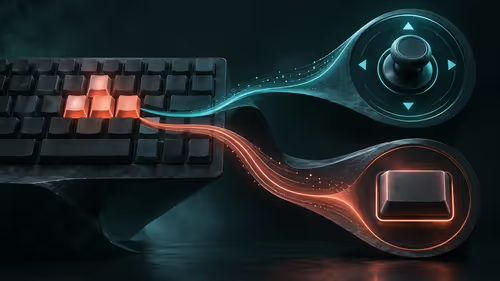
A standard optical switch fires once when the key stem breaks an infrared beam at a fixed depth, producing a binary signal. Analog optical switches go further: instead of a simple beam-break, they use a sensor that reads varying light intensity as the stem partially occludes the beam at different depths. The firmware translates light intensity into a continuous value between 0 and 100 percent. Razer pioneered this approach in their Analog switches used in the Huntsman V3 Pro line. Because there are no physical contacts, the switch is rated for 100 million actuations without wear-induced actuation point drift, a real problem on older contact-based switches. In South Africa, keyboards and keypads using analog optical switches sit in the R2,800 to R6,000 range.
Gaming Applications: Where Analog Keys Shine 🎮
Racing sims are the headline use case. In Assetto Corsa Competizione or BeamNG.drive, binding throttle and brake to analog optical keys gives the same proportional control as a steering wheel pedal set, without the desk space or cost. Flight simulators like Microsoft Flight Simulator 2024 benefit similarly, mapping thrust to key depth. In action-RPGs such as Elden Ring running on PC, analog actuation can map to movement speed, allowing a walking versus running state tied to how firmly you press a key. For competitive FPS play, you can switch the same keys to a tight digital threshold, making them behave as standard binary switches with sub-1 mm actuation when analog control is not needed.
Creative Professional Workflows 💡
Video editors using DaVinci Resolve 19 can map jog speed or scrub sensitivity to analog key depth, giving tactile timeline control without a dedicated jog wheel. In Photoshop, brush size or opacity can respond to key pressure when the software accepts analog controller input via XInput emulation, which some analog keypad drivers support natively. The key caveat: the software must either natively support gamepad analog input or the keypad driver must offer XInput emulation mode.
Enable XInput Mode for Creative Software ⚡
If your analog optical keypad supports XInput emulation, enable it when working in creative software. This presents the keypad as a gamepad to Windows, allowing applications that accept controller analog input, like DaVinci Resolve and some DAWs, to read key depth as a continuous axis rather than a binary press. Switch back to keyboard mode for standard typing and gaming hotkeys.
FAQ
Does analog optical technology add input lag compared to standard optical switches?
No measurable lag is added. Both technologies read at the same polling rate, typically 1,000 Hz or higher on gaming-grade hardware. The analog value carries more data than a binary signal, but the polling interval remains identical.
Can analog optical keypads be used without special software on Windows 11?
Basic key input works plug-and-play on Windows 11, but analog features require the manufacturer's companion software to configure actuation curves, digital thresholds, and XInput emulation. Without the software, keys default to standard binary behaviour.
Are analog optical peripherals significantly more expensive than standard ones in South Africa?
Typically 40 to 80 percent more expensive than equivalent binary models. An entry-level mechanical gaming keypad costs around R900 to R1,400 in South Africa, while a comparable analog optical unit starts around R2,500.
Want to try analog optical input for gaming or creative work?
Evetech stocks gaming keypads and keyboards with advanced switch technology, available with local warranty and fast nationwide delivery. Browse the peripherals section at Evetech.