Quick Answer
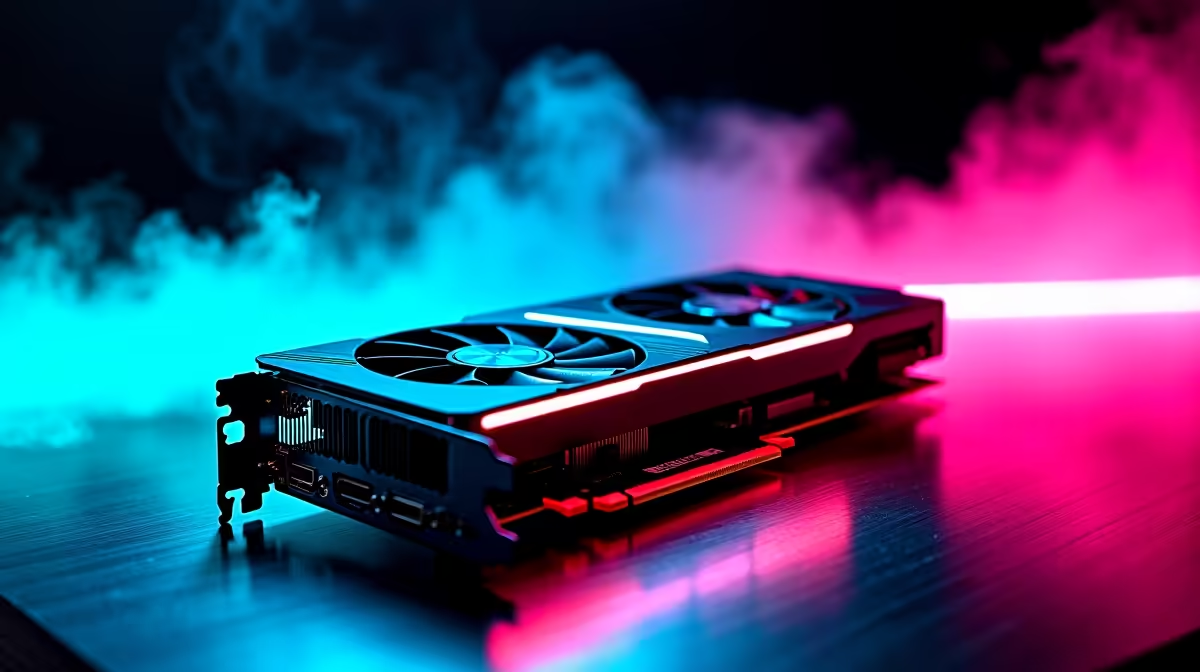
440mm GPU clearance refers to the maximum graphics card length a case can physically accommodate. It matters for modern builds because current flagship GPUs like the RTX 5090 Founders Edition measure up to 336mm, and third-party triple-fan variants from ASUS, MSI, and Gigabyte can reach 380 to 420mm. A case with 440mm clearance accommodates every GPU on the current market with room to spare.
How GPU Clearance Is Measured and Why the Number Varies 📐
GPU clearance is measured from the rear PCI bracket mounting point to the front interior wall of the case, usually with the front drive cage removed. This is an important distinction: a case listed as 440mm clearance with cages removed may offer only 340 to 380mm with cages installed. Modern triple-fan or quad-fan GPU designs grow partly because of larger heat sink surface area requirements as TDP climbs above 350W. The RTX 5090 at 575W TDP ships in a reference design around 336mm long, but AIB partners building custom cooling solutions extend this to 380 to 420mm across their premium lines.
Which Modern GPUs Actually Need 440mm Clearance 🖥️
For most current-generation GPUs, 440mm clearance is generous rather than necessary. The RTX 5080 ships in triple-fan AIB designs in the 340 to 360mm range, well within the clearance of most full-tower and E-ATX cases. The builds where 440mm clearance becomes a genuine requirement are: flagship single-GPU workstation cards with extended VRM cooling fins, dual-slot-width GPU radiator-hybrid designs where the card length extends further to accommodate an additional 240mm radiator section, and high-end cooling configurations from ASUS ROG Matrix or MSI MEG lines. SA builders assembling a future-proof HEDT or creator workstation around an RTX 5090 Ti or next-generation flagship should plan for 440mm clearance as a minimum.
Impact on Airflow and Component Layout 🌬️
A case designed for 440mm GPU clearance is invariably a full-size chassis, which means airflow design benefits are structural. The extra depth provides more internal space between the GPU heat sink and front intake fans, reducing recirculation of GPU exhaust back through the front intake zone. It also allows larger drive cages to be installed behind or below the GPU without competing for the same physical volume. SA builders assembling systems with multiple NVMe SSDs, a full-length GPU, and a 420mm AIO benefit from the physical separation a 440mm-clearance case provides, allowing components to be spaced to avoid thermal interaction.
Measure Your GPU Before Ordering ⚡
Before buying a case for a specific GPU, download the product page and find the actual card length in millimetres, not the PCIe standard length. AIB cards from ASUS, MSI, and Gigabyte vary significantly from the reference length. Compare that number against the case GPU clearance in the configuration you intend to use.
FAQ
Does a shorter GPU perform better in a 440mm clearance case versus a 380mm clearance case?
Not directly. Clearance affects whether the GPU fits, not its performance. However, a larger case typically has better overall airflow design and more fan mounting positions, which can indirectly benefit GPU temperatures by improving ambient case temperature around the card.
Are all 440mm clearance cases full towers?
No. Some oversized mid-towers offer 440mm GPU clearance in a chassis shorter than a traditional full tower, achieving the internal length by extending the front-to-back depth while keeping overall height at 500 to 540mm.
What happens if I install a GPU that exceeds the clearance by 10mm?
The GPU will contact the front drive cage, case fan frame, or front panel interior. Forced installation can bend the PCIe slot on the motherboard or crack the GPU cooler shroud. Do not attempt to force a GPU beyond stated clearance.
Building around a large current-gen GPU?
Evetech stocks full-tower and large mid-tower cases with 440mm GPU clearance designed for modern flagship graphics cards. Check the case range and confirm your GPU fits before you build.