Quick Answer
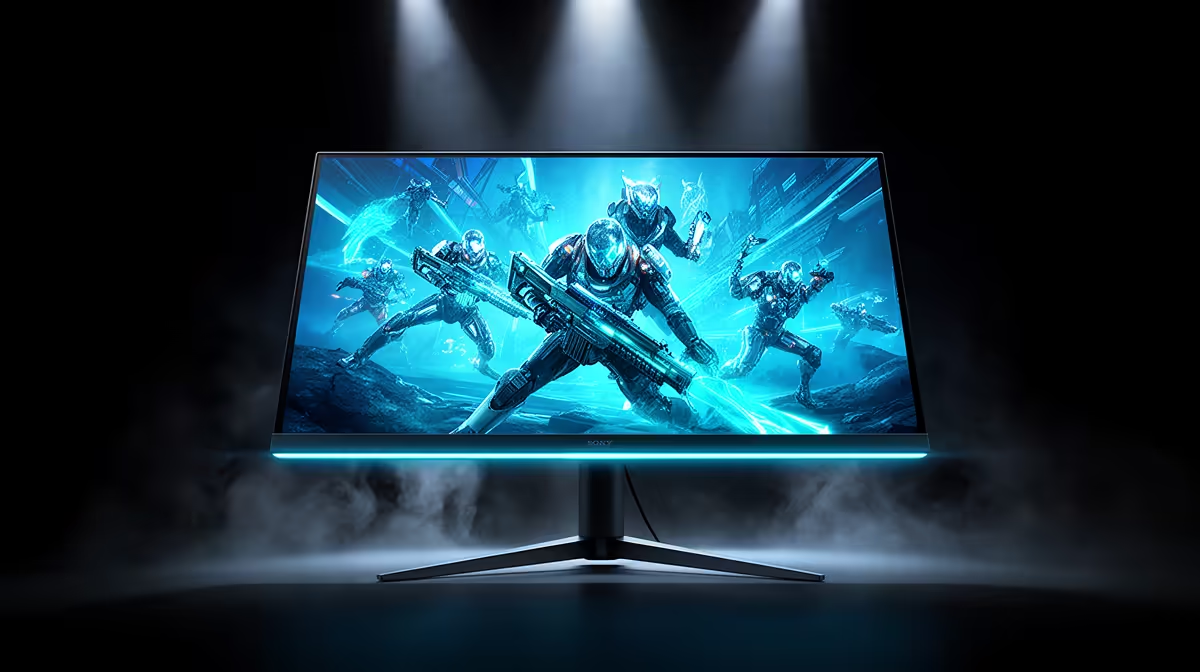
Screen tearing is fixed by VRR (G-Sync or FreeSync). Ghosting is reduced by fast pixel response times and backlight strobing technologies like ELMB Sync. ELMB Sync is ASUS's implementation of backlight strobing that works during VRR operation, addressing both artefacts simultaneously on supported panels.
Screen Tearing: Why It Happens and How VRR Fixes It 📡
Tearing occurs when the GPU sends a new frame to the monitor before the current refresh cycle is complete. The monitor displays part of one frame and part of the next in a single refresh, creating a visible horizontal split.
VRR resolves this by inverting the relationship: instead of the monitor refreshing at a fixed interval regardless of GPU output, the monitor waits for the GPU to signal that a frame is ready. The display then refreshes exactly when that frame is complete. On a G-Sync Compatible or FreeSync Premium Pro monitor running at 48Hz to 300Hz variable range, tearing is eliminated across all frame rate levels within that range.
Ghosting: What Causes It and How to Minimise It 🔧
Ghosting is the trailing smear or shadow that appears behind fast-moving objects on screen. It results from liquid crystal pixels being slow to transition between values.
Overdrive circuitry applies extra voltage to speed up transitions, reducing ghosting. Too much overdrive causes inverse ghosting, where a bright halo appears ahead of the moving object.
Fast IPS panels rated at 0.5ms to 1ms GTG handle ghosting well at 240Hz and above. VA panels at 4ms to 8ms GTG have more noticeable ghosting in fast scenes and are not recommended for competitive play.
ELMB Sync: The Technology That Attacks Both Problems 💡
ELMB Sync is ASUS's branded implementation of VRR-compatible backlight strobing. Standard backlight strobing required a fixed refresh rate to function correctly, forcing users to choose between VRR tear elimination and strobing-based motion blur reduction.
The strobing works by briefly extinguishing the backlight between each frame. This prevents the eye from tracking the pixel decay from the previous frame into the next, which is the underlying cause of perceived blur during movement. The brightness tradeoff is typically 20 to 30 percent, but many users find they can compensate in the monitor's OSD.
Keep VRR On, Toggle ELMB Sync by Environment ⚡
VRR enabled at all times for tearing prevention. Toggle ELMB Sync based on your room's ambient light: in a dark room it sharpens motion visibly, but the brightness drop is less tolerable in a bright environment. Creating two OSD presets, one with ELMB on and one without, lets you switch in under 10 seconds.
FAQ
Can ELMB Sync be used with a non-Nvidia GPU?
ELMB Sync operates at the monitor hardware level and does not require Nvidia or AMD driver support. However, VRR must also be active, and your GPU needs to support G-Sync Compatible or FreeSync for VRR to function. On an AMD GPU with FreeSync enabled on an ASUS ELMB Sync monitor, ELMB Sync works normally.
Does VRR work on HDMI as well as DisplayPort?
Yes, modern VRR implementations support both. HDMI 2.1 carries FreeSync and G-Sync Compatible at up to 4K 144Hz or 1440p 300Hz. DisplayPort 1.4 handles the same bandwidths. For most QHD 300Hz monitors, either connection supports the full refresh range with VRR active, but DisplayPort is more common on desktop builds.
What is the difference between FreeSync, FreeSync Premium, and FreeSync Premium Pro?
Base FreeSync has no minimum frame rate guarantee or LFC (Low Framerate Compensation) requirement. FreeSync Premium adds LFC support, which doubles the refresh rate when fps drops below the minimum VRR range to prevent tearing. FreeSync Premium Pro adds HDR colour requirements on top.
Want a monitor that handles both tearing and ghosting?
Evetech stocks gaming monitors with VRR and advanced motion blur reduction from brands like ASUS and LG, with local warranty coverage. Browse the monitors section to find a panel that fits your competitive setup.