Quick Answer
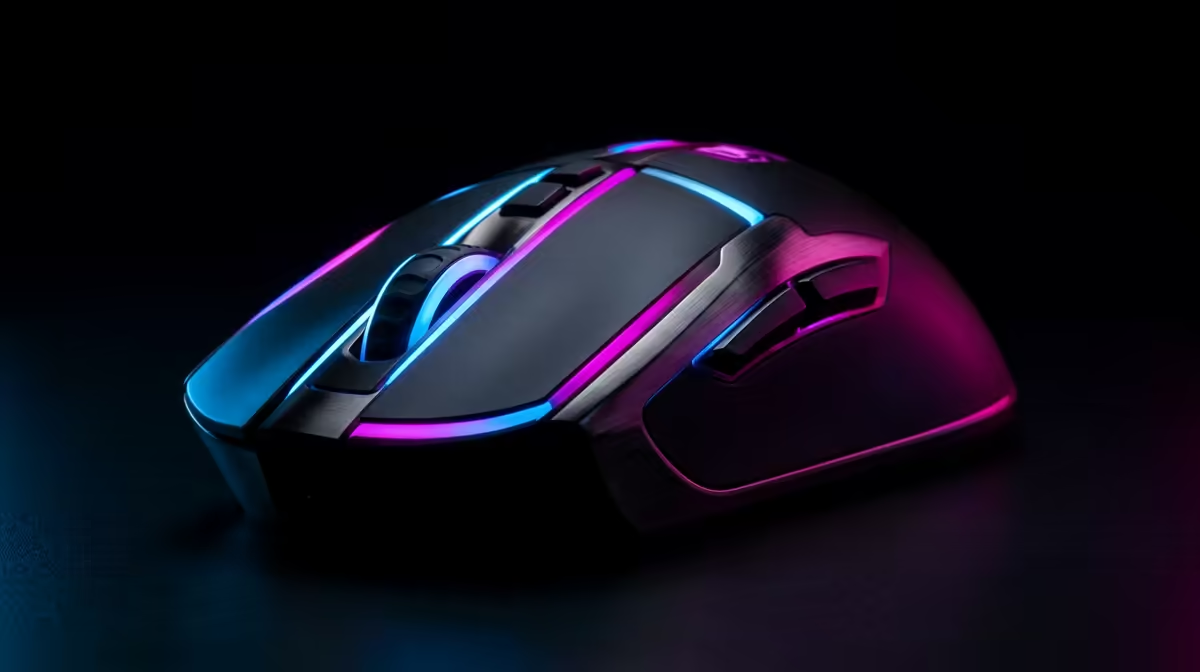
Razer's 5G Advanced 18K DPI sensor is a precision optical sensor tracking at up to 18,000 DPI with 450 IPS speed, zero hardware acceleration, and true 1,000:1 tracking resolution. For practical use, set it to 800 to 1,600 DPI: the 18,000 DPI ceiling is a specification headroom figure, not a recommended daily setting.
What Makes the 5G Advanced Sensor Different 🔬
The 5G Advanced sensor uses a precision lens array and high-speed CMOS image processor to capture surface texture at rapid intervals and compute displacement vectors with minimal filtering. Where cheap sensors apply smoothing algorithms that introduce positional lag, the 5G Advanced reports raw coordinates, earning its "no hardware acceleration" label. Tracking speed of 450 IPS means even the fastest flick shots in FPS titles will not cause the sensor to skip. The sensor works cleanly on most non-reflective surfaces: cloth mouse pads, wood desks, and hard plastic pads. It performs poorly on reflective glass or mirror-finish surfaces, which is a rare but important caveat.
Understanding the 18,000 DPI Rating in Context 🖱️
DPI represents how many steps the sensor reports per inch of physical movement. At 18,000 DPI on a 1080p monitor, one millimetre of mouse movement sweeps nearly the full screen width. This is genuinely useful only on 4K or 8K multi-monitor setups. For South African gamers on standard 1080p or 1440p displays, 400 to 1,600 DPI is the functional sweet spot. The 18K ceiling matters as future-proofing and as a measure of the sensor's underlying resolution capability rather than a setting anyone actually uses day to day.
Wireless Performance and Power Consumption 🔋
In wireless mice like the Orochi V2, the 5G Advanced sensor communicates with the microcontroller via an internal SPI bus. The wireless radio then transmits position data to the receiver. Sensor polling at 1,000 Hz in 2.4 GHz mode consumes more power than Bluetooth mode at a lower polling rate. Razer manages this with a sleep-state algorithm that drops the sensor to low-power tracking mode after seconds of inactivity. On a single AA battery, the Orochi V2 sustains up to 425 hours of 2.4 GHz use with this power management active, a meaningful advantage for SA students gaming in short bursts between classes.
Calibrate the Sensor to Your Specific Pad ⚡
Open Razer Synapse's Surface Calibration feature and select your specific mousepad model or run a manual calibration if it is not listed. This adjusts the sensor's lift-off distance and tracking parameters for your exact pad texture, improving micro-adjustment accuracy at low DPI settings. SA gamers using generic cloth pads should run manual calibration for best results.
FAQ
Does the 5G Advanced sensor work on all surface types?
It performs reliably on cloth, hard plastic, and smooth wood surfaces. Reflective, glass, or heavily uneven surfaces cause tracking errors on this and virtually every optical sensor. A dedicated mousepad is recommended for competitive play.
Is there a perceptible difference between the 5G Advanced and a Pixart 3395 sensor?
Both are top-tier optical sensors with no hardware acceleration and similar tracking speeds. In blind tests, most players cannot distinguish between them. Practical differences appear in wireless power management and driver features rather than raw tracking accuracy.
Can I use the 5G Advanced at very low DPI like 400 without accuracy loss?
Yes. The sensor maintains sub-millimetre accuracy at 400 DPI. The slight downside at very low DPI is that pixel rounding becomes more visible on lower-resolution displays, but for competitive FPS play on 1080p monitors, 400 to 800 DPI is perfectly accurate.
Ready to experience precision wireless tracking on a compact mouse?
Evetech stocks the Razer Orochi V2 and other 5G Advanced sensor mice, available online with fast delivery nationwide.