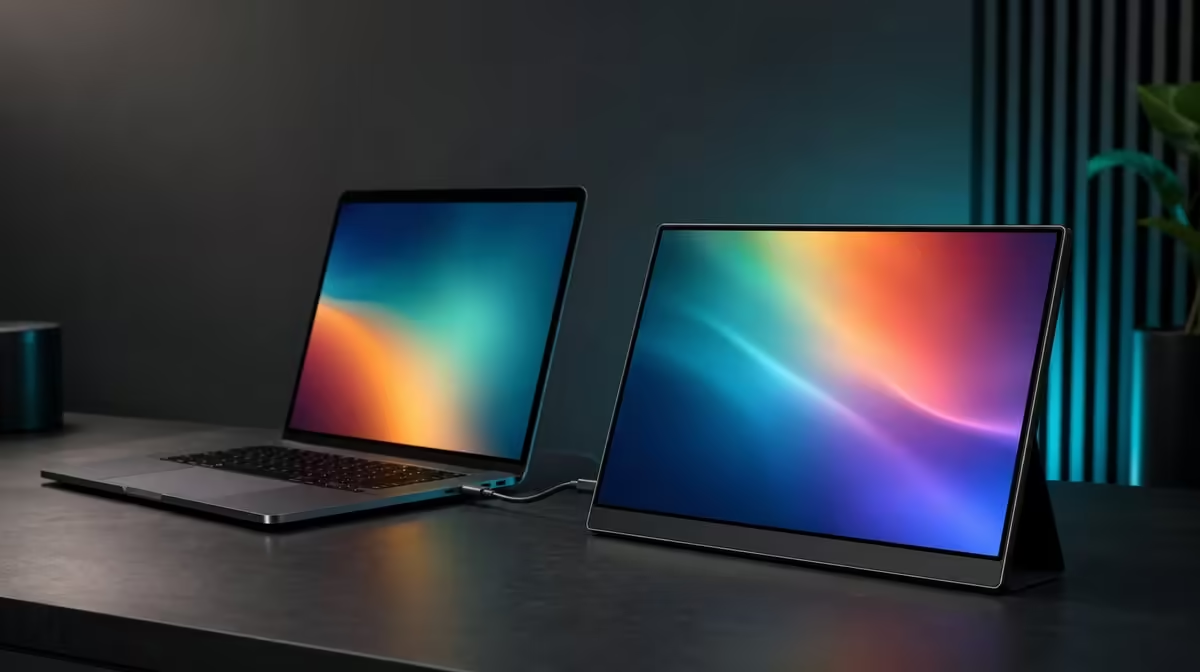
A colour gamut can be broad while individual colours still miss their intended targets. The accuracy of a 125% sRGB portable monitor therefore cannot be answered from the percentage alone; coverage, calibration, measured error and software colour management describe different parts of the result.
Quick Answer
The R2,399 UPERFECT UFree V advertises 125% sRGB gamut coverage on a 15.6-inch IPS panel. That supports a broad colour range. Colour-critical work still needs measurement, calibration and managed applications.
🌈 Separate gamut from accuracy
sRGB defines a reference colour space. A 125% sRGB claim means the panel's gamut covers an area larger than that reference. The shape of the additional coverage matters, so the number does not mean every boundary extends evenly.
Accuracy asks how closely a displayed value matches a target. A screen may cover a large gamut and still need correction. Conversely, a well-calibrated standard-gamut display may reproduce its covered space closely.
The percentage does not mean "25% more accurate", and it does not establish Delta E or another measured error. No such result is confirmed for the UFree V in this fact set.
Use a neutral picture mode when evaluating the monitor. A vivid preset can deliberately boost saturation and make a broad gamut look impressive while obscuring whether skin tones, greys and ordinary sRGB material appear believable.
Evetech's portable display range can be compared by keeping gamut and accuracy in two separate columns.
🧪 Build a controlled colour check
Set the UFree V to native 1920 x 1080 through the connection already proven for that source. Resolution does not determine gamut, but a stable link removes connection changes from the test.
Choose steady room lighting and move reflections off the panel. Set brightness to a repeatable level below the 350cd/m2 maximum when the room allows. Accuracy comparisons become weak when the display and environment change between images.
Open familiar photographs containing neutral greys, natural skin tones, saturated objects and smooth gradients. Add known colour patches when available. Look for unexpected casts, clipping and over-saturation rather than choosing the image that appears most dramatic.
Compare a colour-managed creative application with a program that does not handle the same profile. A difference between them can expose a workflow issue rather than a panel defect.
Use the 178-degree viewing specification as support for off-centre visibility, not as permission to calibrate from the side. Keep the measurement device and primary viewer square to the display.
🎛️ Calibrate when the work demands it
For colour-critical delivery, use appropriate measurement hardware and software. Create a profile for the specific display, brightness target and room arrangement. Save the date and retest after meaningful environment or picture-setting changes.
Calibration can improve the relationship between requested and displayed colour within the panel's capabilities. It cannot create perfect uniformity, remove glare or turn every application into a colour-managed one.
The 1500:1 contrast ratio describes bright-to-dark output, not chromatic accuracy. Near-black separation is relevant to editing, but it should be tested with dedicated tonal patches rather than inferred from the gamut.
If a trusted reference display is available, compare the same managed file under similar light. Agreement is useful evidence; disagreement is a question to measure, not automatic proof that the more vivid screen is better.
Record the source device, cable route, picture mode, brightness, profile and application. Portable monitors move between machines, and a calibration created for one path may not describe another unmanaged setup.
The larger Evetech monitor department can frame fixed colour-work alternatives when controlled placement matters more than travel.
🎨 Decide which creative tasks fit
The UFree V can provide a broad portable canvas for tool panels, asset review, illustration, photo selection and managed previews. It may also suit vivid media where strict delivery accuracy is not the goal.
For final client colour, print proofing or other critical output, require the evidence the job deserves. That may include measured accuracy, uniformity checks and a controlled reference display beyond the confirmed 125% sRGB figure.
Do not ignore ergonomics. Use the foldable stand to centre the panel and keep reflections stable. A creator repeatedly changing angle cannot make consistent visual judgements.
A mobile creative workflow should verify the complete carried weight, including cables and protection. Plan audio through the source or compatible external hardware for video work.
At R2,399, the UFree V offers wide gamut, Full HD IPS, strong stated brightness and useful connections. Its value for creative work is credible when the buyer treats 125% sRGB as coverage and builds the required accuracy process separately.
Check Evetech's current popular monitors with the same evidence requirements at purchase time.
Create a three-level creative-use policy. Level one covers layout, tool panels and general media, where a neutral visual check may be enough. Level two covers managed editing with a measured profile. Level three covers final colour approval against the organisation's required reference process.
Place the UFree V only in the levels supported by evidence. Its 125% sRGB gamut is relevant at every level, while accuracy claims belong only where measurement supports them.
Measure at the brightness used for real work, not the maximum 350cd/m2 output. A calibration created at an unrealistic luminance may not describe the daily setup.
Check uniformity across several panel regions with appropriate tools when the task depends on it. The IPS label and wide viewing number do not supply a uniformity result.
Repeat the neutral image set through USB-C and Mini HDMI only if both routes will be used. Preserve the same source settings so connection changes do not become colour-management changes.
Keep a profile name that includes the source, brightness and date. Another person should be able to select it without assuming that every computer shares the same colour configuration.
Use a soft proof or other application-specific function only when the creator understands its target. A managed display cannot correct an incorrect export or an unmanaged destination.
For client sharing, let wide viewing help conversation while keeping the central seat as the approval position. Move the stand, not the colour controls, to give the group a clearer view.
At review time, report gamut, measured accuracy, uniformity, viewing position and application support separately. This makes the R2,399 panel useful without stretching one percentage into a complete professional guarantee.
Archive the measurement data with the exported work when colour accountability matters. The file should identify the display profile and environment without claiming that every future UFree V setup will reproduce it.
Review the policy whenever the panel moves to a new computer. Colour management belongs to the whole source-to-display path.
Frequently Asked Questions
What does 125% sRGB actually measure?
It describes a gamut area larger than the standard sRGB reference.
Can gamut coverage prove accuracy?
No. Accuracy requires evidence about calibration and measured colour error.
Is the panel still useful for creative work?
Yes. It can provide broad colour space for managed tools, media and portable previews.
Why can a wide gamut look over-saturated?
Standard content can be expanded beyond its intended colours when software or picture modes do not manage the gamut.
How does viewing angle affect colour judgement?
Off-centre visibility may remain good, but centred viewing is more consistent for critical comparison.
What role does brightness play?
It establishes luminance for the room; repeatable colour work needs a stable, suitable level.
What does this wide-gamut panel cost?
The UPERFECT UFree V costs R2,399.
Ready to measure accuracy instead of reading it into a gamut number?
Compare Evetech's wide-colour portable monitors and give the UFree V a neutral, managed and repeatable creative test.