Quick Answer
Frame drops in high-resolution gaming are almost never caused by the DisplayPort cable itself when it is a certified 21.6Gbps DP 1.2 unit. That bandwidth comfortably supports 4K@60Hz (roughly 12.5Gbps required) and 1440p@144Hz. If frames are dropping, the fault is almost certainly the GPU, VRAM saturation, or system RAM bottleneck, not the signal cable.
What 21.6Gbps Actually Covers 🎮
DisplayPort 1.2 delivers 21.6Gbps total, translating to approximately 17.28Gbps of usable payload after 8b/10b encoding overhead. That headroom handles 4K@60Hz, 1440p@165Hz, and 1080p@240Hz simultaneously without any bottleneck at the cable. South African gamers running an RTX 5070 Ti or RX 9070 XT on a 1440p 165Hz monitor are completely fine with a DP 1.2 cable. The cable only becomes a bottleneck above 4K@60Hz, such as 4K@120Hz or higher, which requires DisplayPort 1.4 (32.4Gbps) or DP 2.1 (80Gbps).
The Real Culprits Behind Frame Drops 🔧
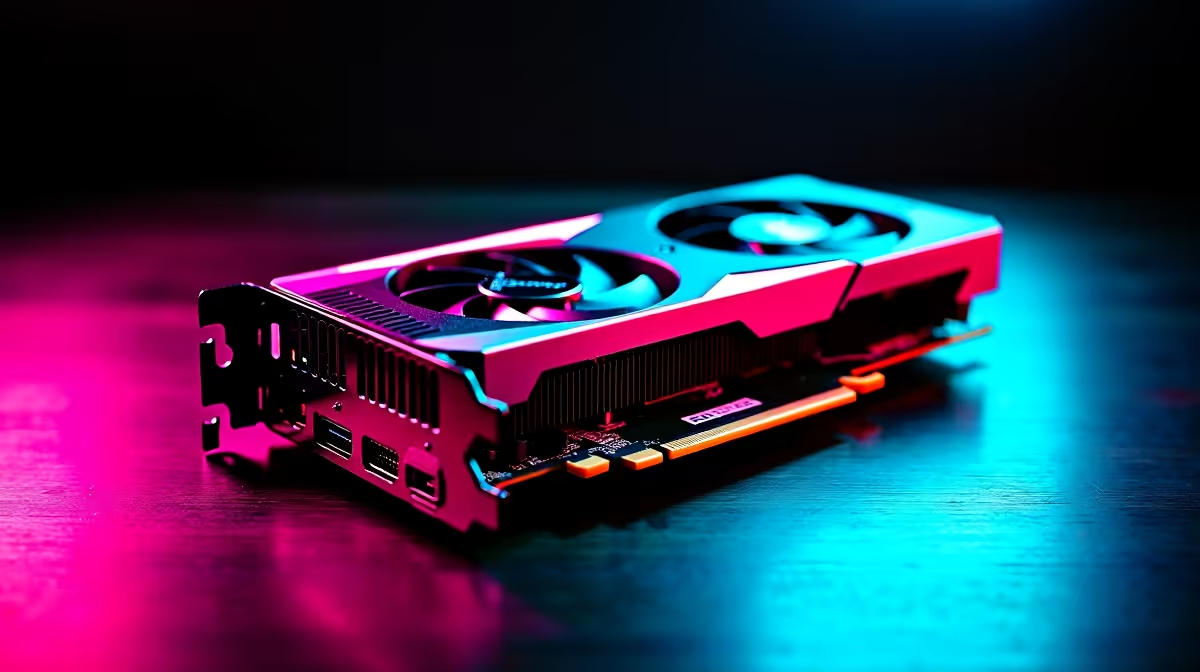
Before blaming the cable, open GPU-Z or MSI Afterburner during gameplay and watch GPU utilisation, VRAM usage, and frame-time spikes. At 4K ultra settings, games like Cyberpunk 2077 can demand 12GB to 16GB of VRAM. If your card has 8GB, frames will stutter when textures overflow to system RAM. A loose PCIe power connector on the GPU can also cause thermal throttling that produces irregular frame drops that look exactly like signal dropouts. Only suspect the cable if you see pixel artefacts or brief black screens alongside the drops. A properly rated DP 1.2 cable certified for 21.6Gbps will not degrade under sustained gaming loads.
Upgrading Your Signal Path for Consistency 🖥️
If you have ruled out GPU and VRAM issues, confirm your cable is genuinely rated for the bandwidth it claims. Cheap unbranded cables sold locally often fail electromagnetic compliance tests, causing sporadic pixel errors or link resets that look identical to frame drops. Investing around R150 to R350 in a certified DisplayPort cable with triple-layer shielding eliminates this variable entirely. For SA coastal users in Cape Town or Durban, humidity accelerates connector oxidation on bare-copper cables, making gold-plated contacts especially important for long-term signal stability.
Reinstall GPU Drivers First ⚡
Before swapping cables, do a clean GPU driver reinstall using DDU (Display Driver Uninstaller) in Safe Mode. Corrupted drivers cause frame-time spikes that are indistinguishable from hardware faults, and a fresh driver install is free and takes under ten minutes.
FAQ
Can a DisplayPort cable cause frame drops?
A defective or underspec cable can trigger link resets that appear as dropped frames, but a correctly rated 21.6Gbps DP 1.2 cable will not limit GPU output. If you see visual artefacts alongside frame drops, try a replacement cable. Pure frame stuttering without artefacts points to GPU thermals or VRAM pressure first.
Is 21.6Gbps enough for 4K gaming in 2026?
For 4K at 60Hz it is more than adequate. For 4K at 120Hz or above you need DisplayPort 1.4 (32.4Gbps). Most mid-range monitors in SA top out at 4K@60Hz or 1440p@144Hz, where 21.6Gbps remains perfectly sufficient through the current hardware generation.
What GPU do I need for smooth 4K 60fps?
For consistent 60fps at 4K ultra settings in current titles, look at a minimum of the RTX 5070 or RX 9070 XT, both available locally. Cards in the R12,000 to R18,000 range handle 4K at high-to-ultra in most AAA titles, and their 12GB to 16GB VRAM prevents texture-related stuttering.
Struggling with frame drops and unsure where to start?
Browse Evetech's current range of GPUs and certified DisplayPort cables to rule out hardware and upgrade with confidence.