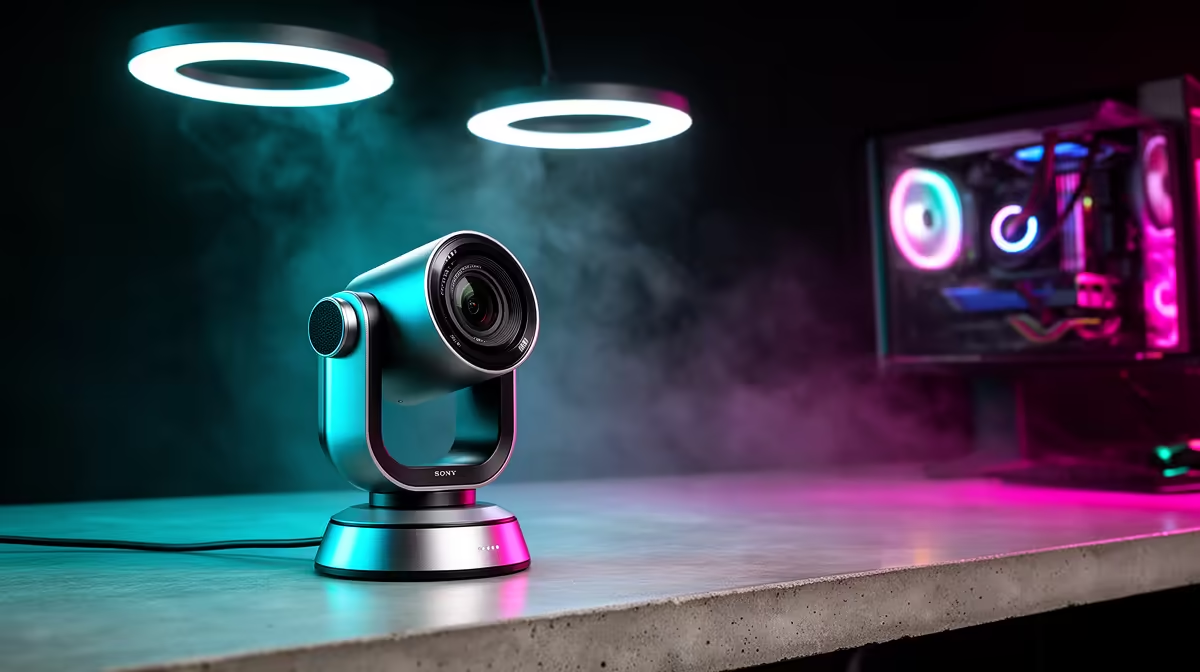
The webcam microphone has improved substantially over the past few years. AI noise cancelling, dual capsule arrays, and dedicated onboard processing have lifted what was once barely adequate hardware into something genuinely usable. The question is whether the built-in AI noise-cancelling webcam microphone has improved enough to replace a dedicated streaming mic, or whether physics still limits what it can do.
Quick Answer
A webcam mic with AI noise cancelling handles meetings and casual streams well: it strips background hiss and keyboard noise reliably. For polished podcasting, voice content, or ASMR, it cannot match a dedicated USB microphone at 15cm. The 40 to 60cm distance a webcam sits from your mouth is the limitation AI cannot fully overcome.
🎙️ The Distance Problem
Microphone performance is fundamentally a proximity equation. Acoustic pressure, which is how sound energy concentrates at the capsule, falls off with distance. A dedicated USB microphone placed 15 to 20cm from your mouth captures a dense, warm signal dominated by your voice. A webcam capsule positioned 40 to 60cm away captures a weaker version of that same voice, plus a proportionally larger sample of everything else in the room: HVAC fans, traffic outside, the hollow reflections from hard walls.
This is not a technology problem that AI can fully solve. The processing can filter out predictable background signals, but it cannot add acoustic energy to your voice that was never captured in the first place. A close microphone picks up the physical resonance of your chest and throat as your voice forms. A distant capsule misses most of it, which is why webcam audio often sounds thin even when it is technically clean.
What the Capsule Array Does
Some higher-end webcams include dual capsule arrays that use directional processing to favour audio from the front of the camera while attenuating audio arriving from other angles. This helps by reducing room noise, but the gain from directional processing still cannot compensate for the fundamental advantage a close-mounted capsule has over a distant one.
🔧 What AI Noise Cancelling Actually Fixes
AI noise cancelling on a webcam is genuine and functional. The processing identifies signals with consistent spectral patterns, fan hum, keyboard clicks, air conditioning rumble, and treats them as noise rather than content. For South African remote workers dealing with the fan hum or HVAC noise that comes with any Joburg flat or home office, a well-implemented AI noise filter keeps voice intelligible without the constant ambient noise floor a non-cancelling mic would deliver.
For video meetings on Zoom or Microsoft Teams, this is often enough. The voice quality threshold for business meetings is clarity and intelligibility, not warmth or richness. An AI-filtered webcam mic delivers both while sitting inconspicuously at the corner of the monitor.
The processing also handles transient noises reasonably well. A brief keyboard rattle or mouse click during a call is largely inaudible with good noise cancelling active. Sustained irregular noises, a nearby conversation, a dog barking repeatedly, exceed what most systems can filter without audible artifacts in the voice signal.
✨ Where the Dedicated Mic Pulls Ahead
Podcasting, commentary recording, and voice content all require more than clean intelligibility. They need warmth, detail, and the natural body of a human voice. These qualities come from the acoustic relationship between lips, throat, chest, and capsule at short range. A 15cm working distance captures harmonics and breath texture that give voice recordings their sense of presence.
On a dedicated dynamic or condenser USB microphone at close range, the low-frequency body of a voice registers clearly. That is the quality that listeners associate with professional audio, whether on a podcast, a YouTube commentary track, or a gaming stream where the host's voice needs to hold attention over several hours.
The webcam mic, regardless of AI processing quality, is sourcing a signal from too far away to capture those qualities fully. AI can clean the signal. It cannot synthesise what was never close enough to record.
ASMR content depends even more heavily on proximity and capsule sensitivity. The delicate, intentional sounds ASMR creators produce require a microphone essentially touching the source. No webcam mic can replicate this, and AI processing would likely suppress many of the very sounds the content depends on.
Pro Tip ⚡
If you are evaluating your webcam mic honestly, record 60 seconds of yourself speaking at normal stream level and listen back on headphones. If you can hear thinness in the voice, the room behind your words, or any sense that you are further away than you should be, those are distance artefacts. A USB mic on a desktop stand would fix them immediately for under R500.
🎯 Which Creators Can Rely on the Webcam Mic
The answer depends on content type and audience expectations.
For remote workers attending video meetings, the webcam mic with AI noise cancelling is legitimate and sufficient. Clarity on a Teams or Zoom call does not require broadcast audio. Participants need to hear and understand. An AI-filtered webcam mic delivers that without any additional gear.
Casual streamers running games with background chat, or IRL streams where audio quality is secondary to the content, can also manage with a webcam mic. The filter keeps chat audible without requiring any thought about microphone positioning or gain structure.
Creators building an audience around voice quality, podcast-style commentary, or any content where the listening experience is a production value, need a dedicated microphone. This does not require expensive gear. A USB dynamic or condenser at a reasonable price point in the R500 to R1,500 range and positioned correctly will clearly outperform any webcam capsule.
Music and ASMR creators need not consider the webcam mic for primary audio capture. Those content types have capsule proximity requirements that a desk-mounted webcam cannot physically meet.
Frequently Asked Questions
Can a webcam mic match a dedicated USB streaming microphone?
For voice clarity on calls, they come close. For audio quality in recorded content or polished streams, no. The physical distance between a webcam and your mouth means the capsule captures less acoustic energy from your voice and more reflected sound from the room. A dedicated USB mic at 15cm picks up a fundamentally richer signal regardless of how good the webcam's AI processing is.
Does AI noise cancelling solve the problem of recording from 50cm away?
Partially. It removes consistent background noise like fans and ambient hum, which makes the voice cleaner and easier to hear. It cannot add the warmth and body that come from recording close to the source. A clean, thin-sounding voice is still thin-sounding after processing. The distance limitation is acoustic, not a filtering problem.
Is a webcam mic adequate for business video calls?
Yes. Intelligibility and clarity are the relevant metrics for meetings, and a well-implemented AI noise cancelling system delivers both. Colleagues on Zoom or Teams need to understand you clearly. That bar is consistently met by modern webcam mics without any additional hardware.
Will a webcam mic pick up echo in a bare room?
More than a close-miked dynamic would. At 50cm or more from the source, the microphone captures a blend of direct voice and reflected sound from the walls. Hard-surfaced rooms common in South African flats and open-plan offices contribute noticeable echo at that distance. Adding soft furnishings or recording in a furnished room reduces this significantly.
Which streamers can rely on the webcam mic as their only audio source?
Casual chatters, casual gaming streamers, and presenters using the webcam for informal screen sharing or meetings can manage well. Creators whose audience expects polished audio, including podcasters, commentators, voice-over producers, and ASMR creators, need a dedicated microphone positioned close to the mouth. The webcam mic handles the former category; it does not cover the latter.
Ready to upgrade your stream audio beyond what the webcam capsule can deliver?
Browse the USB streaming microphone range and find the option that gives your voice the close-miked clarity and warmth your audience will notice.