


PCIe 5.0 vs PCIe 4.0 for Video editing in 4k in SA
PCIe 5.0 vs PCIe 4.0 for video editing in 4k is mainly about fit, features, compatibility, cost, and upgrade path, not one automatic winner. SA buyers should match the choice to the setup.
Read moreThe Ryzen 7 5800X3D can still make sense for an AM4 owner who needs eight cores, 16 threads and 100MB cache without rebuilding the platform. At R7,199, its value depends on BIOS support, cooler and discrete-GPU costs versus moving to a newer system.
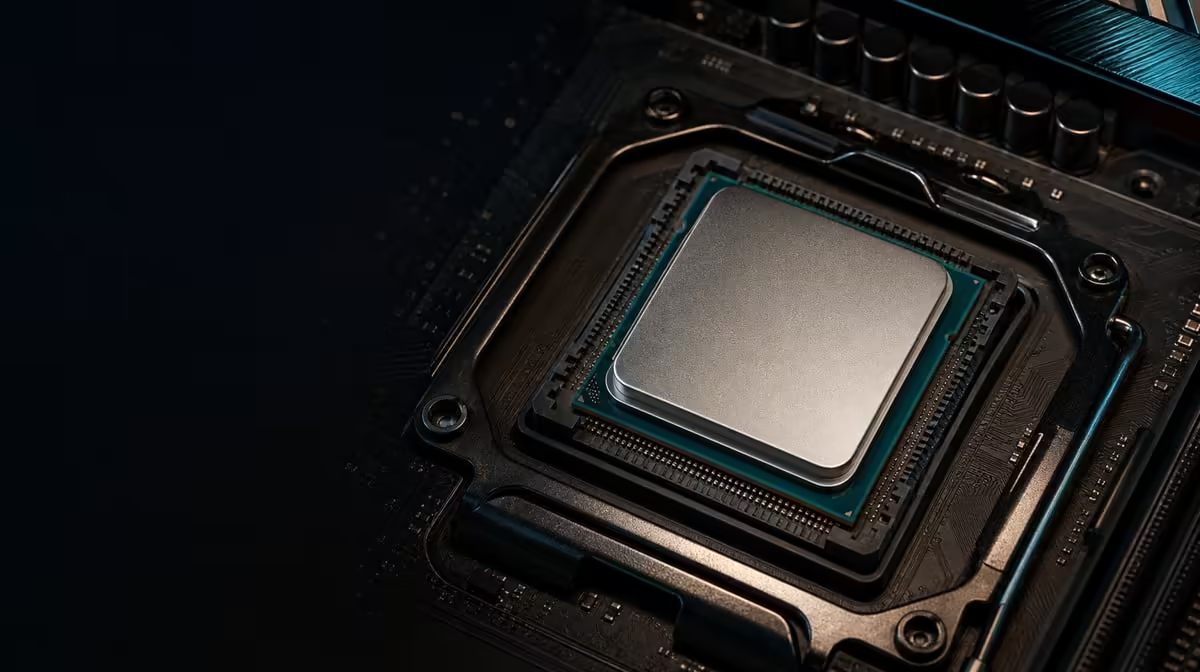
Replacing a processor on an established platform can deliver more value than starting again, but only when the old parts are worth keeping. Is the Ryzen 7 5800X3D still worth buying is therefore an AM4 ownership question before it becomes a benchmark question. Its R7,199 price buys eight Zen 3 cores, 16 threads and 100MB cache, while cooling, graphics and motherboard readiness remain part of the decision.
The Ryzen 7 5800X3D still makes sense for a gamer with a supported AM4 motherboard, serviceable memory and a workload that is genuinely CPU-limited. At R7,199, it can avoid the cost of replacing the wider platform, but it includes no cooler and needs a discrete GPU. Check the exact board and BIOS, price the complete installation, and compare the gain with putting that money into graphics or a newer platform.
The clearest candidate already owns a working AM4 PC. Its motherboard appears on the processor support list, the appropriate BIOS is available, and the memory, power supply, case and graphics card remain suitable for the intended games. In that situation, the new processor can reuse much of the machine instead of turning one performance problem into a multi-component rebuild.
The 5800X3D provides eight cores and 16 threads on the Zen 3 architecture. It also carries 100MB cache, a specification that can be useful in games that repeatedly access the same working data. Those resources create a focused gaming upgrade, but they do not guarantee that every title will respond equally. A game limited by the graphics card may show little change, whereas a CPU-sensitive engine can expose a clearer difference.
An owner should establish the present limit before spending. Repeat a representative game scene, note the graphics settings and observe whether reducing graphics load creates substantially more frames. Check frame consistency, not only the average. If the GPU remains fully occupied while the desired experience is not reached, the graphics card may deserve priority. If processor work is preventing the GPU from being fed quickly enough, a CPU replacement has a stronger case.
For a model-level comparison, Evetech's AMD CPU range lets an AM4 owner weigh the R7,199 option against other processor choices.
The processor price is the starting amount, not necessarily the installed total. No CPU cooler is included, and the 105W processor needs an AM4-compatible solution suited to the workload. The cooler also has to fit the case, clear surrounding parts and work with the chassis airflow. Reusing an existing unit is sensible only after confirming mounting support and capability, rather than assuming every older AM4 cooler remains the right match.
A discrete graphics card is compulsory for display output. Existing AM4 gamers usually have one already, which can strengthen the reuse case, but a new system budget must add it separately. The graphics card also needs suitable power, physical space and a monitor connection. The CPU does not make the motherboard's display sockets functional.
Platform reuse is where the economics can become compelling. Keeping a supported board and usable memory avoids buying replacements simply to change the processor. However, reuse has no value if the board cannot run the 5800X3D reliably, if the machine needs several other expensive repairs, or if the buyer's intended work would benefit more from a broader platform change.
Compare the final total with the outcome, not only with another CPU sticker price. The broader processor category can frame alternatives across platforms, while the decision sheet should include any cooler, labour or companion upgrade genuinely required for the chosen path.
AM4 is the socket family, not a blanket compatibility promise. Find the full motherboard model, open its official processor support information, confirm that the Ryzen 7 5800X3D is named, and note the required BIOS version. Similar board names and revisions can have different firmware histories, so shortcuts based on the chipset label are risky.
If an update is needed, prepare it while the current processor still boots. Record the existing firmware version and stable memory settings, read the board maker's update instructions, and keep a practical rollback plan. Removing the old CPU first can leave the owner without the hardware needed to complete a prerequisite update.
Cooling and display readiness belong in the same compatibility check. Select an appropriate option from the CPU cooler collection only after confirming AM4 mounting and physical fit. Make sure the discrete GPU is installed, powered and connected to the monitor before interpreting a black screen as a processor fault.
After the swap, start with stable settings. Confirm processor detection, memory capacity and safe temperatures before benchmarking. Maximum boost is specified up to 4.5GHz, while the base clock is 3.5GHz. A sustained workload may not hold every core at the maximum, so a single clock number is not a sufficient health test.
The 100MB cache is significant because nearby data can be served without as many trips to slower system memory. Games that reuse data effectively may respond well, especially when the processor is the active constraint. Other titles may be governed mainly by the graphics card, a frame cap, engine behaviour or a demanding visual setting. The CPU feature is real; a universal performance percentage is not.
Eight cores and 16 threads also give the machine room for game processes and parallel background work. That does not mean core count alone settles every multitasking comparison. The exact applications, their thread behaviour, memory use and storage activity all affect the result. Compare the actual workloads rather than treating a tier name as a substitute for measurement.
Resolution and target frame rate change the value judgement. Higher visual loads often push more work onto the GPU, while a high-frame-rate target can demand quicker CPU preparation of frames. A buyer playing graphics-heavy games at a capped frame rate may find another upgrade more visible. Someone retaining AM4 for processor-sensitive play may find the 5800X3D addresses exactly the missing resource.
There is no honest claim that one CPU will remain ideal for a fixed number of years. A defensible conclusion uses today's system, intended games, board support and complete cost. If the machine can reuse sound AM4 parts and testing points to a CPU limit, R7,199 can be a focused investment. If support is absent or multiple platform parts already need replacement, compare a wider move before committing.
An AM4 owner with documented motherboard support, reusable memory, a suitable discrete GPU and evidence of a processor limit has the strongest case. That combination concentrates spending on the part that needs improvement.
Treat R7,199 as the CPU price, then add any required cooler, installation and companion hardware. Compare that installed total with the likely result of a graphics upgrade or a broader platform replacement.
A supported AM4 motherboard, serviceable memory, an adequate power supply, a suitable case and a capable discrete GPU can all be reused. Each item should be checked rather than counted automatically.
The 5800X3D is rated at 105W and has no cooler in the package. An AM4-compatible solution with enough capacity, clearance and airflow is therefore required to complete the installation.
Results differ from game to game. Cache-sensitive titles may benefit, but engine design, settings, resolution and the GPU can change how much difference is visible. Controlled tests are more useful than a single general percentage.
Consider it when the motherboard lacks support, several old components need replacement, or the intended workload calls for capabilities beyond the current platform. Compare the whole-system totals before choosing.
A discrete GPU is still required for any display output. It must be installed, powered and connected to the monitor, and it should be balanced with the intended gaming resolution.
Want to find out whether this AM4 upgrade fits your actual PC? Compare the R7,199 Ryzen 7 option with Evetech's processor and cooling choices, then confirm board firmware and graphics readiness before buying.
An AM4 owner with documented motherboard support, reusable memory, a suitable discrete GPU and evidence of a processor limit has the strongest case. That combination concentrates spending on the part that needs improvement.
Treat R7,199 as the CPU price, then add any required cooler, installation and companion hardware. Compare that installed total with the likely result of a graphics upgrade or a broader platform replacement.
A supported AM4 motherboard, serviceable memory, an adequate power supply, a suitable case and a capable discrete GPU can all be reused. Each item should be checked rather than counted automatically.
The 5800X3D is rated at 105W and has no cooler in the package. An AM4-compatible solution with enough capacity, clearance and airflow is therefore required to complete the installation.
Results differ from game to game. Cache-sensitive titles may benefit, but engine design, settings, resolution and the GPU can change how much difference is visible. Controlled tests are more useful than a single general percentage.
Consider it when the motherboard lacks support, several old components need replacement, or the intended workload calls for capabilities beyond the current platform. Compare the whole-system totals before choosing.
A discrete GPU is still required for any display output. It must be installed, powered and connected to the monitor, and it should be balanced with the intended gaming resolution.
PCIe 5.0 vs PCIe 4.0 for video editing in 4k is mainly about fit, features, compatibility, cost, and upgrade path, not one automatic winner. SA buyers should match the choice to the setup.
Read more
Wi-Fi 7 vs Wi-Fi 6e for competitive esports comes down to router support, latency goals, device compatibility, and coverage. SA buyers should match the choice to the real network setup.
Read more
ATX 3.1 vs ATX 3.0 for mMO and live-service games buyers - what changes is mostly about compatibility, budget, upgrade path, and setup fit. SA buyers should check device support and real needs before expecting a clear win from either option.
Read more
LGA 1851 vs LGA 1700 can affect Twitch and YouTube streaming when gaming and encoding share CPU resources. For SA creators, the real-world difference depends on encoder choice, memory support, motherboard cost, thermals, and upgrade plans.
Read more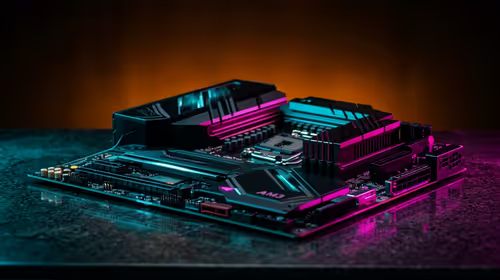
X870E vs X670E for aaa single-player gaming is mainly about fit, features, compatibility, cost, and upgrade path, not one automatic winner. SA buyers should match the choice to the setup.
Read more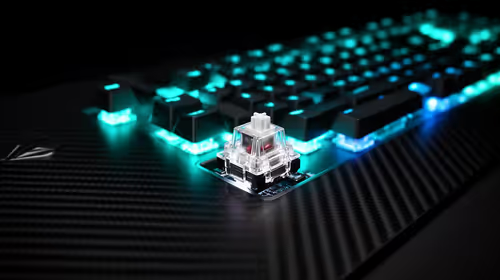
Hall Effect switches vs Mechanical switches for mMO and live-service games is mostly about compatibility, budget, upgrade path, and setup fit. SA buyers should check device support and real needs before expecting a clear win from either option.
Read more
A fake 113GB GTA VI ISO reportedly used empty padding around a small malware payload. SA gamers should delete unofficial builds, keep Windows security active and wait for official channels.

Wi-Fi 6E vs Wi-Fi 6 matters for 4K video editing when files move across a network. The real-world difference between Wi-Fi 6E and Wi-Fi 6 for video editing in 4K depends on NAS access, cloud uploads, router range, and SA creator workflows.

The difference between PCIe 5.0 and PCIe 4.0 for SA gamers is mostly bandwidth headroom. Compare GPU slot needs, NVMe speed, motherboard support, and upgrade timing before paying extra for a newer platform.

Gaming PC stuck pixel checks in South Africa should confirm the monitor fault first. Use colour tests, screenshot comparison, cable swaps, display menu checks, and clear photos before deciding on support.

Shokz OpenFit Air 2 earbuds weigh 7.2g each and use a redesigned dual-driver open-ear layout. SA buyers should choose them for comfort and awareness, not maximum isolation.

AMD's current driver now lists a Radeon RX 9050 4GB, while product coverage details a narrowed memory system. SA buyers should weigh the low VRAM ceiling against current local Radeon options.

Samsung Display has demonstrated a 16-inch 2.5K OLED laptop panel running at 300Hz. SA buyers should wait for a named notebook, full panel specifications and a local price before planning an upgrade.

Microsoft says some Windows 11 game crashes after recent updates are linked to RGB-related drivers. Affected SA gamers should confirm the update and driver before using the published registry workaround.
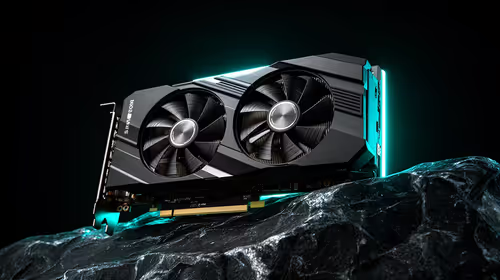
RTX 5090 on a 650W PSU is a tight pairing with very limited headroom. For SA gaming PCs, focus on total system draw, PSU quality, connector support, CPU choice, and avoid OC plans unless the full build is carefully power-limited.
PCIe 5.0 vs PCIe 4.0 for video editing in 4k is mainly about fit, features, compatibility, cost, and upgrade path, not one automatic winner. SA buyers should match the choice to the setup.
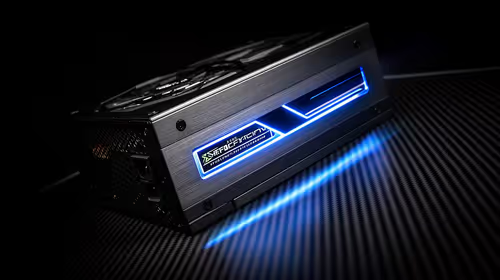
850W PSU safety for RTX 5090 is plausible with a quality unit and balanced parts. In SA, confirm connector support, CPU power draw, case airflow, PSU age, and spare capacity before building around 850W.
Wi-Fi 7 vs Wi-Fi 6e for competitive esports comes down to router support, latency goals, device compatibility, and coverage. SA buyers should match the choice to the real network setup.