


PCIe 5.0 vs PCIe 4.0 for Video editing in 4k in SA
PCIe 5.0 vs PCIe 4.0 for video editing in 4k is mainly about fit, features, compatibility, cost, and upgrade path, not one automatic winner. SA buyers should match the choice to the setup.
Read moreATX 3.1 vs ATX 3.0 for mMO and live-service games buyers - what changes is mostly about compatibility, budget, upgrade path, and setup fit. SA buyers should check device support and real needs before expecting a clear win from either option.
Plenty of MMO and live-service games rigs run beautifully on ATX 3.0, so it pays to know exactly what ATX 3.1 adds before you spend extra.
For MMO and live-service games, ATX 3.0 already covers what you need, and ATX 3.0 units still deliver native 600 W PCIe 5.0 power. Step up to ATX 3.1 only if your build is high-end or you want headroom; expect to pay in the R1,800 to R5,500 band depending on tier.
ATX 3.1 buys you more time before the next upgrade, which suits a fresh platform you plan to keep for years. ATX 3.0 is the pragmatic pick if you upgrade in smaller, more frequent steps.
ATX 3.1 refines the 12V-2x6 connector and transient handling. For always-online worlds and seasonal live-service titles, that translates into stable frame pacing in crowded hubs and quick zone loads when the rest of the system can keep up. The win is real but narrow: it shows in edge cases, not in every minute of play.
ATX 3.0 units still deliver native 600 W PCIe 5.0 power, which keeps it firmly in the value seat. If your current parts are healthy, the money saved by choosing ATX 3.0 is better aimed at the component that limits you most right now.
Often yes, if your motherboard already supports it. Buy a platform with the right slots now and you keep the door open without paying for ATX 3.1 today.
A measurable one in the right scenario, yes. Whether it is a felt difference depends on the rest of your hardware keeping pace.
Only if your platform is new and the price gap is small. For pure MMO and live-service games, ATX 3.0 delivers nearly the same feel, and ATX 3.0 units still deliver native 600 W PCIe 5.0 power.
Decide your MMO and live-service games priorities first, then let the ATX 3.1 versus ATX 3.0 choice fall out of that, not the other way round.
PCIe 5.0 vs PCIe 4.0 for video editing in 4k is mainly about fit, features, compatibility, cost, and upgrade path, not one automatic winner. SA buyers should match the choice to the setup.
Read more
Wi-Fi 7 vs Wi-Fi 6e for competitive esports comes down to router support, latency goals, device compatibility, and coverage. SA buyers should match the choice to the real network setup.
Read more
LGA 1851 vs LGA 1700 can affect Twitch and YouTube streaming when gaming and encoding share CPU resources. For SA creators, the real-world difference depends on encoder choice, memory support, motherboard cost, thermals, and upgrade plans.
Read more
X870E vs X670E for aaa single-player gaming is mainly about fit, features, compatibility, cost, and upgrade path, not one automatic winner. SA buyers should match the choice to the setup.
Read more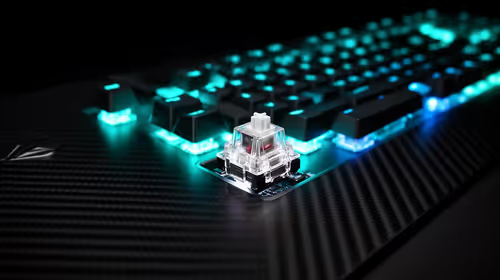
Hall Effect switches vs Mechanical switches for mMO and live-service games is mostly about compatibility, budget, upgrade path, and setup fit. SA buyers should check device support and real needs before expecting a clear win from either option.
Read more
Where Gqeberha gamers buy a gaming PC should be shortlisted around the job it must do. South African buyers should compare fit, performance, compatibility, and upgrade room, warranty path, and upgrade room before treating any pick as best.
Read more
A fake 113GB GTA VI ISO reportedly used empty padding around a small malware payload. SA gamers should delete unofficial builds, keep Windows security active and wait for official channels.

Wi-Fi 6E vs Wi-Fi 6 matters for 4K video editing when files move across a network. The real-world difference between Wi-Fi 6E and Wi-Fi 6 for video editing in 4K depends on NAS access, cloud uploads, router range, and SA creator workflows.

The difference between PCIe 5.0 and PCIe 4.0 for SA gamers is mostly bandwidth headroom. Compare GPU slot needs, NVMe speed, motherboard support, and upgrade timing before paying extra for a newer platform.

Gaming PC stuck pixel checks in South Africa should confirm the monitor fault first. Use colour tests, screenshot comparison, cable swaps, display menu checks, and clear photos before deciding on support.

Shokz OpenFit Air 2 earbuds weigh 7.2g each and use a redesigned dual-driver open-ear layout. SA buyers should choose them for comfort and awareness, not maximum isolation.

AMD's current driver now lists a Radeon RX 9050 4GB, while product coverage details a narrowed memory system. SA buyers should weigh the low VRAM ceiling against current local Radeon options.

Samsung Display has demonstrated a 16-inch 2.5K OLED laptop panel running at 300Hz. SA buyers should wait for a named notebook, full panel specifications and a local price before planning an upgrade.

Microsoft says some Windows 11 game crashes after recent updates are linked to RGB-related drivers. Affected SA gamers should confirm the update and driver before using the published registry workaround.
Shokz OpenFit Air 2 earbuds weigh 7.2g each and use a redesigned dual-driver open-ear layout. SA buyers should choose them for comfort and awareness, not maximum isolation.
A fake 113GB GTA VI ISO reportedly used empty padding around a small malware payload. SA gamers should delete unofficial builds, keep Windows security active and wait for official channels.

The ROG Flux Charger Dock combines 260W total output, 140W laptop charging and HDMI 2.1. SA buyers should check laptop USB-C limits, display needs and local warranty first.

ASRock's Rock 360 Digital AIO adds a 1.05-inch CPU temperature display, 360mm radiator and simplified wiring. SA builders should check case fit, socket support and local warranty.