The component worth paying for is the one that removes a frequent constraint while preserving balance elsewhere in the PC. AMD upgrade kit components worth paying for in South Africa therefore need a workload, platform and complete-budget test. The R38,999 9950X3D package contains premium parts, but each must earn its place separately.
Quick Answer
At R38,999, the package puts a 144MB-cache 9950X3D beside ASUS's X870E Dark Hero, KLEVV 48GB DDR5-7200 and an LQ360 from DeepCool. Pay for the processor when gaming or work can use it, for 48GB when capacity pressure is real, for the board when its exact platform matches the build, and for the cooler when the case supports the liquid layout. Unused capability is not automatically value.
🧠 Give the processor a measured workload
The 9950X3D is the most visible part, but visibility is not the same as priority. Identify CPU-limited games, recurring creation tasks or multitasking patterns before assigning it most of the budget. A powerful GPU-limited gaming setup may see less processor benefit than a high-frame-rate or simulation-heavy workload.
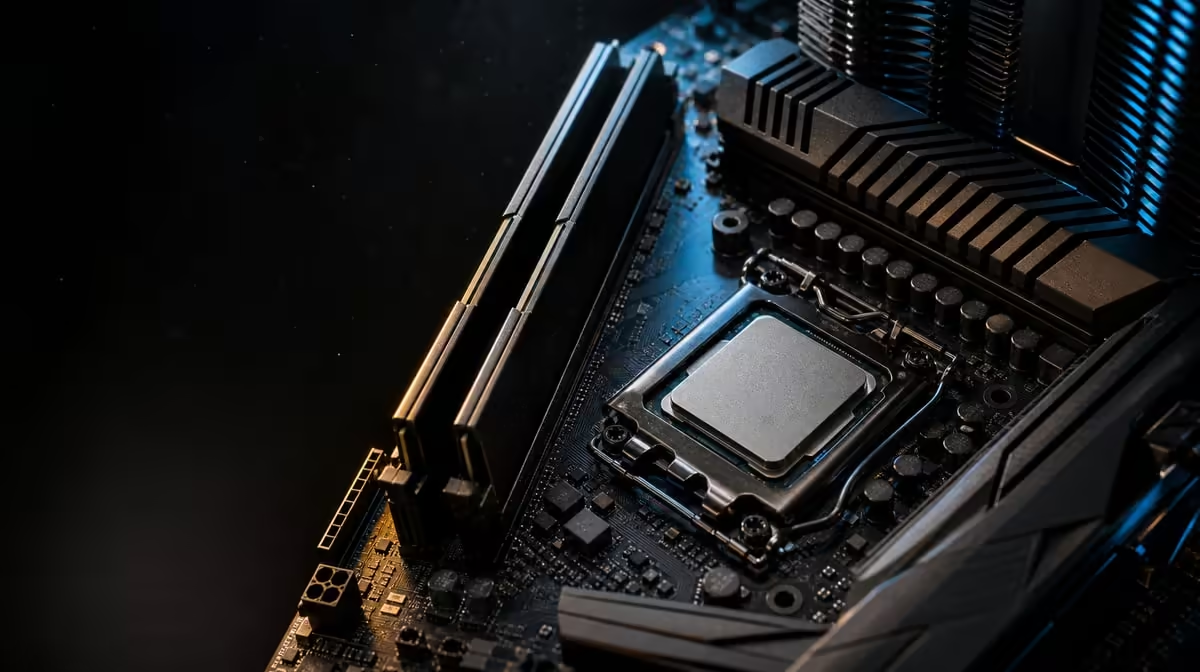
Its 144MB GameCache can reduce some trips to system memory when a game reuses data in cache-friendly patterns. That creates a clear gaming feature, not a fixed uplift. Game engine, resolution, graphics load and scene complexity all influence what can be measured.
The up-to-5.7GHz maximum boost specification also needs boundaries. It describes peak capability under suitable conditions, while active cores, workload, temperature and power shape actual clocks. Do not price the CPU as though every core remains at 5.7GHz during sustained work.
Compare processor alternatives through Evetech's AMD CPU range. A less expensive CPU can be better value when it still meets the frame-rate and application targets and leaves money for a more important GPU or storage need.
🧮 Make 48GB and 7200MHz defend different roles
Capacity comes first when games, creative tools and background software crowd the memory pool. Forty-eight gigabytes can keep more active data available, reducing the need to close applications or reload working sets. Record the current peak demand to see whether that headroom addresses a genuine constraint.
The 7200MHz rating is a separate performance target. The stable result depends on the 9950X3D memory controller, Dark Hero firmware and chosen settings. A reliable configuration that completes mixed work is worth more than an unstable speed shown only in a firmware screen.
Test capacity and speed differently. Capacity can be observed during the normal multi-application routine. Speed should be assessed with controlled benchmarks and relevant software, holding other variables constant. If a game remains GPU-limited, the memory-rate difference may be small.
KLEVV CRAS V RGB styling does not add functional speed. Treat lighting as preference after the 48GB pool and stable performance meet the requirement.
🧱 Require exact work from the Dark Hero and LQ360
Score the X870E ROG Crosshair Dark Hero from ASUS against a component inventory. List the planned graphics card, storage, external devices, case connections and expansion. Verify the exact board against that list. Avoid giving the chipset label credit for an assumed port or slot.
Physical fit is part of board value. The chassis must accommodate the board, DeepCool LQ360 and eventual graphics card together. Cable access and storage placement should remain practical after assembly.
The LQ360 removes the need to select a separate CPU cooler, but it does not remove thermal planning. Confirm radiator support, mount it according to the model instructions, connect pump and fans correctly, and test temperatures under representative work. Cooler size cannot guarantee one temperature or a frame-rate increase.
The board and cooler should not be priced as prestige objects. A simpler board that passes every connection row or another cooling approach that fits a different case can be rational in a separate build. This kit fixes the Dark Hero and LQ360, so the buyer must want that combination.
Compare exact boards in Evetech's AMD motherboard category.
💵 Score the complete R38,999 platform
Create five columns: requirement, evidence, frequency, consequence and result. For the CPU, evidence may be a repeatable game or application bottleneck. For memory, it may be observed capacity use and stable tests. For the board, it is the connection map. For the cooler, it is case integration and sustained thermal behaviour.
Frequency stops occasional benefits from dominating. A feature used through every working day should carry more weight than an expansion option reserved for a vague future. Consequence distinguishes a required pass from a convenient extra.
Add graphics, storage, PSU and chassis to the budget before deciding. Those parts are outside the bundle, and an underfunded GPU can weaken a gaming system built around an enthusiast CPU. The R38,999 price is the core, not the complete machine.
Compare other packages through Evetech's AMD upgrade kit selection. Score each complete package on the same workloads rather than choosing the longest feature list.
Finish with a stability gate. Recognise all 48GB, verify LQ360 operation and run the normal work before tuning. Premium components have paid their way when the platform is stable, balanced and repeatedly useful. Check current availability after that evidence supports the spend.
Use a lost-opportunity row in the scorecard. Every Rand directed to the platform is unavailable for the GPU, display, storage or backup plan. If reducing the board tier would fund a graphics change that matters at the target resolution, compare those complete outcomes. If the platform is already paired with suitable graphics and storage, retaining the Dark Hero may make more sense.
Separate convenience from component performance. A kit can be valuable because it coordinates four decisions, even when none of the parts becomes faster simply by being bundled. Write that convenience benefit beside the technical benefits rather than folding it into a vague premium claim.
After several weeks, review which features were used. Check peak memory demand, whether the cache-focused games were actually played, which board connections became active and how the cooler behaved during long work. This post-build evidence provides a better guide for later spending than the original feature count.
That review should also note what remained outside the bundle. If graphics or storage becomes the next constraint, directing the next Rand there may improve the machine more than changing a platform component that still meets its target.
Keep the scorecard after purchase. It provides a guard against replacing a part that continues to pass simply because another premium option appears.
Frequently Asked Questions
Which component should get the most budget?
The part addressing the most frequent and consequential bottleneck should lead, which may differ between gaming and creation builds.
When is 144MB GameCache worth prioritising?
It is most relevant when important games are CPU-limited and respond to additional processor cache.
Why can the Dark Hero earn its place?
It earns value when its exact platform and layout satisfy required expansion, storage and connection needs.
Who benefits from 48GB?
Users whose games, creative tools and background applications create meaningful pressure on smaller memory pools.
How does the LQ360 add value?
It covers CPU cooling in the package, provided the case supports it and installation passes operational and thermal checks.
Should 7200MHz outrank stability?
No. A stable, repeatable configuration is more useful than a rated target the complete platform cannot maintain reliably.
What remains outside the decision?
Graphics, storage, power and chassis still need to be selected and funded around the kit.
Ready to pay only for AMD components that solve visible problems?
Explore Evetech platform kits and score every part of the R38,999 bundle against your own games, applications and complete budget.